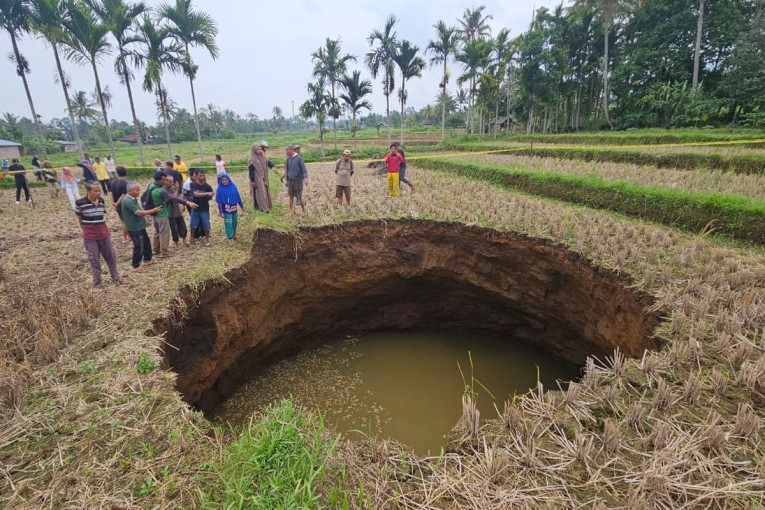
As West Sumatra has yet to recover from a series of hydrometeorological disasters, the province has once again been shaken by a geological hazard: a sinkhole (a dish-shaped ground collapse caused by the failure or erosion of underlying rock layers that support surface materials). The ground suddenly subsided on Friday (Jan. 4) in a rice field area of Jorong Tepi, Nagari Situjuah Batua, Lima Puluh Kota Regency, West Sumatra. The mysterious hole, which is more than 10 meters in diameter, is likely to expand and deepen further.
A lecturer at the Department of Geological Engineering, Faculty of Engineering, Universitas Gadjah Mada (FT UGM), Professor Wahyu Wilopo, explained that the phenomenon resulted from a combination of geological factors, including limestone dissolution, weathering-induced erosion, and high rainfall intensity.
He added that Cyclone Senyar, which occurred in late November 2025, triggered exceptionally heavy rainfall.
“As we know, parts of West Sumatra consist of several rock units, one of which is limestone, and the presence of Cyclone Senyar could trigger the formation of sinkholes. Total prevention is difficult, but mitigation can be carried out through geological monitoring, land-use control, and proper drainage systems,” he said on Wednesday (Jan. 7) at UGM.
Professor Wilopo noted that sinkholes do not occur in all types of soil but are more common in specific geological settings, such as karst areas (limestone), porous soils, or regions where human activities accelerate dissolution and erosion.
In karst areas, he explained, rainwater can dissolve rocks and create underground cavities.
In porous soils, Professor Wilopo continued, sinkholes may result from natural caves or mining activities.
He added that areas composed of weathered volcanic materials are prone to erosion and therefore vulnerable to subsidence.
“In some cases, this can also occur due to excessive groundwater extraction, which lowers the water table, enlarges cavities, and weakens soil structures, eventually leading to sinkholes,” he explained.
Beyond altering the topography of what was previously an agricultural area, the sinkhole may also damage the surrounding flora and fauna ecosystems.
According to him, the phenomenon could allow waste or hazardous materials to enter underground rivers and contaminate water. The formation of cavities also increases the risk of further ground collapse around the site.
Given that sinkholes can appear without warning, Professor Wilopo emphasized that they pose serious risks to human safety. In addition, infrastructure damage can disrupt daily activities and local economic cycles.
“This situation also creates anxiety and trauma among affected communities,” he said.
According to him, addressing sinkholes is not merely about filling the hole, but also about managing water, reinforcing soil structures, and involving communities in vigilance efforts.
After residents are evacuated, geological and geophysical surveys are conducted to determine the depth of the cavity using methods such as geoelectric surveys, seismic testing, and ground-penetrating radar (GPR).
Soil stabilization can be achieved by filling the cavity with solid materials or by grouting, which involves injecting liquid cement into underground voids. Other measures include improving drainage and water flow, as well as engineering reinforced foundation structures.
While this natural phenomenon is indeed difficult to prevent, Professor Wilopo stressed that its impacts can be minimized.
He pointed to early warning signs such as cracked or gradually subsiding ground surfaces, leaning or shifting buildings or trees, changes in water flow, and the appearance of small holes.
He urged communities in sinkhole-prone karst areas, along with all relevant stakeholders, to play an active role in addressing this issue.
“The government needs to conduct geological surveys and map areas vulnerable to sinkholes, while communities should actively report suspicious signs as mentioned earlier. Collective education is crucial so residents can understand the risks and mitigation measures,” he concluded.
Author: Hanifah
Editor: Gusti Grehenson
Post-editor: Rajendra Arya
Photograph: Kompas


 www.fox5atlanta.com/content/uploads/2026/01/932/524/detour-map.jpg?ve=1&tl=1" alt="" width="429" height="241"/>

You need to be a member of Earth Changes and the Pole Shift to add comments!
Join Earth Changes and the Pole Shift