Volcano watch
Volcanic activity at Mount Merapi, Java, Indonesia 5/5/26
ZetaTalk Explanation 1/31/2020: Volcano eruptions invariably mark the 7 of 10 Plate Movements, as they lie along plate borders or are centered in stretch zones. That so many extinct volcanoes are threatening to erupt and many of mankind’s most populous cities are suddenly faced with evacuation concerns is thus not unexpected. But over the centuries, mankind has not been concerned about prophecies about the End Times and allowed their cities to develop in harm’s way. Thus, we have Popocatepetl threatening 9 million people in Mexico City, Klyuchevskoy threatening 9 million in Tokyo, and Taal threatening Manila, the capitol of the Philippines.
That all these volcanoes are erupting at the same time is a sign that the 7 of 10 Plate Movements are in the end-stage of this phase – all moving and adjusting at once. The lifting Indio-Australian Plate is roiling the lava under its eastern edge, as the fires in Australia attest. This allows the Pacific to compress, with the Philippine Plate tilting and pushing under Taal. Central America is being crushed as the Caribbean Plate is forced westward by the S American Roll, as the Puerto Rican quake swarms attest. The tightening bow in the N American Continent is forcing the tip near Kamchatka into a crunch. All plates are in the dance, at present.
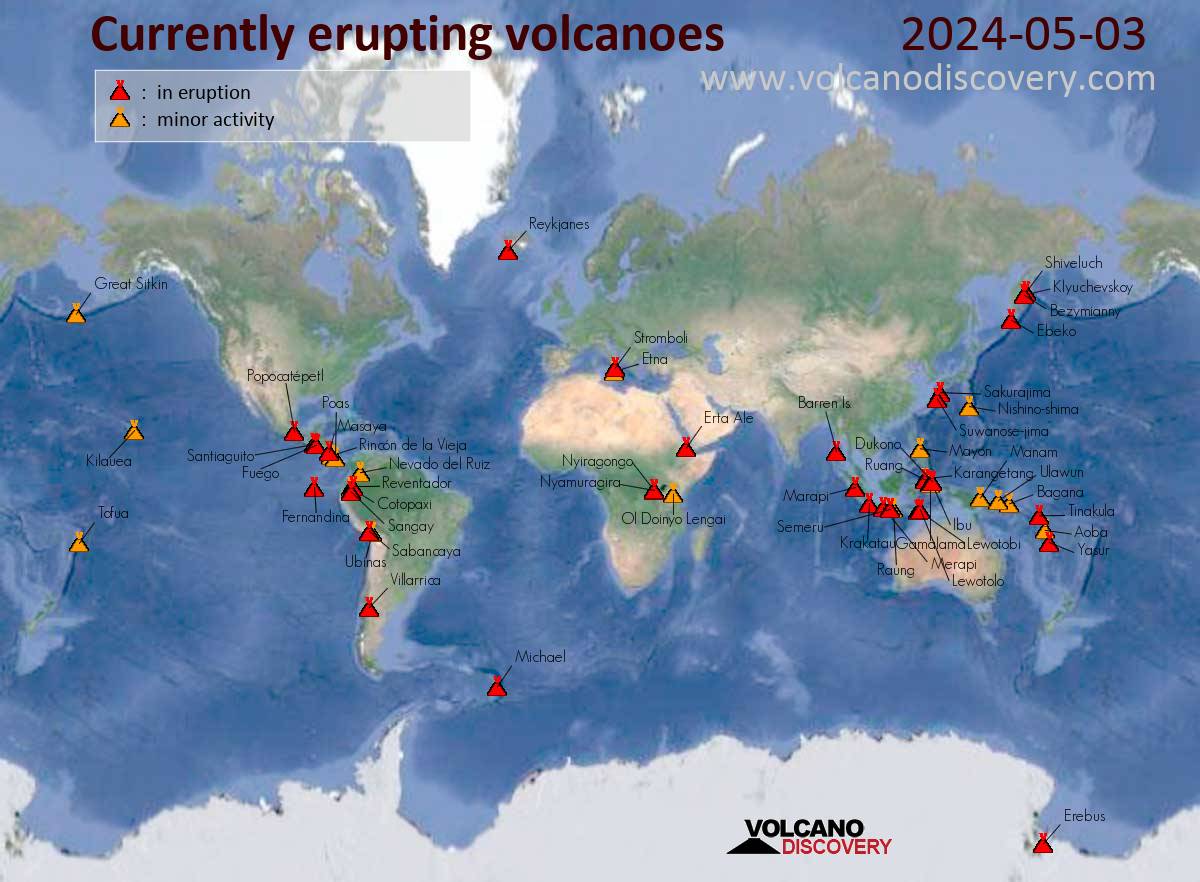
Benevolent extraterrestrials monitoring volcanoes to provide early warning to human partners.
Volcanic activity worldwide 18 October, 2025: Kilauea in Hawaii, Santiaguito volcano, Fuego, Semeru, Ibu, Dukono, Reventador, and soon "all volcanoes that have been active within the memory of man will begin spewing and burping and oozing, and many that were not expected to become active will reactive."
"Of course, all volcanoes will explode, as this is going to be a very severe pole shift. What about the months and years preceding the pole shift? It is no secret that Mammoth Lake and the caldera of Yellowstone are warming up, and the populace has been prepared for these occurrences by the movie Volcano where there, in the middle of LA, lava is bubbling up. In fact, there is a fault line running from the approximate San Diego/LA area, up into the Sierras, and this is liable to rupture rather violently during one of the quakes that precedes the pole shift by some months. Volcanic eruptions from that area in the Sierras can be expected. Will Mount St. Helen erupt? All volcanoes that have been active within the memory of man will begin spewing and burping and oozing, and many that were not expected to become active will reactive." ZetaTalk - Feb 15, 2000
Views: 232692
Comment
-
Comment by Juan F Martinez on October 12, 2026 at 12:17am
-
An underground fire in Kalimantan, Indonesian Borneo, was shared in a post published on October 11, 2026, at 3:35 AM, as shown on X.
Hot Earth With increasing Earth Wobble and Torque Effect, Indonesia plunging under the curve of Indo-Australian Plate is accelerating. As it tilts, magma fills in, underground methane and peat moss burning. With Nibiru creeping closer to the ecliptic, its N Pole pointing at Earth, comes more Skyfires that explode near the ground, the fires keep burning and spreading.
-
-
A mud volcano eruption was recorded on September 26, 2026, in Azerbaijan's Garadagh District, near Baku. According to reports citing the country's seismic monitoring authorities, the eruption occurred at 07:32 local time, lasted about 10 minutes, and was accompanied by a column of flame, which can occur when natural gases emitted by mud volcanoes ignite.
Azerbaijan is well known for its mud volcanoes. The country contains a large portion of the world's known mud volcanoes, especially around the Absheron Peninsula and the Caspian Sea region. These features typically expel mud, water, and gases rather than molten lava.
-
-
Activity at Mount Lewotolok, East Nusa Tenggara, Indonesia. September 9, 2026.
-
-
Activity at the Fuego volcano, Guatemala. August 20, 2026.
-
-
Lava flow on Mount Etna, Sicily, Italy. August 14, 2026.
-
-
The Oro‑Oro Kesongo mud volcano in Gabusan Village, Jati District, Blora Regency, Central Java experienced a multi‑burst mud eruption on August 7, 2026, with 5–6 discrete explosions recorded between 06:30 and 11:24 WIB. The bursts reached 10–15 meters in height and lasted about five minutes each, according to multiple Indonesian news outlets.
-
-
Activity at the Telica volcano, Nicaragua. July 26, 2026.
-
-
Now fire 🔥 is coming out from under the ground in areas where the ground opened in Venezuela
They comment that a smell of burned coal is being felt.
For now, the cause is not known
If it has to do with oil
Or is it some volcano that is in that area?
-
-
Activity at Klyuchevskaya Sopka volcano, Kamchatka. 7.06.2026.
Klyuchevskaya Sopka is currently in an elevated eruptive phase, with clear signs of intensified summit activity reported in early June 2026. The most recent confirmed update (June 5, 2026) indicates increasing explosive behavior and rising ash‑plume heights, prompting official safety warnings for Kamchatka residents and tourists.
What is happening at Klyuchevskaya Sopka (as of 7 June 2026)
Based on the latest available reporting close to your date:
Summit activity is increasing, with scientists observing a growing eruption at the crater.
Ash plumes may reach up to ~8 km altitude, posing aviation hazards.
Emergency services have issued warnings advising people to avoid the volcano due to unpredictable explosive behavior.
This escalation follows a long period of intermittent activity typical of Klyuchevskaya, but the current phase is strong enough to trigger public advisories.
"All volcanoes that have been active within the memory of man will begin spewing and burping and oozing, and many that were not expected to become active will reactive." ZetaTalk - Feb 15, 2000
-
-
At least three people have been confirmed dead and ten others are missing after the eruption of Mount Dukono in eastern Indonesia.
🌋 What happened
Multiple credible reports confirm that Mount Dukono, located on Halmahera Island in eastern Indonesia, erupted on May 8, 2026, sending a massive ash plume up to 10 km into the sky. The eruption struck while hikers were on the mountain, despite the area having been declared off‑limits due to elevated volcanic activity.🚨 Casualties and Missing Persons
Across all reports, the numbers are consistent:3 hikers killed
2 foreign nationals (reported as Singaporean in several sources)
1 Indonesian resident from Ternate
10 hikers missing
The missing individuals were part of a group that entered a restricted zone.
Search efforts are ongoing but dangerous due to continued eruptions.
Several injured
At least five climbers were reported injured in one account.
© 2026 Created by Juan F Martinez.
Powered by


You need to be a member of Earth Changes and the Pole Shift to add comments!
Join Earth Changes and the Pole Shift