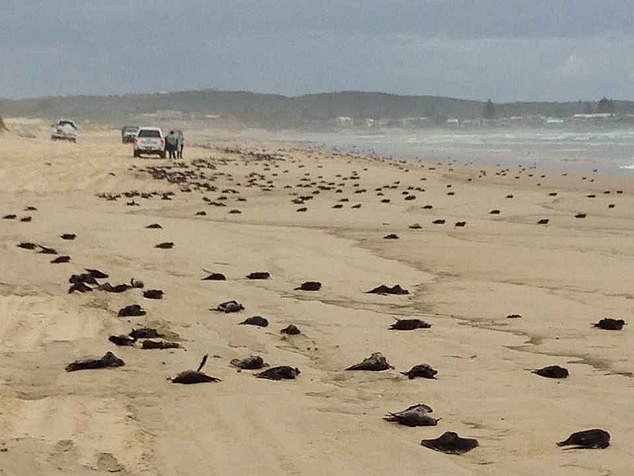
Animal Behavior, Methane Poisoning, Dead or Alive and on the move (+ interactive map)

----------------------------------------------------------------------------------------------

When Planet X entered the inner Solar System in late 2002 - early 2003, it was not just the Earth that reacted, as it did with an increase in earthquakes, volcanism and extreme weather, the animal life on Earth also started showing signs of the approaching monster.

The most noticeable symptoms were:

  • Crazy Animal Behaviour:  Reports of bizarre behaviour including animal attacks from normally passive creatures and spiders spinning webs over whole fields.
  • Confused Animals:  Whales and dolphins stranding themselves on beaches in droves or getting lost upstream in coastal rivers.
  • Large fish and bird kills:  Flocks of birds falling dead from the sky and shoals of fish dying and floating to the surface of lakes, rivers and washing up along coastlines.

----------------------------------------------------------------------------------------------

Crazy Animal Behaviour

Reports of crazy animal behaviour have included sheep that charged a farmer’s wife off a cliff, deer attacking a car and rabbits biting pedestrians.  Spiders have spun webs over whole fields and caterpillar larvae have covered whole trees in silk.

As usual, the Zetas explain the true causes:

http://www.zetatalk.com/transfor/t154.htm (Jan 11th 2003)

Animal behavior also has been noted as almost crazed, where animals normally passive and seeking to avoid confrontation will attack with provocation, or fly in the wrong direction during migration. This is due to signals the animals or insects get from the core of the Earth, signals not known to man, but nonetheless there.  [……]  Spiders weaving webs to an extreme so that acres are covered under webs, get noted, but the base behavior is normal for a spider.  EOZT

----------------------------------------------------------------------------------------------

Confused Animals

Other erratic behaviour among animals included a seeming loss of direction with whales and dolphins swimming inland and stranding themselves on beaches.

Unreliable Compasses  (March 28th, 2009)

The compass is unreliable for the past few years, and lately has gotten very extreme in its variance. Many animals and insects have a biological compass, recording during migrations where that compass laid, and when taking a return trip relying on the recording to guide them back. If the Earth's N Pole swings away from the press of Planet X, which is increasingly pointing its N Pole at the Earth, then these animals are not given correct clues and aim for land or up a river. Sad to say, this will only get worse as the last weeks and the pole shift loom on the horizon.   EOZT

Are due to the Magnetic Clash   (July 1st, 2006)

The compass anomaly, swinging to the East, is indicative of the Earth adjusting to the approach of Planet X and the clash of their magnetic fields. The change is indicative of a clash in magnetic fields as Planet X comes ever closer to the Earth, their fields touching. It is the combined field that Earth must adjust to, and continue to adjust to, not the exact position of the N Pole of Planet X within these fields, and the Sun's magnetic field enters into the equation too. This dramatic change, noted by a conscientious tracker, checking dual compasses daily for years, indicates that the Earth is trying to align side-by-side with Planet X, bringing its magnetic N Pole to point toward the Sun, as Planet X is currently doing in the main. These adjustments are temporary, and change about, as magnets can make dramatic and swift changes in their alignment with each other. Put a number of small magnets on a glass, with iron ore dust, and move a large magnet about under them, and watch the jerking about they do. Are we saying the Earth's magnetic field is going to get more erratic in the future, dramatically so? There is no question that this will be one of the signs that will come, yet another not covered by the Global Warming excuse.   EOZT

----------------------------------------------------------------------------------------------

Large fish and bird kills

Hundreds, if not thousands, of these events have taken place with the frequency increasing year on year.  Poignant examples include the 20 tonnes of dead herring which washed ashore in Norway and 1200 pelicans found on a beach in Peru.

Earth Farts  (January 9th, 2007)

We have explained, in great detail, that the stretch zone does not register great quakes when rock layers pull apart and sink, as this is a silent Earth change. Nancy has carefully documented breaking water and gas mains, derailing trains, dislocating bridge abutments, mining accidents, and outbreaks of factory explosions, showing that these have occurred in rashes on occasion, when the rock layers pulled apart. [……]  In September-October of 2005, a smell of rotten eggs was sensed from LA to Thunder Bay on Lake Superior to the New England states and throughout the South-Eastern US. We explained at that time that this was due to rock layers being pulled apart, releasing gas from moldering vegetation trapped during prior pole shifts, when rock layers were jerked about, trapping vegetation. We explained in March of 2002 that black water off the coast of Florida was caused by this phenomena. Do these fumes cause people to sicken, and birds to die? Mining operations of old had what they called the canary in a birdcage, to warn the miners of methane gas leaks. Birds are very sensitive to these fumes, and die, and this is indeed what happened in Austin, TX. Were it not for the explosions associated with gas leaks, it would be common knowledge that gas leaks sicken, as the body was not structured to breathe such air for long.   EOZT


Zetatalk Explanation  (January 8th, 2011)

Dead fish and birds falling from the sky are being reported worldwide, suddenly. This is not a local affair, obviously. Dead birds have been reported in Sweden and N America, and dead fish in N America, Brazil, and New Zealand. Methane is known to cause bird dead, and as methane rises when released during Earth shifting, will float upward through the flocks of birds above. But can this be the cause of dead fish? If birds are more sensitive than humans to methane release, fish are likewise sensitive to changes in the water, as anyone with an aquarium will attest. Those schools of fish caught in rising methane bubbles during sifting of rock layers beneath them will inevitably be affected. Fish cannot, for instance, hold their breath until the emergency passes! Nor do birds have such a mechanism.   EOZT

----------------------------------------------------------------------------------------------

----------------------------------------------------------------------------------------------

Views: 179913

Comment

You need to be a member of Earth Changes and the Pole Shift to add comments!

Join Earth Changes and the Pole Shift

Comment by KM on December 8, 2019 at 11:43am

Source

Fish all gone! Gulf of Alaska fishery to close for the first time ever: No more cod: Salmon all but gone: Millions of small sea birds died since 2015

November 2019, thousands of short-tailed shearwaters birds migrating from Alaska were washing up dead on Sydney's iconic beaches

Extremely low cod numbers have lead feds to close the Gulf of Alaska fishery for the first time ever. In an unprecedented response to historically low numbers of Pacific cod, the federal cod fishery in the Gulf of Alaska is closing for the 2020 season. It’s a decision that came as little surprise, but it’s the first time the fishery was closed due to concerns of low stock. “We’re on the knife’s edge of this over-fished status,” North Pacific Fisheries Management Council member Nicole Kimball said during talks in Anchorage Friday afternoon. It’s not over-fishing to blame for the die-off, but rather, climate change. Warming ocean temperatures linked to climate change are wreaking havoc on a number of Alaska’s fisheries, worrying biologists, locals and fishermen with low returns that jeopardize fishing livelihoods. A stock assessment this fall put Gulf cod populations at a historic low, with “next to no” new eggs, according to NOAA research biologist Steve Barbeaux, who authored the report.

Up until the emergence of a marine heatwave known as “the blob” in 2014, Gulf cod was doing well. But the heatwave caused ocean temperatures to rise 4-5 degrees. Young cod started dying off, scientists said. “A lot of the impact on the population was due to that first heatwave that we haven’t recovered from,” Barbeaux said during an interview last month. Following the first heatwave, cod numbers crashed by more than half, from 113,830 metric tons in 2014 to 46,080 (a loss of almost 68,000) metric tons in 2017. The decline was steady from there. AK

Last month The Big Wobble reported more misery for Alaskan pink salmon fisheries. Prince William Sound Science Center field season was marked by a low flow and high pre-spawn mortality. This year, virtually no rain led to extremely low flows and field crews observed unprecedented pre-spawning die-offs and unusually late migration into the streams. According to the Prince William Sound Science Center, the fish finally started, what was for many, an ill-fated journey into the streams after some rain in early September. The rain stopped and the rivers dried up again. Soon thousands of fish were restricted to tide pools without enough water to return to the bays. They all suffocated. “During the first 10 days of September, our dead fish count in one of our streams rose from virtually none to nearly 30,000 dead pink salmon, all dying prior to spawning”. “Our field crews estimated 10,000 died over a single night. We have never documented anything like that in the past.”

In November 2019, thousands of short-tailed shearwaters birds migrating from Alaska were washing up dead on Sydney's iconic beaches and the bird deaths had nothing to do with the massive wildfires in the area, thousands more, short-tailed shearwaters were dying out at sea, in what was confirmation of the incredible fish shortages in the Pacific Ocean. The corpses had been spotted at several shorelines including Bondi, Manly and Cronulla. The birds were migrating back to southern Australia to breed after spending the summer in Alaska. But, according to experts, a higher number than usual are dying on the way due to a lack of food. The birds need to be at full strength to make the 14,000km trip over the Pacific but the krill and other fish they feed on have apparently dwindled due to sea temperatures rising.

BirdLife Australia has rendered the problem a 'crisis'. In a statement on its website, the group says: 'For the fifth consecutive year, the sea surface temperatures off Alaska have been unusually warm, which has led to a dire shortage of the shearwaters' marine prey, resulting in thousands of dead shearwaters being washed ashore along Alaska's beaches. 'According to the U.S. Fish and Wildlife Service, they died of starvation. 'It wasn't a single event, though; instead, it was a series of catastrophic die-offs. 'Starting in late June, these die-offs continued along different sections of the Alaskan coast, occurring progressively further south, through into August. 'Numerous shearwaters also washed up on Russia's Chukotka Peninsula as well. 'Although many thousands of birds were found dead and dying on the beach, this is likely the tip of the iceberg.'
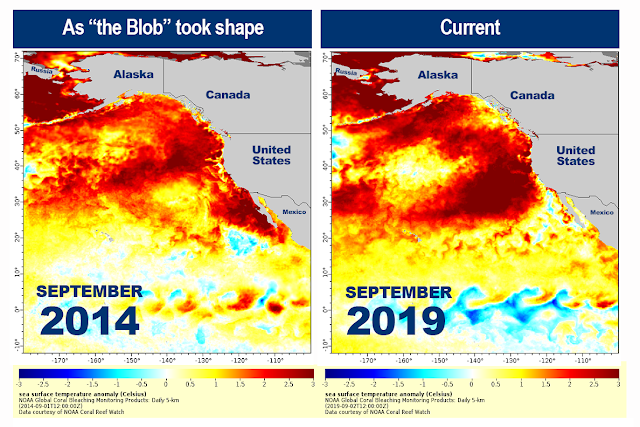
Credit NOAA. The Pacific Blob has returned and is causing havoc for marine life. Click on image to enlarge.

 
It is the tip of the iceberg!

2019 Alaska Seabird Die-off

In May 2019, the U.S. Fish and Wildlife Service (USFWS) and the National Park Service (NPS) began receiving reports of dead and dying seabirds from the northern Bering and Chukchi seas, including near Bering Land Bridge National Preserve.
From late June to early August, thousands of Short-tailed Shearwaters were reported dead and washing up on beaches in the Bristol Bay region, or observed weak and attempting to feed on salmon gillnets in inland waters (TBW Quote: most of the salmon had died prior to spawning). By mid-August, the shearwater die-off had extended north, in smaller numbers but widespread locations, into the northern Bering and Chukchi seas along the coasts of Alaska and the Chukotka Peninsula of Russia. Puffins, murres, and auklets were also being reported, but at much lower numbers than shearwaters. Additionally, live Short-tailed Shearwaters have been observed in large numbers this August in the Gulf of Alaska, along the coasts of Glacier Bay and Kenai Fjords national parks, and bays of Kodiak Island. It is unusual to see this species in high abundance in these areas, as it is typically offshore and comes from the southern hemisphere to forage in the Bering and Chukchi seas during the summer and fall.
Historically, seabird die-offs have occurred occasionally in Alaska; however, large die-off events are now occurring each year since 2015. (TBW Quote: millions of small sea birds have been reported dead since 2015, this year it's Short-tailed Shearwaters but recent years have seen puffins, murres, and auklets dying thought to be due to starvation).  
 
Consistently, dead birds examined from the Bering and Chukchi seas during these recent die-offs were determined to have died due to starvation. Seabird carcasses from the 2019 die-off events were collected from multiple locations and sent to the U.S. Geological Survey (USGS) National Wildlife Health Center for examination and testing. Initial results indicate starvation as the cause of death for most locations. However, in southeast Alaska, exposure to saxitoxin (a biotoxin associated with paralytic shellfish poisoning) was linked in June to a localized die-off of breeding Arctic Terns.

The Big Wobble has been reporting an unprecedented seabird die-off in Alaska and Canada since 2015. Climate change is considered by scientists as a significant contributor to seabird declines with reports of British species such as terns and kittiwakes facing an uncertain future as sea temperatures rise. Puffins, in particular, have suffered enormous losses in recent years and a report from the International Union for Conservation of Nature in April warned the iconic species was at risk of extinction. Thousands of dead seabirds have been found washed ashore on sites from islands in the Bering Sea to villages north of the Bering Strait, signs of another large die-off in the warmed-up waters of the North Pacific Ocean. (The actual numbers will be in the millions as most will die at sea.) The dead birds are mostly northern fulmars and short-tailed shearwaters, species that migrate long distances to spend summers in waters off Alaska and other northern regions, the U.S. Fish and Wildlife Service reported. Also in the mix are some kittiwakes, murres and auklets, the federal agency said.

The cause is being investigated. Necropsies so far show that the birds are emaciated - with no food in their stomachs or intestines and little or no fat on their bodies. "Right now, we know that they are starving to death and can't hold their heads above water, and they're drowning," said Ken Stenek, a teacher in Shishmaref and volunteer in a program that monitors seabirds.

The precise toll is unclear. The new die-off follows a massive loss of common murres in 2015 and 2016, 2017 and 2018, the biggest murre die-off on record in Alaska, and a precursor to near-total reproductive failures for murres in the Gulf of Alaska and Bering. It also follows the deaths of thousands of puffins found last fall on St. Paul Island in the Pribilofs and, prior to that, mass deaths of murres and auklets along the U.S. West Coast. In each death wave, starving birds have left emaciated carcasses, and each wave has been associated with unusually warm marine waters. 
Comment by Starr DiGiacomo on November 12, 2019 at 10:52pm

https://www.bbc.com/news/world-asia-india-50387924

Rajasthan: 'Thousands' of birds found dead in India's Sambhar lake

  • 12 November 2019

More than 1,000 birds have been found dead along the shore of India's biggest inland saltwater lake, a senior forest official has told the BBC.

The birds were discovered around Sambhar Lake, 80km (49 miles) south-west of the city of Jaipur, in the northern state of Rajasthan.

The dead include a number of different species, including migratory birds who flock to the lake every year.

The deaths are being investigated by government agencies.

"We are still counting the dead birds," senior forest official Sanjay Kaushik said. "They are strewn over the entire area around the lake. Some 20 to 25 birds who were still alive are being treated."

The first reports of the birds emerged on Sunday, when they were spotted by tourists visiting the lake.

"We have never seen anything like this," Abhinav Vaishnav, a local bird-watcher, told the Press Trust of India news agency.

Vikas Choudhary, a photographer with the Down To Earth magazine who is in the area, said the dead birds were strewn all over an area stretching from 12 to 15km around the lake.

"I am sure the numbers will rise further, and may even touch 5,000 birds. There are just so many dead birds lying all over the place," Mr Choudhary told the BBC.

The birds, which include ruddy shelduck, ruddy turnstone, northern shoveler, blackwinged stilt and common coot, are being buried in deep pits dug near the water.

Forest official Rajendra Jakhar told Press Trust of India that a hailstorm which hit the area a few days ago may have caused the deaths.

"We are also looking at other possibilities, like toxicity of the water and bacterial or viral infection," he said. A local veterinarian has ruled out bird flu as a reason.

Some of the dead birds have been sent to a laboratory in Bhopal for further examination.

Comment by Starr DiGiacomo on November 10, 2019 at 8:07pm

https://www.stuff.co.nz/the-press/news/117309159/westport-beach-cle...

Westport beach cleaned after dead rats wash up

The carcasses of hundreds of dead rats that mysteriously washed up on a West Coast beach on Saturday, have been cleaned up.

A spokesperson for the Department of Conservation (DoC) said on Sunday afternoon about 600 rat carcasses had been removed from Westport's North Beach and a follow-up inspection did not find any more carcasses above the high tide lines. Dead fish and birds in the area have also been removed.

The cause of the animals' death still remains unknown. Samples from the rats were being urgently tested, but according to the spokesperson, the results will only be available Monday late afternoon at the earliest.

It is thought that the rats washed up on the beach sometime over Friday and Saturday. DoC Western South Island operations director Mark Davies earlier said one possibility being considered is that the rats were killed by a recent aerial 1080 poison drop at Te Maruia in the Lewis Pass National Reserve, and washed out of the hills by the heavy rain. Te Maruia and Inangahua river catchment feeds into the Buller River and had a plague of rats treated with toxin a week ago.

However, the dead fish and birds that were found along with the rats, puts a question mark over the possible link to the 1080 drop, as that is not consistent with the way 1080 is understood to work.

The poison operation was also more than 140km away from North Beach.

According to the DoC dog owners' are urged to be cautious when taking their dogs to the beach as more rats could wash up over the next few days, but the beach has not been officially closed.

DoC staff will continue to check the beach after high tides over the next couple of days.

and another:

https://stockdailydish.com/volunteers-chronicle-dead-seabirds-on-wa...

Volunteers chronicle dead seabirds on Washington coast

Bob Witt picks up the remains of a Brandt's cormorant as part of a citizen patrol surveying dead birds that wash ashore on beaches along the U.S. West Coast, in Ocean Shores, Wash., in September. (AP Photo/Elaine Thompson)Barbara Patton walks toward a dead bird she is about to examine as part of a citizen patrol surveying dead birds that wash ashore on beaches along the U.S. West Coast, in Ocean Shores, Wash., in September. (AP Photo/Elaine Thompson)Jeanne Finke, left, Susan Kloeppel and Bob Witt begin to identify the remains of birds they collected as part of a citizen patrol surveying dead birds that wash ashore on beaches along the U.S. West Coast, in Ocean Shores, Wash., in September. (AP Photo/Elaine Thompson)

OCEAN SHORES, Wash. — Barbara Patton scans the expansive beach on Washington’s outer coast looking for telltale signs of dead seabirds: a feather sticking straight up, dark colors in the sand, unusual seaweed clumps that could mask a carcass.

Minutes into the nearly mile-long walk near her Ocean Shores home, she and her husband, Mike, encounter the first of three birds they’ll find that morning.

Experience tells them it’s a common murre. But the retired volunteers work through a protocol to identify the species: Eyes gone. Breast eaten. Feet pliable. They measure the wing, bill and other body parts, and photograph the bird, front and back.

All of that information is entered into a massive database kept by the Coastal Observation and Seabird Survey Team, or COASST. The long-running citizen monitoring program at the University of Washington tracks dead seabirds as an indicator of the coastal environment’s health.

“The data that the participants collect is invaluable,” said Julia Parrish, associate dean of the university’s college of environment and head of the program. “We can’t get it remotely, with satellites, with drones.”

Lately, the data has pointed to bigger and more frequent seabird die-offs.

“It’s causing us to step back and say, ‘Whoa, what’s going on here?’” Parrish said. “For four years running, we’ve had unusual mortality events of marine birds from California to the Arctic Circle.”

Seabirds spend most of their time feeding and living out at sea, coming to land to breed or nest. But more birds are dying and dying close to shore, Parrish said.

Climage change may play role

Researchers think warmer-than-usual ocean temperatures shook up the ecosystem, favoring warmer species and redistributing the seabirds’ food.

COASST volunteers are helping search for clues and identify die-offs faster.

In 2014, when Cassin’s auklets, a small diving seabird with blue feet, began washing ashore by the thousands along the U.S West Coast, citizen scientists patrolling their stretch of beaches were among the first to notice it. Patton recalls counting a few dozen dead birds in one walk.

Under the program, hundreds of volunteers comb stretches of beach from Mendocino, California, to Kotzebue, Alaska, each month looking for carcasses that have washed ashore. Since 1998, they’ve recorded nearly 76,000 dead birds.

Combined with other large-scale data from satellites and other surveys, Parrish said, it can provide high-quality data over a geographic scale not attainable any other way.

The data is used to track seasonal, short-term and long-term changes in seabirds, revealing patterns about where and when certain species die. There are seasonal peaks, after breeding seasons when exhausted parents and chicks wash ashore or when seasonal migratory birds get stranded.

The data amassed has also been used by other scientists and resource managers to monitor bird health and other research.

Kristine Bovy, associate anthropology professor at the University of Rhode Island, used the modern bird data to help evaluate how indigenous people in the Pacific Northwest may have scavenged to find bones and other natural resources on the coast hundreds of years ago.

“It helped us to be able to test our ideas in the past about whether people may be scavenging bird carcasses from the beach,” she said.

Parrish said there can be skepticism about citizen science. She designed the bird surveying program years ago so information collected could be independently verified – by photographs, measurements and other paper records.

Hunting for carcasses

On a recent clear day not far from where the Pattons collected their carcasses, Jeanne Finke, Susan Kloeppel and Bob Witt fan out across the beach.

Brown pelicans and seagulls soar above crashing waves. Little sandpipers scurry and peck in the wet sand. But Finke and her team are more interested in the birds that are dead than alive.

“It’s an early warning system for the ocean,” said Finke, a retired Boeing worker. “I think some people think we’re odd for doing it,” she added, but she likes learning about her environment and isn’t afraid to put on gloves and rummage for dead birds.

Before long, she and the others line up five carcasses on a massive log and get to work. They record where on the beach the birds were found, whether the wings or chest are intact, what kind of bill and foot the bird has.

The records and photos they take are sent to COASST’s scientific expert to be verified. Most of the time, the citizen scientists nail the ID.

“It doesn’t bother us to handle these dead birds,” said Kloeppel, a retired middle school teacher. “We’re just monitoring the cycle of life.”

Comment by Starr DiGiacomo on November 8, 2019 at 6:01pm

https://in.news.yahoo.com/37-migratory-birds-found-dead-155746608.html

37 migratory birds found dead in Rajasthan's Khinchan

7 November 2019

Jodhpur, Nov 7 (PTI) Thirty-seven demoiselle cranes were found dead at Khichan in Phalodi subdivision of Jodhpur on Thursday morning.

Three of the carcasses were sent to a vet dispensary at Machia Biological Park for a medical examination to ascertain the cause of their death.

According to Sevaram Mali, a bird lover, the migratory birds were found dead at different places.

'We received information in the morning that some birds have been spotted dead near Vijay Sagar. When we reached there, we found 15 carcasses,' said Mali.

Later, they received information about the death of more birds near Ratari Nadi.

On reaching their, they found 16 carcasses.

Six birds were found dead at other locations.

A medical board examined the dead birds but failed to reach a conclusion about their death.

'It may be both due to poisoning or disease. For further examination, we have sent the viscera of the birds to the FSL and Disease Diagnostic Centre in Ludhiana,' said a board member and pathologist, Vipin Gupta

Comment by Juan F Martinez on October 21, 2019 at 11:03pm

Surface Methane 10 21 2019
Over 1250 ppb is unlivable. Methane was about 750 ppb for hundreds of thousands of years before 1800.   There are methane numbers here over 2180 ppb.   The North America and New Madrid is definitely part of the problem.   All those disoriented birds dropping from the sky?  Hmm.

https://atmosphere.copernicus.eu/charts/cams/methane-forecasts

Comment by Starr DiGiacomo on October 19, 2019 at 6:51pm

https://www.freep.com/story/news/local/michigan/2019/10/18/dead-loo...


More than 2 dozen dead loons wash up at beach near Sleeping Bear Dunes


Detroit Free Press Published 1:32 p.m. ET Oct. 18, 2019

EMPIRE, Mich. – More than two dozen common loons have been found dead at a beach in northern Michigan.

Good Harbor Bay beach is at Sleeping Bear Dunes National Lakeshore in Leelanau County.

Officials believe the birds were likely killed by Type E botulism and washed ashore this week.

Botulism has been linked to more than 80,000 bird deaths around the Great Lakes since 1999.

Experts at the Michigan Sea Grant believe the birds could have eaten fish that were carrying the toxin.

People are urged to avoid touching a dead bird on a Great Lakes beach. Keep pets away, too

Comment by Starr DiGiacomo on October 18, 2019 at 5:33am

Birds are dying in Sarasota area, experts struggle to find out why

https://www.orlandosentinel.com/news/environment/os-ne-birds-dying-...

Oct 17, 2019

Laughing gulls are dying of a mysterious disease on the beaches of Siesta Key and Anna Maria Island, according to a report by WFLA, a NBC affiliated news station serving the Tampa area.

Two dozen laughing gulls were found dead last week on the west coast beaches, WFLA reported. The sightings of dead or sick birds began on Oct. 2 at Siesta Key and have soared since, the report showed.

Experts and organizations such as Save Our Seabirds in Sarasota, are taking in sick birds in an effort to avoid a lethal outcome.

Birds with the unknown disease would exhibit symptoms resembling a behavior similar to drunkenness, WFLA reported.

The Florida Fish and Wildlife Conservation Commission is investigating the matter, WFLA reported

another link:

https://www.wfla.com/news/sarasota-county/why-are-birds-suddenly-dy...

Why are birds suddenly dying on Sarasota area beaches?


ANNA MARIA ISLAND, Fla. (WFLA) – A mysterious illness is killing seagulls throughout Siesta Key and Anna Maria Island. No one seems to know why.

Experts are searching for answers to make sure the trend does not continue northward.

Ed Straight from Wildlife, Inc. is hoping four laughing gulls will make it. When they came in, they struggled to stand or flap their wings.

But they’re the lucky ones.

Just last week, two dozen laughing gulls were found dead nearby.

“We’ve never really seen this many dead laughing gulls in these areas like this before,” said Straight.

It’s a trend that seemingly came out of nowhere.

Dead laughing gulls were spotted on Siesta Key on Oct. 2. Since then, the number has skyrocketed. Just about on a daily basis, sick or dead birds have been reported throughout Siesta Key.

Then, over the past few days, the trend appeared on Anna Maria Island. It’s always the same species – juvenile laughing gulls.

“It’s concerning because mainly right now we don’t know what it is,” said Straight.

Save Our Seabirds in Sarasota just took in two birds on Wednesday.

“They were all very down, very weak, almost drunken looking,” said Save Our Seabirds Senior Hospital Technician Jonathan Hande.

Officials do not believe it’s red tide. Instead, the experts believe it’s a type of bacterial illness, like botulism.

The FWC is investigating as well and time is of the essence. Officials want to quickly get to the bottom of this and prevent it from occurring again.

“Is it trash on the beach? Did something wash up that needs to be removed?” said Hande.

If you spot sick or dead wildlife, contact FWC or your nearest wildlife agency.

Comment by jorge namour on October 5, 2019 at 11:05pm

EGYPT OCTOBER 5 2019

https://www.facebook.com/1845165892429941/photos/a.1845325855747278...

TRADUCED

Serious topic (Port Said crocodile) EGYPT

Although people take it laughing , but it is very dangerous, where some people hunted Port Said crocodile One meter length and active and healthy and well and others say and swear to God that they saw another crocodile below the stones waves barriers

Surprisingly, they said that the crocodile was dropped from his ship, but any freshwater creature if it descended salt water dies after a short time or at least will collapse physically, but this crocodile was resisting and his mouth was tied so as not to hit anyone and denied the existence of crocodiles salt sea

But on the Internet, we found that the most dangerous species of crocodiles are the crocodiles of the seas and oceans. THEY prey on
Sharks and their mainland on northern Australia

We ask the Ministry of Environment to pay attention to the matter to educate people and I find it difficult to control or expel the crocodiles of salt water from its home, especially if the East branch of the branch in Port Said
And the breadth of its course, a place where they found the crocodile

Comment by Starr DiGiacomo on October 1, 2019 at 8:59pm

https://www.washingtonpost.com/world/the_americas/cuba-battles-plag...

Cuba battles plague of giant snails

September 30 at 12:20 PM
In this Aug. 28, 2019 photo, a giant African snail makes its away along a tube inside a building in Havana, Cuba. With their shiny, brilliantly striped shells and bodies up to 8 inches (20 centimeters) long, the snails have become public enemy No. 1 for epidemiologists on the island as many frightened citizens grow to fear their ability to transmit diseases and harm crops.

HAVANA — Silently and without pause, the giant African snail has been invading Cuba.

With their shiny, brilliantly striped shells and bodies up to 8 inches (20 centimeters) long, the snails have become public enemy No. 1 for epidemiologists and citizens have grown to fear their ability to transmit diseases and harm crops.

“I never heard of them before, but now they’re everywhere,” said Yusmila Marín, a 29-year-old nurse who lives in a neighborhood rife with the mollusks, whose scientific name is Achatina fulica.

In recent months, Cuban authorities have activated the nationwide civil defense system to battle the snails. But some say the state’s response is inadequate.

Marín and families in the Villa Panamericana neighborhood are keeping children indoors to play due to the danger of infection from the snails, which can transmit a potentially severe brain infection called meningoencephalitis and an abdominal disease known as angiostrongiliasis.

First detected in Cuba in 2014, the snail can now be found throughout Havana and in almost every one of the island’s provinces. It’s not known how the snail arrived in the nation.

It is also found in countries around the world, where it has had similar destructive effects.

Health authorities have asked people to collect snails without touching them with their bare hands and then destroy them in sealed containers. But they still say it will take some time to get the infestation under control.

The snail has no natural predators in Cuba and eats fruits, vegetables and even garbage, allowing it to rapidly proliferate.

“It’s a health problem, an economic problem and an ecological problem, said Isbel Díaz, a biologist who runs a non-governmental environmental group in Havana.

Díaz said many people were doing their best to help, but without proper training or equipment were not collecting or destroying the snails safely.

“It’s a real challenge,” he said. “No country has been able to control this plague and Cuba won’t be able to in the short or mid-term.

Comment by Starr DiGiacomo on September 27, 2019 at 6:54pm

https://www.wsbtv.com/news/trending-now/15-pilot-whales-dead-in-2nd...


5 pilot whales dead in 2nd mass stranding on Georgia coast in two months

Cox Media Group National Content Desk

Updated: Sep 27, 2019 - 12:25 PM

SEARCH PS Ning or Zetatalk

 
Search:

Crop Circle Confirms ZetaTalk Prediction: Last Weeks begin in November 2026, and Pole Shift February 2027  

https://poleshift.ning.com/forum/topics/last-trimester-event-timeline

NEW POLE SHIFT UPDATE!

Nancy Lieder November 11, 2025 ZetaTalk Chat for November 30, 2025 - Earth Changes and the Pole Shift

Nancy Lieder, Emissary of the Zetas.

https://poleshift.ning.com/xn/detail/3863141:Comment:1168188

Awakening to the Alien Presence ZetaTalk

The truth will likely never to be known to the public but be washed away in the Nibiru panic soon to engulf the world.

The Worst of the Cover-Up
https://poleshift.ning.com/profiles/blogs/the-worst-of-the-cover-up

Main Establishment Lies

https://poleshift.ning.com/profiles/blogs/main-establishment-lies

Donate

Donate to support Pole Shift ning costs. Thank you!

© 2025   Created by 0nin2migqvl32.   Powered by

Badges  |  Report an Issue  |  Terms of Service
