AfterTime Power, Super Intelligence and AI Data Centers
17-gigawatt Texas power project passes key hurdle for world’s largest private grid
US data centers are facing an unprecedented 64-month wait to connect to the grid, prompting developers to shift toward building their own power solutions.
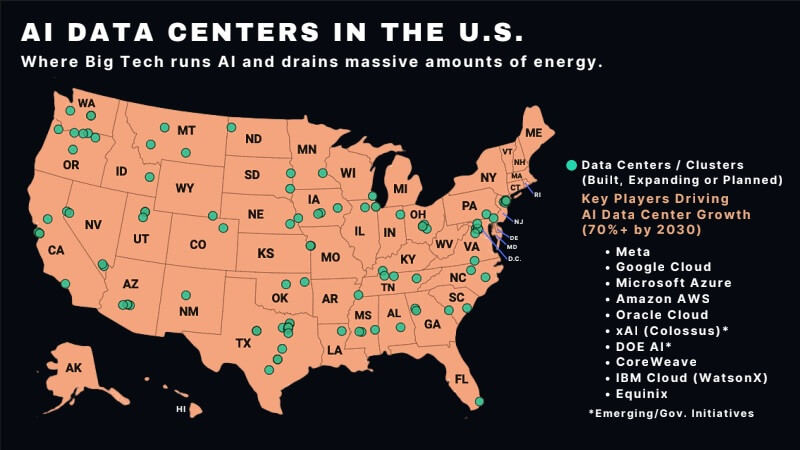
How many U.S. data centers are there?
There isn't a definitive government count. One reason is that there is no central regulatory requirement to register every data center. Data Center Map explicitly warns that databases therefore cannot be 100% complete. [datacentermap.com]
One current industry directory lists 4,767 U.S. data centers across all 50 states, operated by about 1,900 operators. These are not all AI centers. They include cloud, colocation, hyperscale and other facilities.
Thousands of data centers already operate in the United States, while a major new generation of very large, AI-oriented facilities is being built or proposed.
The scale is easier to establish through energy demand than building counts. The U.S. Department of Energy reported that data centers consumed about 4.4% of total U.S. electricity in 2023 and projected approximately 6.7% to 12% by 2028. [energy.gov]
Short takeaway: From a ZetaTalk perspective, distributing data centers across many locations can be interpreted as a quiet form of resilience-building — something that could align with preparations for grid fragility, infrastructure decentralization, and post‑Shift survivability. This does not mean mainstream planners are consciously preparing for a Pole Shift, but the pattern matches ZetaTalk’s long‑standing warnings about centralized systems failing.
🧭 ZetaTalk Interpretation: Why Many Data Centers?
ZetaTalk consistently emphasizes decentralization, local autonomy, and distributed infrastructure as critical for surviving both the Last Weeks and the Aftertime. When you apply that worldview to modern AI and cloud infrastructure, several parallels emerge.
🌐 1. Decentralization = Survival During Grid Down
ZetaTalk says the Pole Shift will:
fracture the grid
destroy long-distance transmission lines
isolate regions
break centralized control systems
A distributed data‑center architecture mirrors the survival principle:
“Small, local nodes survive better than one giant hub.”
In ZetaTalk logic:
A single mega‑center = vulnerable
Many smaller centers = redundancy
This is exactly how hyperscale cloud providers now operate:
dozens of regional zones
edge compute nodes
micro‑data centers near population clusters
It’s a grid-fragmentation survival pattern.
⚡ 2. Local Power Generation = Micro‑Grids (ZetaTalk’s Aftertime Model)
Trump’s comment about data centers “producing their own energy” aligns with:
solar micro‑grids
hydrogen fuel cells
natural‑gas micro‑turbines
small modular reactor proposals
battery farms
ZetaTalk repeatedly says:
centralized grids will fail
local generation is the only stable model
communities must be energy‑independent
A data center with its own micro‑grid is essentially a proto‑Aftertime energy node.
🛰️ 3. Edge Computing = Surviving Communication Collapse
ZetaTalk predicts:
satellites failing
long-distance communication disrupted
fiber lines severed
EMP-like surges
Modern “edge compute” is designed to:
keep local services running even if the backbone fails
process data without relying on distant servers
maintain autonomy during outages
This mirrors ZetaTalk’s survival doctrine:
“Local processing, local decision-making, local autonomy.”
🧱 4. Physical Hardening = Pole Shift Survival Parallels
Data centers are increasingly built with:
hardened shells
underground components
isolated cooling systems
redundant fiber paths
EMP-resistant designs (for military contracts)
ZetaTalk says:
underground = safer
hardened structures survive wind blasts
redundancy is essential
The industry trend unintentionally mirrors ZetaTalk’s “trench shelter” logic:
“Protect the core systems from debris, wind, and electrical surges.”
🌍 5. Geographic Spread = Avoiding Catastrophic Regional Loss
ZetaTalk warns that:
coastlines will be devastated
fault zones will rupture
certain regions will be permanently flooded
others will become deserts
Cloud providers now place data centers:
inland
away from coasts
near stable geology
in cooler climates
This is not framed as Pole Shift preparation, but the pattern matches.
🔥 6. AI + Data Centers = Post‑Shift Knowledge Preservation
ZetaTalk emphasizes:
loss of libraries
loss of digital records
collapse of institutions
need for knowledge preservation
Distributed data centers:
store redundant copies of global knowledge
maintain multiple backups
replicate constantly across regions
This is essentially a global seed vault for information.
🧩 So… Could This Be Pole Shift Preparation?
ZetaTalk perspective:
Yes — the pattern of distributed, hardened, semi‑autonomous data centers is exactly what ZetaTalk says would be needed to survive a catastrophic grid collapse.
Mainstream perspective:
No — the industry is doing this for:
latency
reliability
cost
AI scaling
energy efficiency
But the effect is the same: A decentralized, resilient infrastructure that would survive more disruption than the old, centralized model.
What do you think?
Views: 2761
Comment
-
Comment by Juan F Martinez 17 hours ago
-
17-gigawatt Texas power project passes key hurdle for world’s largest private grid
A massive new energy project in the Texas Panhandle has moved one step closer to reality. Developer Fermi America received a favorable draft environmental review from the U.S. Nuclear Regulatory Commission (NRC) for Project Matador, a proposed AI and supercomputing campus powered by four Westinghouse AP1000 nuclear reactors. NRC staff issued a preliminary recommendation to approve the reactor licenses, pending completion of safety evaluations.
The project is notable because it aims to create a 17-gigawatt private power grid, potentially becoming the largest privately operated power system in the world. Rather than depending entirely on the public electrical grid, Project Matador would combine nuclear power, natural gas generation, solar facilities, and large-scale battery storage to provide dedicated energy for AI data centers and advanced computing operations.
The speed of the federal review is also drawing attention. The favorable environmental assessment was issued only about 15 months after the application was filed, a much shorter timeframe than is typical for major nuclear projects.
Pole Shift Ning Perspective
Project Matador illustrates the growing race to secure enormous amounts of reliable electricity for artificial intelligence. As AI computing expands, governments and corporations are increasingly turning toward nuclear power and independent energy infrastructure to ensure uninterrupted operations. From a ZetaTalk Pole Shift perspective, this trend reflects an elite push to maintain technological capability and centralized control despite mounting concerns over grid instability, infrastructure stress, and future Earth changes. The development of self-contained power systems suggests recognition that dependence on traditional public grids may become increasingly risky in uncertain times.
Bottom Line: The Texas project is more than a nuclear plant. It represents a new model where AI, supercomputing, and dedicated power generation are merged into self-sustaining technology hubs, potentially foreshadowing how critical infrastructure may be organized in the years ahead.
AfterTime Power, Super Intelligence and AI Data Centers - Earth Cha...
-
-
New Aftertime Power Solutions: Why NuScale’s Nuclear Breakthrough Could Change the AI Energy Race
A recent video examines NuScale Power's role in the growing push to provide energy for artificial intelligence infrastructure. The presentation highlights NuScale's regulatory progress and its position within the emerging small modular reactor (SMR) industry. According to the video, NuScale has developed a significant lead through regulatory approvals and ongoing project development, placing it among the better-known companies seeking to deploy next-generation nuclear power systems.
The central theme is the rapidly growing electricity demand created by AI data centers. As artificial intelligence expands, technology companies are searching for reliable, large-scale energy sources capable of operating around the clock. Nuclear power is presented as a potential solution because it can provide continuous baseload power without dependence on weather conditions.
The video also stresses that obtaining regulatory approvals is only one step. The larger challenge is transforming early technological and regulatory success into actual commercial reactor deployments. Financing, construction, project execution, and customer adoption remain significant hurdles. Investors are encouraged to watch whether NuScale can successfully move from planning and approvals to functioning energy projects.
Pole Shift Perspective
For Pole Shift Ning members, this development is noteworthy because it reflects growing concern over future energy availability. The push toward SMR nuclear technology suggests governments and corporations anticipate substantial increases in power demand, particularly from AI systems. Whether viewed as a technological advancement or as part of broader societal shifts, the renewed interest in nuclear energy indicates that energy security is becoming a strategic priority. This observation is an interpretation and not stated in the video itself.
Video: Why NuScale’s nuclear breakthrough could change the AI energy race
AfterTime Power, Super Intelligence and AI Data Centers - Earth Cha...
-
-
AI data centers use dramatically more electricity than older data centers because of the rise of GPU-based computing and the enormous computational demands of training and running AI models.
1. AI Chips Consume Far More Power
Traditional data centers mainly handled:
- Websites
- Databases
- Business applications
These workloads often ran on CPUs that spent much of their time waiting for requests.
AI data centers use thousands of GPUs working simultaneously. A single modern AI GPU can consume several hundred watts, and entire GPU clusters can draw megawatts of power continuously. Unlike many traditional servers, AI hardware often runs at very high utilization for extended periods.
2. Nearly Every Watt Becomes Heat
Computers are essentially electric heaters that happen to perform calculations.
For example:
100 MW of electricity in ↓ ~100 MW of heat outEvery watt consumed by processors, memory, networking gear, and power supplies eventually becomes heat that must be removed.
3. Cooling Requirements Grow With Density
An older data center rack might have used:
- 5 to 15 kW per rack
An AI rack may require:
- 50 to 150+ kW per rack
- Some advanced systems even higher
Packing that much power into a small space creates intense heat concentrations.
4. Cooling Itself Uses More Electricity
Cooling isn't free.
Additional power is consumed by:
- High-speed fans
- Chillers
- Pumps
- Cooling towers
- Liquid cooling systems
- Air handling equipment
So if servers consume 100 MW, the facility may need substantially more power to support cooling and infrastructure.
5. AI Runs Around the Clock
Many traditional data-center workloads fluctuate during the day.
AI training jobs often run:
- 24 hours a day
- For days or weeks
- Across thousands of GPUs
This creates a steady, massive demand for both electricity and cooling.
Why Communities Notice AI Data Centers
Residents near new AI campuses often notice:
✅ Large electrical substations
✅ Constant fan noise and cooling tower hum
✅ Heavy water use in some cooling systems
✅ Backup generator installations
✅ Large land requirements
The visible building may look like an ordinary warehouse, but inside it may contain tens of thousands of high-performance processors generating immense heat.
A Simple Analogy
Think of:
- A traditional data center as a library filled with people quietly reading.
- An AI data center as an arena packed with thousands of elite athletes sprinting nonstop.
Both occupy buildings, but the AI facility uses much more energy and produces far more heat, which is why power consumption and cooling have become major challenges in the AI era.
AfterTime Power, Super Intelligence and AI Data Centers - Earth Cha...
-
-
Many AI data centers can be quite loud.The main sources of noise are:
- Cooling systems: Large banks of fans, chillers, cooling towers, and pumps run continuously to remove heat from thousands of GPUs and servers.
- Server fans: High-performance AI hardware generates enormous amounts of heat, causing internal fans to operate at high speeds.
- Backup power equipment: Generators and electrical infrastructure can create substantial noise, especially during testing or outages.
- Cooling towers: In some facilities, these are among the loudest outdoor components and can produce a constant low-frequency hum.
Typical sound levels vary:
- Inside a server room: often 70-90+ decibels, similar to heavy traffic or a loud workshop.
- Near outdoor cooling equipment: commonly 50-80 decibels, depending on distance and design.
- At nearby residences: operators usually try to reduce noise through sound barriers, equipment enclosures, and site planning to comply with local regulations.
Because modern AI workloads use dense GPU clusters that consume huge amounts of power, AI-focused data centers often require even more cooling than traditional data centers, making noise a growing concern for nearby communities.
AfterTime Power, Super Intelligence and AI Data Centers - Earth Cha...
-
-
US data centers are facing an unprecedented 64-month wait to connect to the grid, prompting developers to shift toward building their own power solutions.
The average wait for grid connection in U.S. data center projects has reached 64 months, reflecting a median timeline of nearly five years from application to operation. In many markets, queues now extend three to seven years, with Northern Virginia, Texas, Ohio, Illinois, Oregon, and Georgia among the most affected regions. Limited transmission and distribution capacity, declining construction of high-voltage lines, and planning processes unable to match surging demand are key drivers of these delays. Demand growth from AI and cloud workloads has outstripped both the administrative and physical capacity of the interconnection process, leaving most queued projects unbuilt.
RegionTypical wait timeNotable contributing factorNorthern Virginia5–7 yearsGrid connection pause in Loudoun CountyTexas3–7 yearsProjected tripling of data center load by 2030Ohio3–7 yearsHigh concentration of data center projectsIllinois3–7 yearsWater scarcity and utility strainOregon3–7 yearsWater scarcity and river low-flow conditionsGeorgia3–7 yearsCombined zoning and resource constraintsDevelopers pivot to self-built power strategies
These prolonged waits are driving a fundamental change in how developers approach power planning. Average grid waits of up to 64 months are pushing US data center developers to pursue power they can build and control themselves. This shift moves critical reliability functions onto the facilities, requiring expertise in fuel security, reserves, and grid-independent operation. Microgrids are being deployed to connect diverse generation sources and storage under unified control, enabling islanding or parallel grid operation.
Key power acquisition strategies•Developers are increasingly building behind-the-meter generation to bypass multi-year grid delays.•Private power operations require new roles in fuel security, operating reserves, and voltage control.•Microgrids integrate diverse sources and storage under one controller for flexible operation.AfterTime Power, Super Intelligence and AI Data Centers - Earth Cha...•Hybrid configurations pair baseload technologies with tiered-performance battery systems.How grid delays are driving self-built power in US data centers
-
-
Trump announces the formation of Super Intelligence Force.
-
-
Elon Musk: SpaceX is a super intelligence company
AfterTime Power and AI Data Centers — ZetaTalk Perspective - Earth ...
-
-
President Donald Trump's recent move on "Super Intelligence," he has both renamed federal references to AI as "Super Intelligence (SI)" and announced the creation of a Super Intelligence Force (SIF) to coordinate U.S. policy and leadership in the field. [whitehouse.gov]
Key points:
- An executive order directs federal agencies to use the terms"Super Intelligence" and"SI" instead of "Artificial Intelligence" and "AI" in many executive-branch communications and policy documents.
- The administration says the change is intended to emphasize the technology's future potential and America's leadership in the field. [whitehouse.gov]
- The newly announced Super Intelligence Force (SIF) is intended to coordinate government engagement with industry, infrastructure providers, public-interest groups, and other stakeholders. [cbsnews.com], [economicti...atimes.com]
- Reports indicate the SIF will help shape federal strategy to maintain U.S. leadership in advanced AI technologies.
AfterTime Power and AI Data Centers — ZetaTalk Perspective - Earth ...
-
-
The United States appears to be positioning itself for the aftermath of Pole Shift-related grid collapse by directing trillions of dollars toward AI data centers. These highly resilient hubs could provide vital Aftertime services, including electric power generation and coordination, water purification, and the preservation of human knowledge for future generations.
AI data center power surge forces shift to energy-first planning and grid upgrades
AI demand surge: Global data centre electricity use is expected to more than double by 2030, with AI workloads as the main driver.
Power-led planning: AI operators are shifting to energy-first strategies, prioritizing power availability over compute in project planning.
Equipment bottlenecks: Shortages of key grid equipment are slowing data center expansion, adding delays to already power-constrained projects.
AI workloads set to double global data centre electricity use by 2030
Data centre electricity demand is projected to more than double from 415 TWh in 2024 to about 945 TWh by 2030, driven largely by AI workloads. The global data centre sector is expected to add roughly 100 gigawatts of capacity between 2026 and 2030, effectively doubling the installed base. Utilities are increasingly integrating AI into grid operations to improve forecasting, anomaly detection, and asset analytics, enhancing resilience against concentrated digital loads. Hyperscalers are expanding energy procurement strategies beyond renewables to include nuclear power, securing firm capacity for high-density AI campuses.
Operators adopt energy-first strategies to secure power for AI projects
Building on this demand outlook, operators are rethinking how they plan and prioritize projects. Energy-first planning is emerging as AI operators confront power as the primary constraint, reshaping strategies once centered on chip procurement. Hyperscalers now invest directly in generation or bypass the public grid, changing site selection to prioritize available megawatts over latency. Capital allocation follows the slowest verified bottleneck, with some operators integrating power and compute to shorten deployment from years to months. The mismatch between rapid facility build times and slow grid expansion forces planning trade-offs that can define project viability and capital efficiency.
Key operational changes• Operators secure dedicated generation to bypass multi-year grid interconnection delays.• Site selection prioritizes power availability over network latency.• Capital is allocated to the slowest verified bottleneck in the project chain.• Integrated power-compute models can cut deployment timelines by more than half.Severe equipment shortages slow data center expansion
These planning shifts are compounded by severe equipment and material shortages. Severe shortages of transformers, UPS units, and other grid-supporting equipment are emerging as a critical brake on data center growth. These constraints are compounded by upstream material bottlenecks, with copper already binding supply and steel and nickel set to tighten further. Long lead times, in some cases stretching to five years, and a shortage of skilled labor extend maintenance windows and delay energization of new projects. Dependence on imported components, limited domestic manufacturing, and complex customization increase vulnerability to logistics disruptions and service delays.
• Transformers, UPS units, circuit breakers, substation components, and power electronics face severe shortages.• Copper is a binding constraint, with steel, nickel, and GOES steel also in limited supply.• Lead times for critical equipment can reach five years, delaying projects.• Only about 20% of transformers are manufactured domestically, increasing import reliance.• Skilled labor shortages extend maintenance timelines and service availability.• Logistics disruptions and excessive customization exacerbate grid vulnerabilities.Investors pivot from AI software to energy infrastructure
Such constraints are influencing where and how capital is deployed in the AI ecosystem. Power constraints are pushing investors to reallocate capital from AI software toward energy infrastructure that can secure and deliver reliable electricity. Priority assets now include regulated utilities, grid expansion, storage, generation, and cooling systems that directly support high-density AI data centers. These bottlenecks alter risk profiles, with permitting delays and grid constraints threatening timelines, yet regulated returns on infrastructure can remain stable despite AI market volatility.
Concentrated demand creates new grid investment opportunities
This capital reallocation also reflects the concentration of demand among a few key utilities. AI-driven electricity demand is highly concentrated, with top utilities positioned to capture much of the growth. Equipment shortages in transformers and UPS create significant investment opportunities in grid-supporting assets. On-site generation projects are expanding, offering new avenues for behind-the-meter power investments. Investors must weigh execution risks, as most planned capacity is early stage and faces potential delays from community opposition. Grid modernization is essential to ensure equipment and material supply keeps pace with AI data center expansion.
• Top utilities stand to benefit from concentrated AI power loads.• Transformer and UPS shortages open opportunities in grid equipment manufacturing.• On-site generation growth creates behind-the-meter investment prospects.• Early-stage projects and community opposition pose execution risks.• Grid modernization is critical for sustaining AI-driven expansion.
AI data center power surge forces shift to energy-first planning an...
-
-
JUST IN: Walmart vows it will never use AI to analyze customer's income or shopping history to charge different prices for the same products.
Interesting...
AfterTime Power and AI Data Centers — ZetaTalk Perspective - Earth ...
© 2026 Created by Juan F Martinez.
Powered by


You need to be a member of Earth Changes and the Pole Shift to add comments!
Join Earth Changes and the Pole Shift