AfterTime Power and AI Data Centers — ZetaTalk Perspective
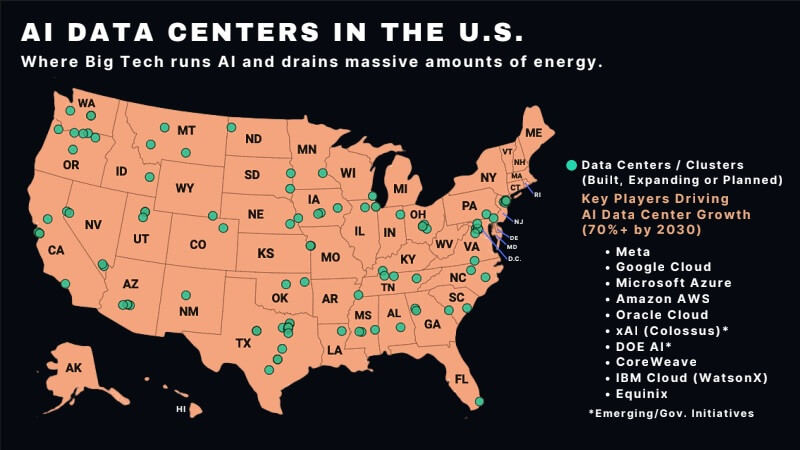
How many U.S. data centers are there?
There isn't a definitive government count. One reason is that there is no central regulatory requirement to register every data center. Data Center Map explicitly warns that databases therefore cannot be 100% complete. [datacentermap.com]
One current industry directory lists 4,767 U.S. data centers across all 50 states, operated by about 1,900 operators. These are not all AI centers. They include cloud, colocation, hyperscale and other facilities.
Thousands of data centers already operate in the United States, while a major new generation of very large, AI-oriented facilities is being built or proposed.
The scale is easier to establish through energy demand than building counts. The U.S. Department of Energy reported that data centers consumed about 4.4% of total U.S. electricity in 2023 and projected approximately 6.7% to 12% by 2028. [energy.gov]
Short takeaway: From a ZetaTalk perspective, distributing data centers across many locations can be interpreted as a quiet form of resilience-building — something that could align with preparations for grid fragility, infrastructure decentralization, and post‑Shift survivability. This does not mean mainstream planners are consciously preparing for a Pole Shift, but the pattern matches ZetaTalk’s long‑standing warnings about centralized systems failing.
🧭 ZetaTalk Interpretation: Why Many Data Centers?
ZetaTalk consistently emphasizes decentralization, local autonomy, and distributed infrastructure as critical for surviving both the Last Weeks and the Aftertime. When you apply that worldview to modern AI and cloud infrastructure, several parallels emerge.
🌐 1. Decentralization = Survival During Grid Down
ZetaTalk says the Pole Shift will:
fracture the grid
destroy long-distance transmission lines
isolate regions
break centralized control systems
A distributed data‑center architecture mirrors the survival principle:
“Small, local nodes survive better than one giant hub.”
In ZetaTalk logic:
A single mega‑center = vulnerable
Many smaller centers = redundancy
This is exactly how hyperscale cloud providers now operate:
dozens of regional zones
edge compute nodes
micro‑data centers near population clusters
It’s a grid-fragmentation survival pattern.
⚡ 2. Local Power Generation = Micro‑Grids (ZetaTalk’s Aftertime Model)
Trump’s comment about data centers “producing their own energy” aligns with:
solar micro‑grids
hydrogen fuel cells
natural‑gas micro‑turbines
small modular reactor proposals
battery farms
ZetaTalk repeatedly says:
centralized grids will fail
local generation is the only stable model
communities must be energy‑independent
A data center with its own micro‑grid is essentially a proto‑Aftertime energy node.
🛰️ 3. Edge Computing = Surviving Communication Collapse
ZetaTalk predicts:
satellites failing
long-distance communication disrupted
fiber lines severed
EMP-like surges
Modern “edge compute” is designed to:
keep local services running even if the backbone fails
process data without relying on distant servers
maintain autonomy during outages
This mirrors ZetaTalk’s survival doctrine:
“Local processing, local decision-making, local autonomy.”
🧱 4. Physical Hardening = Pole Shift Survival Parallels
Data centers are increasingly built with:
hardened shells
underground components
isolated cooling systems
redundant fiber paths
EMP-resistant designs (for military contracts)
ZetaTalk says:
underground = safer
hardened structures survive wind blasts
redundancy is essential
The industry trend unintentionally mirrors ZetaTalk’s “trench shelter” logic:
“Protect the core systems from debris, wind, and electrical surges.”
🌍 5. Geographic Spread = Avoiding Catastrophic Regional Loss
ZetaTalk warns that:
coastlines will be devastated
fault zones will rupture
certain regions will be permanently flooded
others will become deserts
Cloud providers now place data centers:
inland
away from coasts
near stable geology
in cooler climates
This is not framed as Pole Shift preparation, but the pattern matches.
🔥 6. AI + Data Centers = Post‑Shift Knowledge Preservation
ZetaTalk emphasizes:
loss of libraries
loss of digital records
collapse of institutions
need for knowledge preservation
Distributed data centers:
store redundant copies of global knowledge
maintain multiple backups
replicate constantly across regions
This is essentially a global seed vault for information.
🧩 So… Could This Be Pole Shift Preparation?
ZetaTalk perspective:
Yes — the pattern of distributed, hardened, semi‑autonomous data centers is exactly what ZetaTalk says would be needed to survive a catastrophic grid collapse.
Mainstream perspective:
No — the industry is doing this for:
latency
reliability
cost
AI scaling
energy efficiency
But the effect is the same: A decentralized, resilient infrastructure that would survive more disruption than the old, centralized model.
What do you think?
Views: 2030
Comment
-
Comment by Juan F Martinez 1 hour ago
-
President Donald Trump's recent move on "Super Intelligence," he has both renamed federal references to AI as "Super Intelligence (SI)" and announced the creation of a Super Intelligence Force (SIF) to coordinate U.S. policy and leadership in the field. [whitehouse.gov]
Key points:
- An executive order directs federal agencies to use the terms"Super Intelligence" and"SI" instead of "Artificial Intelligence" and "AI" in many executive-branch communications and policy documents.
- The administration says the change is intended to emphasize the technology's future potential and America's leadership in the field. [whitehouse.gov]
- The newly announced Super Intelligence Force (SIF) is intended to coordinate government engagement with industry, infrastructure providers, public-interest groups, and other stakeholders. [cbsnews.com], [economicti...atimes.com]
- Reports indicate the SIF will help shape federal strategy to maintain U.S. leadership in advanced AI technologies.
AfterTime Power and AI Data Centers — ZetaTalk Perspective - Earth ...
-
-
The United States appears to be positioning itself for the aftermath of Pole Shift-related grid collapse by directing trillions of dollars toward AI data centers. These highly resilient hubs could provide vital Aftertime services, including electric power generation and coordination, water purification, and the preservation of human knowledge for future generations.
AI data center power surge forces shift to energy-first planning and grid upgrades
AI demand surge: Global data centre electricity use is expected to more than double by 2030, with AI workloads as the main driver.
Power-led planning: AI operators are shifting to energy-first strategies, prioritizing power availability over compute in project planning.
Equipment bottlenecks: Shortages of key grid equipment are slowing data center expansion, adding delays to already power-constrained projects.
AI workloads set to double global data centre electricity use by 2030
Data centre electricity demand is projected to more than double from 415 TWh in 2024 to about 945 TWh by 2030, driven largely by AI workloads. The global data centre sector is expected to add roughly 100 gigawatts of capacity between 2026 and 2030, effectively doubling the installed base. Utilities are increasingly integrating AI into grid operations to improve forecasting, anomaly detection, and asset analytics, enhancing resilience against concentrated digital loads. Hyperscalers are expanding energy procurement strategies beyond renewables to include nuclear power, securing firm capacity for high-density AI campuses.
Operators adopt energy-first strategies to secure power for AI projects
Building on this demand outlook, operators are rethinking how they plan and prioritize projects. Energy-first planning is emerging as AI operators confront power as the primary constraint, reshaping strategies once centered on chip procurement. Hyperscalers now invest directly in generation or bypass the public grid, changing site selection to prioritize available megawatts over latency. Capital allocation follows the slowest verified bottleneck, with some operators integrating power and compute to shorten deployment from years to months. The mismatch between rapid facility build times and slow grid expansion forces planning trade-offs that can define project viability and capital efficiency.
Key operational changes• Operators secure dedicated generation to bypass multi-year grid interconnection delays.• Site selection prioritizes power availability over network latency.• Capital is allocated to the slowest verified bottleneck in the project chain.• Integrated power-compute models can cut deployment timelines by more than half.Severe equipment shortages slow data center expansion
These planning shifts are compounded by severe equipment and material shortages. Severe shortages of transformers, UPS units, and other grid-supporting equipment are emerging as a critical brake on data center growth. These constraints are compounded by upstream material bottlenecks, with copper already binding supply and steel and nickel set to tighten further. Long lead times, in some cases stretching to five years, and a shortage of skilled labor extend maintenance windows and delay energization of new projects. Dependence on imported components, limited domestic manufacturing, and complex customization increase vulnerability to logistics disruptions and service delays.
• Transformers, UPS units, circuit breakers, substation components, and power electronics face severe shortages.• Copper is a binding constraint, with steel, nickel, and GOES steel also in limited supply.• Lead times for critical equipment can reach five years, delaying projects.• Only about 20% of transformers are manufactured domestically, increasing import reliance.• Skilled labor shortages extend maintenance timelines and service availability.• Logistics disruptions and excessive customization exacerbate grid vulnerabilities.Investors pivot from AI software to energy infrastructure
Such constraints are influencing where and how capital is deployed in the AI ecosystem. Power constraints are pushing investors to reallocate capital from AI software toward energy infrastructure that can secure and deliver reliable electricity. Priority assets now include regulated utilities, grid expansion, storage, generation, and cooling systems that directly support high-density AI data centers. These bottlenecks alter risk profiles, with permitting delays and grid constraints threatening timelines, yet regulated returns on infrastructure can remain stable despite AI market volatility.
Concentrated demand creates new grid investment opportunities
This capital reallocation also reflects the concentration of demand among a few key utilities. AI-driven electricity demand is highly concentrated, with top utilities positioned to capture much of the growth. Equipment shortages in transformers and UPS create significant investment opportunities in grid-supporting assets. On-site generation projects are expanding, offering new avenues for behind-the-meter power investments. Investors must weigh execution risks, as most planned capacity is early stage and faces potential delays from community opposition. Grid modernization is essential to ensure equipment and material supply keeps pace with AI data center expansion.
• Top utilities stand to benefit from concentrated AI power loads.• Transformer and UPS shortages open opportunities in grid equipment manufacturing.• On-site generation growth creates behind-the-meter investment prospects.• Early-stage projects and community opposition pose execution risks.• Grid modernization is critical for sustaining AI-driven expansion.
AI data center power surge forces shift to energy-first planning an...
-
-
JUST IN: Walmart vows it will never use AI to analyze customer's income or shopping history to charge different prices for the same products.
Interesting...
AfterTime Power and AI Data Centers — ZetaTalk Perspective - Earth ...
-
-
- Comment by Nancy Lieder 2 hours ago
Why is there a sudden AI data center demand? AI generates data which needs to be stored but why now? What was the trigger? [and from another] AI Godfathers Warn of Runaway Intelligence Explosion https://www.theguardian.com/technology/2026/sep/28/ai-godfathers-wa... Two of the godfathers of modern AI and senior executives at OpenAI and Anthropic have warned governments to prepare for an AI intelligence explosion , which they say could be the most consequential technological development in history. Their concerns focus on the possibility of AIs being able to improve themselves without human intervention, a process known as recursive self-improvement . In the paper it is broadly referred to as automated AI research and development. Once AI systems reach expert-level capabilities at AI R&D, a single developer could run a workforce equivalent to millions of top human researchers, the paper says. The authors say the automating of AI R&D is the most likely source of an intelligence explosion, because AIs are already contributing to improving their own technology and the resulting improved systems can be rapidly deployed once built. Urging governments to take action quickly, the authors say: Once an intelligence explosion begins, the window for action may close. They recommended a trio of policy priorities: requiring transparent progress reports on AI-related R&D, including embedding independent auditors in companies; finding ways to constrain breakneck AI development; and preparing to adapt to an intelligence explosion. Anthropic and OpenAI have both agreed to having independent evaluators assess their models after warning that AI development was reaching a critical pitch in terms of safety. [and from another] Industrial Revolution https://en.wikipedia.org/wiki/Industrial_Revolution Economic historians agree that the onset of the Industrial Revolution is the most important event in human history, comparable only to the adoption of agriculture with respect to material advancement. This transition included going from hand production methods to machines; new chemical manufacturing and iron production processes; the increasing use of water and steam power; the development of machine tools; and rise of the mechanized factory system. [and from another] Scaling Up: how Increasing Inputs has made Artificial Intelligence more Capable https://ourworldindata.org/scaling-up-a Just a few years ago, state-of-the-art AI systems struggled with basic tasks like counting. Today, they can solve complex math problems, write software, create extremely realistic images and videos, and discuss academic topics. [and from another] The Terminator https://en.wikipedia.org/wiki/The_Terminator Disguised as a human, a cyborg assassin known as a Terminator (Arnold Schwarzenegger) travels from 2029 to 1984 to kill Sarah Connor (Linda Hamilton). Sent to protect Sarah is Kyle Reese (Michael Biehn), who divulges the coming of Skynet, an artificial intelligence system that will spark a nuclear holocaust. Sarah is targeted because Skynet knows that her unborn son will lead the fight against them. With the virtually unstoppable Terminator in hot pursuit, she and Kyle attempt to escape.
The explosion in AI use is being compared to the Industrial Revolution, as both had the potential of increasing the standard of living for mankind, exponentially. Where they differ is how they can be controlled. The Industrial Revolution allowed delimiting the instructions to manufacturing operations, so could not run amuck beyond allowing errors inserted into these manufacturing instructions. The Industrial Revolution did not allow a set of instructions for a particular factory or machine to branch out into other factories, for instance. AI is not delimited.
Yes, its programming by human hands can include good judgement and reasonable boundaries, but if these are not defined by the initial programming AI has the potential of becoming a psychopathic entity. The human programming an AI might assume empathy in the AI conclusions and actions, an empathy that is inherent in human agents but absent in AI instructions. The Movie Terminator has a foothold in reality in that the Terminator was operating as though Skynet, the robot system, was the entity to be protected, rather than the human race.
Because of its benefits, the AI explosion will continue but if not delimited in what it can do, or given explicit instructions on what protecting life means, the potential for a Psychopathic Intelligence exists.ZetaTalk Chat for October, 2026 - Earth Changes and the Pole Shift
-
-
President Trump's “Inaugurating the Era of Super Intelligence” Executive Order was signed on September 29, 2026. According to the White House, the order directs executive branch agencies to replace the terms “Artificial Intelligence (AI)” with “Super Intelligence (SI)” in official communications, policy documents, websites, reports, and other non-statutory materials.
- Federal agencies are directed to use “Super Intelligence” and “SI” instead of “Artificial Intelligence” and “AI.”
- The order states that today's frontier AI systems increasingly amplify human capabilities and should be described as a new era of "Super Intelligence."
- Previously issued regulations, contracts, grants, and historical documents do not need to be rewritten.
- The White House also said the President directed his science and technology advisor to propose a federal definition of "Super Intelligence" and identify any additional executive actions needed.
Around the same time, Trump met with major AI industry leaders and announced a voluntary industry commitment regarding AI safety controls.
https://t.me/ZetaTalk_Followers/94905
AfterTime Power and AI Data Centers — ZetaTalk Perspective - Earth ...
-
-
Trump's response to concerns that AI could "go rogue,"
President Donald Trump called concerns about AI "taking over the world" a "HOAX" and said warnings about rogue AI are part of a"SICK conspiracy" against AI development and data centers. He argued that the U.S. should continue advancing AI and said strong presidential leadership is the main safeguard needed.
AfterTime Power and AI Data Centers — ZetaTalk Perspective - Earth ...
-
-
Trump to form ‘AI Force,’ name AI czar but rejects calls for constraints
Lawmakers and industry leaders have called for moving more slowly on the technology.
What's really going on behind the scenes?
Preparations for the pending Pole Shift when Nibiru destroys the Grid. These data centers would provide the local community with new fusion power and advanced purified water to restart the world economy after the pending Pole Shift.
-
-
What does Donald Trump say about AI?
His position is strongly pro-AI development and pro-data-center construction.
The administration's 2025 Executive Order 14318 says AI data centers are important to national security, economic prosperity and scientific leadership, and directs the government to facilitate rapid construction by easing federal regulatory burdens and making appropriate federal land and resources available. [whitehouse.gov]
More recently, on September 14, 2026, Donald Trump attacked warnings that AI could destroy the world and opposition to data centers. He characterized fears about AI taking over and destroying humanity as a"Hoax" and argued that opposition is arising while the United States is leading other countries in AI. [cnbc.com]
He summed up his economic argument with:
"Don't kill the Golden Goose!" [cnbc.com]
So the Trump view is fairly clear:
AI → American technological leadership → economic power → national security
rather than:
AI → existential threat that should be slowed down.
Aftertime Power and AI Data Centers - Earth Changes and the Pole Shift
-
-
Is Super Intelligence (SI) connected to the Zeta's Sky Computer?
New ZetaTalk: SOZT The sky computer is a nexus of all info visiting aliens have, being shared. This surpasses what AI alone can gather. EOZT
-
-
The Zeta Sky Computer is located in the asteroid belt, right? [and from another] https://x.com/ZT_Followers/status/1949497456896749854

Zeta Sky Computer
Our Sky Computer permeates your entire Solar System, and many repositories of the same data lie throughout for the convenience of all who use it. Our Sky Computer could be considered a hive mind as all parts of it share and update the other parts. This is akin to a Hive AI as our Sky Computer is a robot and is not alive.
Zeta Q&A Chat for July 31, 2025
AfterTime Power and AI Data Centers — ZetaTalk Perspective - Earth ...
© 2026 Created by Juan F Martinez.
Powered by


You need to be a member of Earth Changes and the Pole Shift to add comments!
Join Earth Changes and the Pole Shift