Related Informations:


Wobble in General:

Explaining the Earth Wobble

Navy Dilemma

Earth Wobble

Twirling wobble

Drunken Lurch

Twirling into Darkness

Potters Wheel

Hell Unleashed

Lean to the left

Intermittent Lurch

Violent Push

Wobble effect

TT - Earth Wobble

Magnetic twist and the effects


Wobble- Weather:

Weather Wobble

Jet Stream tornados

Siberian Freeze Weather Wobble

Wild weather , [2]

Wobble Clouds

Hurricane development

Violent Push

Weather & ocean currents

Europe Weather


Wobble- Tide, currents and whirlpools:

Storm Clash whirlpools

Lurch of earth

Tides , [2]

Whirlpools

Wobble Sloshing


Wobble- Sun, Moon & Constellations:

Temporary adjustments

Sun position

Effect on the Moon


Other Factors:

Simulating the seasons

Constellation visibility

Northstar position

Constallation Rotation

Capricorn Visibility

Affecting cranes


Christmas Hammer

Trimester effect

Establishment and the Wobble


SOZT

"We warned at the start of ZetaTalk, in 1995, that unpredictable weather extremes, switching about from drought to deluge, would occur and increase on a lineal basis up until the pole shift. Where this occurred steadily, it has only recently become undeniable. ZetaTalk, and only ZetaTalk, warned of these weather changes, at that early date. Our early warnings spoke to the issue of global heating from the core outward, hardly Global Warming, a surface or atmospheric issue, but caused by consternation in the core. Affected by the approach of Planet X, which was by then starting to zoom rapidly toward the inner solar system for its periodic passage, the core was churning, melting the permafrost and glaciers and riling up volcanoes. When the passage did not occur as expected in 2003 because Planet X had stalled in the inner solar system, we explained the increasing weather irregularities in the context of the global wobble that had ensued - weather wobbles where the Earth is suddenly forced under air masses, churning them. This evolved by 2005 into a looping jet stream, loops breaking away and turning like a tornado to affect the air masses underneath. Meanwhile, on Planet Earth, droughts had become more intractable and deluges positively frightening, temperature swings bringing snow in summer in the tropics and searing heat in Artic regions, with the violence of storms increasing in number and ferocity."

ZETATALK


From the ZetaTalk Chat Q&A for February 4, 2012:


The wobble seems to have changed, as the temperature in Europe suddenly plunged after being like an early Spring, Alaska has its coldest temps ever while the US and much of Canada is having an extremely mild winter. India went from fatal cold spell to balmy again. Has the Earth changed position vs a vs Planet X to cause this? [and from another] Bitter cold records broken in Alaska - all time coldest record nearly broken, but Murphy's Law intervenes [Jan 30] http://wattsupwiththat.com/2012/01/30/bitter-cold-records-broken-in-alaska Jim River, AK closed in on the all time record coldest temperature of -80°F set in 1971, which is not only the Alaska all-time record, but the record for the entire United States. Unfortunately, it seems the battery died in the weather station just at the critical moment. While the continental USA has a mild winter and has set a number of high temperature records in the last week and pundits ponder whether they will be blaming the dreaded "global warming" for those temperatures, Alaska and Canada have been suffering through some of the coldest temperatures on record during the last week.

There has been no change in the wobble pattern, the wobble has merely become more severe. Nancy noted a Figure 8 format when the Earth wobble first became noticeable, in early 2005, after Planet X moved into the inner solar system at the end of 2003. The Figure 8 shifted along to the east a bit on the globe between 2005 and 2009, (the last time Nancy took its measure) as Planet X came closer to the Earth, encountering the magnetic N Pole with a violent push earlier in the day. But the pattern of the Figure 8 remained essentially the same. So what changed recently that the weather patterns became noticeably different in late January, 2012?

The N Pole is pushed away when it comes over the horizon, when the noon Sun is centered over the Pacific. This regularly puts Alaska under colder air, with less sunlight, and thus the historically low temps there this January, 2012 as the wobble has gotten stronger. But by the time the Sun is positioned over India, the N Pole has swung during the Figure 8 so the globe tilts, and this tilt is visible in the weather maps from Asia. The tilt has forced the globe under the hot air closer to the Equator, warming the land along a discernable tilt demarcation line.

The next loop of the Figure 8 swings the globe so that the N Pole moves in the other direction, putting the globe again at a tilt but this time in the other direction. This tilt is discernable in weather maps of Europe, again along a diagonal line. Depending upon air pressure and temperature differences, the weather on either side of this diagonal line may be suddenly warm or suddenly cold. The tilt and diagonal line lingers to affect much of the US and Canada, but the Figure 8 changes at this point to be an up and down motion, pulling the geographic N Pole south so the US is experiencing a warmer than expected winter under a stronger Sun. Then the cycle repeats, with the magnetic N Pole of Earth pushed violently away again as the Sun is positioned over the Pacific.


From the ZetaTalk Chat Q&A for April 6, 2013:

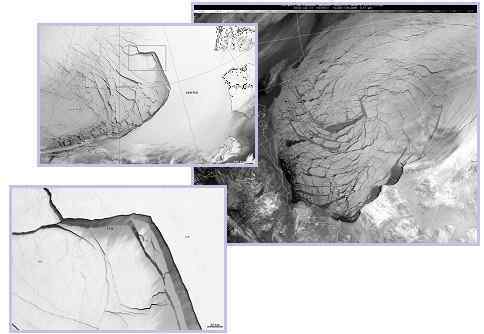
Would the Zetas be able to let us know what is causing the early break-up of the Arctic Ice, the ice seems to have taken on a swirling pattern at the same time, would this be wobble related? [and from another] http://www.vancouversun.com/news/national/Canada+Arctic+cracks+spec...  The ice in Canada’s western Arctic ripped open in a massive “fracturing event” this spring that spread like a wave across 1,000 kilometres of the Beaufort Sea. Huge leads of water – some more than 500 kilometres long and as much as 70 kilometres across – opened up from Alaska to Canada’s Arctic islands as the massive ice sheet cracked as it was pushed around by strong winds and currents. It took just seven days for the fractures to progress across the entire area from west to east. [and from another]  http://earthobservatory.nasa.gov/IOTD/view.php?id=80752&src=iot...  A high-pressure weather system was parked over the region, producing warmer temperatures and winds that flowed in a southwesterly direction. That fueled the Beaufort Gyre, a wind-driven ocean current that flows clockwise. The gyre was the key force pulling pieces of ice west past Point Barrow, the northern nub of Alaska that protrudes into the Beaufort Sea.


The Figure 8 formed by the N Pole during the daily Earth wobble has shifted somewhat to the East, due to Planet X positioned more to the right of the Earth during its approach. This was anticipated, and well described in ZetaTalk, the Earth crowding to the left in the cup to escape the approach of Planet X, so the angle between these two planets would change slightly. This shift of the Figure 8 to the East is due to the push against the Earth’s magnetic N Pole occurring sooner each day than prior. Thus instead of occurring when the Sun is high over the Pacific, over New Zealand, it is now occurring when the Sun is high over Alaska. All the wobble points have shifted eastward accordingly.

This has brought a lingering Winter to the western US, and a changed sloshing pattern to the Arctic waters. Instead of Pacific waters being pushed through the Bering Straits into the Arctic when the polar push occurs, the wobble is swinging the Arctic to the right, and then later to the left, creating a circular motion in the waters trapped in the Arctic. Since the Earth rotates counterclockwise, the motion also takes this path. This is yet another piece of evidence that the establishment is hard pressed to explain. They are attempting to ascribe this to high pressure and wind, all of which are not new to the Arctic, but this circular early breakup of ice in the Arctic is new. 


[Edited by the Moderation]

Views: 129864

Tags: blending of the seasons, collection, deluge, drought, heat, record, seasons, snow, summer, weather, More…wobble

Comment

You need to be a member of Earth Changes and the Pole Shift to add comments!

Join Earth Changes and the Pole Shift

Comment by KM on April 16, 2013 at 2:59am

http://www.theweathernetwork.com/news/storm_watch_stories3&stor...

Floods invade Poland


Rivers in 10 Polish provinces are under a state of alert following days of heavy rain and flooding

April 15, 2013 — Heavy rains have led to substantial flooding in parts of Poland.

The Nurzec River in northeastern Poland is more than 80 cm above normal levels

Rivers in 10 Polish provinces are under a state of alert following days of heavy rain and flooding.

Numerous roads have been inundated with water. The worst of the flooding is said to have occurred in Ciechanowiec, where several homes and a football stadium have been affected.

The Nurzec River in northeastern Poland is more than 80 cm above normal levels.

This recent bout of heavy rain has caused memories of the historic floods of 2010, which killed 37 people and forced 23,000 from their homes across central Europe.

Comment by Saanvi on April 15, 2013 at 10:08pm

Lion Air crash pilot felt jet "dragged" from sky---

PARIS/DENPASAR, Indonesia (Reuters) - The pilot whose Indonesian jet slumped into the sea while trying to land in Bali has described how he felt it "dragged" down by wind while he struggled to regain control, a person familiar with the matter said.

All 108 passengers and crew miraculously survived when the Boeing 737 passenger jet, operated by Indonesian budget carrier Lion Air, undershot the tourist island's main airport runway and belly-flopped in water on Saturday.

As the Lion Air plane was coming in to land, with an aircraft of national carrier Garuda following behind and another about to take off on the runway just ahead, the co-pilot lost sight of the runway as heavy rain drove across the windshield.

Between 400 and 200 feet, pilots described flying through a blur of heavy rainfall, according to the source. Heavy localized showers that temporarily reduce visibility are not uncommon in the tropics but the aircraft's low height would have meant the crew had little time to react.

With no sight of the runway, according to this account, the captain decided to abort the landing and perform a "go around", a routine maneuver for which all pilots are well trained. But the captain told officials afterwards that instead of climbing, the brand-new 737 started to sink uncontrollably."The captain says he intended to go around but that he felt the aircraft dragged down by the wind; that is why he hit the sea," said the source, who was briefed on the crew's testimony.

http://ca.news.yahoo.com/exclusive-lion-air-crash-pilot-felt-jet-dr...

Comment by Mario V-R on April 14, 2013 at 7:23pm

Peru develops early warnings of melting glaciers – in pictures

The snow-topped peaks in northern Peru are retreating so much that many visitors now come to see how much the glaciers have melted. The environmental changes have increased the risk of flooding and other problems for local people, but they are finding solutions to protect themselves and their water resources.Villagers in Pariacaca watch a presentation about Peru’s first early warning system, which monitors glacial lake 513, located above their village. In 2010, they managed to escape a landslide precipitated by an ice avalanche into the lake because they had constructed tunnels to drain off extra water. As the glaciers melt, the excess meltwater will cause more floods in downstream villages such as Pariacaca. Now, with technical assistance from the University of Zurich and Swiss aid, the solar-powered early warning system allows them to sleep more easily at night.Farmer Alejandro Cruz measures the pH of the Black river, which is turning increasingly red due to acidic iron oxide deposits. An unexpected side-effect of the glacial retreat is the acidification of the meltwater, as the withdrawing ice exposes metal-rich rocks to the air for the first time in tens of thousands, or even millions, of years .After heavy rainfall, the pH reading of the river water stands at 4.9 (highly acidic, for water). Cruz and his farming community are working with scientists to use local plants to counteract the heavy metals in the meltwater. Certain plants have an 'extraordinary capacity to absorb metals', says Raul Loayza, an aquatic toxicologist at Lima’s Cayetano Heredia University. Cruz and his fellow farmers are beginning to tailor the existing highland wetlands – which act like slow-release sponges for glacial meltwater – to combat the deteriorating quality of the water as well as storing it.Geronimo Salvador examines his potato crops, which have been blighted by ‘rancha negra’: 'It happens when the soil is waterlogged. The potato looks burnt.' The weather is much more extreme than it used to be, he says. 'There are more rains in the rainy season, more droughts in the dry season, and more frosts in the winter'.'We never used to have pests at 3,500 metres above sea level, but now that it’s warmer at this time of year, we do,' says Salvador. 'Some farmers are starting to use insecticide for the first time,' he adds. Farmers in the Cordillera Blanca are now learning about irrigation from farmers in the Cordillera Negra on the other side of the Santa valley. They are preparing for a time when there will be less water, both in quantity and quality after the glaciers have melted
Source-http://www.guardian.co.uk/global-development/gallery/2013/apr/12/pe...

Comment by Derrick Johnson on April 14, 2013 at 9:13am


More heavy rain on way will worsen flooding


“ The brutal drought that gripped southern Wisconsin in 2012 will be a distant memory by the time a series of storms drenching the area end in snow on Friday, with more storms possible Sunday through Tuesday, according to forecasters.

The weather-related woe replacing the drought is flooding: the counties of Rock, Green, Jefferson, Lafayette and Sauk are under flood warnings, and all other counties in south-central Wisconsin are under a flood watch through Friday at noon.

The rivers causing the flood warnings are the Crawfish in Jefferson County, the Baraboo in Sauk County, the Rock in Jefferson and Rock counties, the east branch of the Pecatonica in Lafayette County, the Pecatonica in Green County, the Sugar in Rock and Green counties. as well as the Fox in Lake and Kenosha counties, the Milwaukee on Ozaukee County, and the Sheboygan in Sheboygan County.

Officially, a record 1.46 inches of rain fell at the Dane County Regional Airport in Madison on Tuesday, boosting Madison’s 2013 precipitation total (rain plus snow converted to liquid) to 9.76 inches, 3.92 inches above normal.”

Source

Comment by KM on April 14, 2013 at 5:05am
Comment by Saanvi on April 12, 2013 at 7:55pm

Large hail damages crops in China--April 12, 2013 — Hail the size of golf balls caused damage to vehicles and crops in China Thursday.

Giant hailstones pounded a county in southeast China's Yunnan Province Thursday morning, causing damages to crops and vehicles.

The storm started in Jinning County around 10:30 am, with hailstones the size of ping-pong balls striking down tree branches and crops. The falling hailstones dented cars as well. There were also reports of broken windows and damaged roofs.

"I'm 50 years old and I've never seen hailstones as big as this," said the owner of a grocery store in Jinning.

The local weather station said that some of the hailstones collected on Thursday had a diameter of up to three centimetres.

http://www.theweathernetwork.com/news/storm_watch_stories3&stor...

Comment by Saanvi on April 12, 2013 at 3:36pm

SWINGING OF WEATHER BACK & FORTH~ IN SPRING, WINTER STORMS ARE BEING EXPERIENCED.

April 12,2013--- Ice storm leaves power outages, slippery streets--An overnight ice storm brought freezing rain, gusty winds and isolated power outages across the Greater Toronto Area on Friday morning.

The storm, which began late Thursday, led to about 50 flight cancellations at Toronto’s Pearson airport, with conditions worst in areas outside city.

http://ca.news.yahoo.com/ice-storm-leaves-power-outages-slippery-st...

A power outage affected about 5,600 customers in Toronto in an area bordered by Bathurst Street to Keele Street and Sheppard Avenue West to Wilson Avenue

In Hamilton ice-laden trees snapped, taking down power lines. At one point more than 4,000 residents in the Ancaster, Dundas and Hamilton area were without power. CBC overnight reporter Tony Smyth found parked cars and sidewalks in Orangeville coated by a thick layer of ice.

Spring weather? Not for parts of Ontario, Quebec, Maritimes.There were no school or bus cancellations in the Toronto District School Board with both public and catholic schools and buses running on a normal schedule.

Comment by KM on April 12, 2013 at 2:56am

http://www.cbc.ca/news/canada/saskatchewan/story/2013/04/11/sk-roof...

It's been an unusual year for snow accumulation in Saskatchewan, normally we don't get heavy wet snow or high humidity, but we've had plenty of the white stuff this year.  Residents have been cautioned to move the snow off their roofs to prevent collapse as the spring thaw takes place.

Hockey rink roof collapses in Bredenbury, Saskatchewan.

Posted: Apr 11, 2013 1:21 PM CST

Last Updated: Apr 11, 2013 3:54 PM CST

The roof of the rink in Bredenbury collapsed under the weight of snow. The roof of the rink in Bredenbury collapsed under the weight of snow. (Supplied to CBC)

It's a common story in Saskatchewan this year — heavy snow destroying buildings.

The only hockey rink in the town of Bredenbury is the latest victim. The roof of the rink collapsed on Wednesday night. Bredenbury is about 40 kilometres southeast of Yorkton.

The exact cause of the roof collapse is still unknown, but heavy snow was a factor.

Kim Varga, the town's administrator, said she is just relieved no one was injured.

"Everyone is sad and sort of in shock," Varga said. "Everybody is just devastated and people are thankful that nobody got hurt and nobody was around."

Terry Hall, Bredenbury's rink manager, said the arena was host to about 50 hockey games every winter. It was also used by several hockey teams from surrounding communities.

Comment by Derrick Johnson on April 11, 2013 at 9:15am

 More wild weather swings

-----------------------------------------------

Record Cold In March 2013


Last March, we were smashing records with highs in the 80s and enjoying sunshine. This March couldn't have been more different. With gray skies and cold temps, you might expect surplus moisture. But the lack of rain wasn't the only surprise.

More than a foot of snow blanketed Sisseton last month and while most of it's gone now, it was still the coldest March on record. The average temperature for the month was 18 degrees. That ‘s more than ten degrees below normal.

Last March was the warmest on record. 

It was a similar situation in Watertown, where the average temperature was nearly 24 degrees colder than a year earlier. 

Pierre picked up nearly three feet of snow this winter but March didn't add to the stockpiles with just 15-hundredths of an inch. That is more than an inch less than usual. 

Aberdeen actually got more moisture last March, but lost much of it to evaporation. 

While Sioux Falls received half its normal moisture, we fell seven inches behind on snowfall.
And while we were cold, perhaps the lack of snow helped temperatures.  Though Sioux Falls was more than five degrees cooler than average, it wasn't quite enough to crack the top ten coldest Marches on record.


Source

Comment by Derrick Johnson on April 11, 2013 at 9:06am


Denver weather sets record low temperature


 Denver tied a record low temperature on Wednesday, as the mercury dipped to a paltry 6 degrees.

The reading broke the low mark for April 10, 7 degrees set in 1959.

After several inches of snowfall on Tuesday, the cold will stick around Wednesday in Denver. Weather forecasters predict a 10 percent chance for additional snow.

The National Weather Service forecast calls for the high temperature in Denver on Wednesday to reach 28 degrees.

"The average highs for this date are near 60s," said Bob Kleyla, a meteorologist with weather service. "If we only get to 28, that's 30 degrees below normal."

Wednesday night into Thursday, the low temperature is expected to dip to 18 degrees.

A warming trend is on tap for the rest of the week, according to the weather service.

"Saturday, we should be back up to near normal," Kleyla said.

Roads in the Denver metro area are wet, with patches of ice and snowpack in some spots. Main roads have been cleared, but side streets could be tricky.

The Colorado Department of Transportation reopened an eastbound stretch of Interstate 70 to the Kansas border around 5 a.m. after closing it overnight.

Denver International Airport has all runways clear and open Wednesday, after canceling 495 flights on Tuesday. The FAA is not reporting any major delays at DIA Wednesday morning, and officials said they did not expect to need to put full deicing operations in place.

Source

SEARCH

FUND RAISERS

Mirror Site GOAL MET after 14 hours.

Ning Fees GOAL MET after only an hour!

Thank You!

© 2013   Created by Gerard Zwaan.   Powered by

Badges  |  Report an Issue  |  Terms of Service