Earth Changes and the Pole Shift
Volcano watch
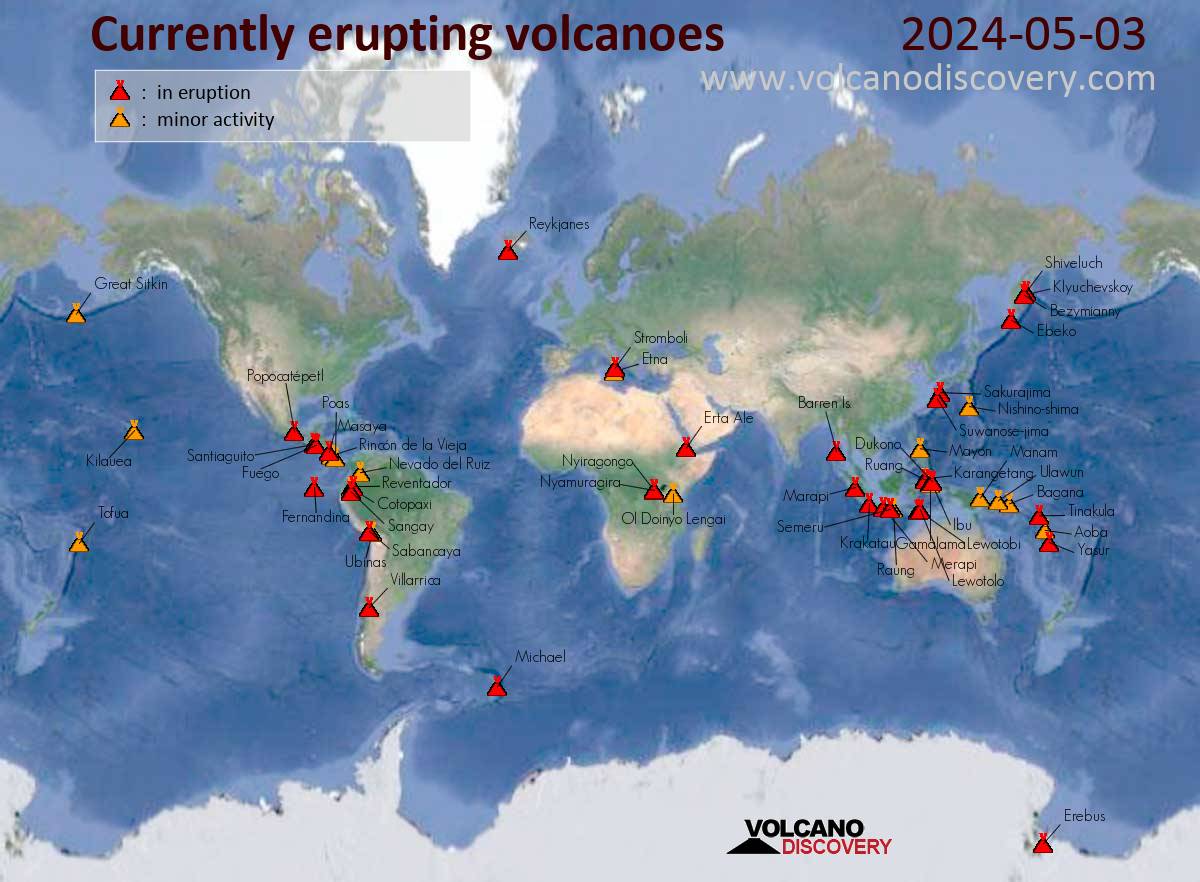
Benevolent extraterrestrials monitoring volcanoes to provide early warning to human partners.
Volcanic activity worldwide 18 October, 2025: Kilauea in Hawaii, Santiaguito volcano, Fuego, Semeru, Ibu, Dukono, Reventador, and soon "all volcanoes that have been active within the memory of man will begin spewing and burping and oozing, and many that were not expected to become active will reactive."
"Of course, all volcanoes will explode, as this is going to be a very severe pole shift. What about the months and years preceding the pole shift? It is no secret that Mammoth Lake and the caldera of Yellowstone are warming up, and the populace has been prepared for these occurrences by the movie Volcano where there, in the middle of LA, lava is bubbling up. In fact, there is a fault line running from the approximate San Diego/LA area, up into the Sierras, and this is liable to rupture rather violently during one of the quakes that precedes the pole shift by some months. Volcanic eruptions from that area in the Sierras can be expected. Will Mount St. Helen erupt? All volcanoes that have been active within the memory of man will begin spewing and burping and oozing, and many that were not expected to become active will reactive." ZetaTalk - Feb 15, 2000
Howard
Turrialba Volcano Closes Costa Rica Airports (Sep 19)
The first eruption occurred at 2:53 a.m. and lasted about 15 minutes. The explosion launched ashes, gases and incandescent rocks into the air to about 1,000 meters (3,280 feet) above the volcano’s crater, UNA’s Volcanological and Seismological Observatory of Costa Rica (OVSICORI) reported.
The second explosion occurred at 11:32 a.m. and spewed material about 13,000 feet into the air, the agency said.
OVSICORI volcanologist María Martínez said that after the second explosion, reports were received of ash falling in communities north and west of San José, including Coronado, Moravia, Tibás, Guadalupe, Escazú and as far away as Alajuela province.
Operations at the Juan Santamaria International Airport, the country’s main air terminal, and the Tobias Bolanos airport, were suspended until conditions improve, according to the chief of the Civil Aviation Directorate Ennio Cubillo.
Authorities also considered whether to limit the general aviation activities at the Daniel Oduber International Airport located in the northwest of the Central American nation.
Sources
http://aa.com.tr/en/americas/costa-rica-closes-2-airports-after-vol...
https://au.news.yahoo.com/world/a/32670537/volcano-forces-costa-ric...
http://www.ticotimes.net/2016/09/19/turrialba-volcano-explosion
Sep 20, 2016
Howard
Costa Rica's Turrialba Volcano Eruptions Continue (Sep 22)
The latest eruption on Sep 22 remained constant for nearly 4 hours, spewing ash, gas and vapor almost 3,000 meters (some 9,800 feet) above the crater.
The National University’s Volcanological and Seismological Observatory of Costa Rica (OVSICORI) reported that wind conditions prompted ash to reach northern areas of Heredia and Alajuela provinces.
Ash also reached the Braulio Carrillo National Park, Guápiles and other communities in the Caribbean province of Limón.
Sources
https://www.wired.com/2016/09/costa-ricas-turrialba-volcano-makes-a...
https://www.enca.com/world/costa-rica%E2%80%99s-volcano-erupts-for-...
http://www.ticotimes.net/2016/09/22/turrialba-volcano-costa-rica
Sep 23, 2016
Howard
Global volcanic activity has increased to such an extent that Volcano Discovery, once a reliable source of detailed information on volcanic eruptions, has resorted to only posting minimalist Volcanic Ash Advisory Center bulletins.
Volcanoes Today, 23 Sep 2016:
Klyuchevskoy (Kamchatka): (23 Sep) Volcanic Ash Advisory Center Tokyo (VAAC) issued the following report: VA EMISSIONS CONTINUING OBS VA DTG:23/0520Z
Shiveluch (Kamchatka): Volcanic Ash Advisory Center Tokyo (VAAC) issued the following report: VA EMISSIONS CONTINUING OBS VA DTG:23/1720Z
Volcanic Ash Advisory Center Tokyo (VAAC) issued the following report: ERUPTION AT 20160923/0009Z FL190 EXTD SE REPORTED OBS VA DTG:23/0010Z
Sinabung (Sumatra, Indonesia): (23 Sep) Volcanic Ash Advisory Center Darwin (VAAC) issued the following report: GND REPORT OF VA TO FL120 MOV E AT 23/0025Z
Dukono (Halmahera): Volcanic Ash Advisory Center Darwin (VAAC) issued the following report: CONTINUOUS VA EMISSION OBS TO FL080 MOV NE AT 23/1740Z.
Volcanic Ash Advisory Center Darwin (VAAC) issued the following report: CONTINUOUS MINOR VA OBS AT 23/0030Z EXT 30NM NE
Yasur (Tanna Island, Vanuatu): (23 Sep) Volcanic Ash Advisory Center Wellington (VAAC) issued the following report: CONTINUOUS LOW LEVEL ASH EMISSION OBS VA DTG:23/0138Z
Popocatépetl (Central Mexico): Volcanic Ash Advisory Center Washington (VAAC) issued the following report: LGT VA EM
Copahue (Chile/Argentina): Volcanic Ash Advisory Center Buenos Aires (VAAC) issued the following report: ONGOING EMISSION OF WV AND GASES WITH PSBL LGT ASH OBS VA DTG:23/1335Z
Sep 23, 2016
Howard
Indonesian Volcano Erupts, Flight Cancellations Strand Hundreds (Sep 27)
Mount Barujari, a sub-volcano of Mount Rinjani in Lombok, West Nusa Tenggara (NTB), erupted at around 2:45 p.m. local time on Tuesday, spewing volcanic ash around 2,000 meters into the sky.
Hundreds of passengers of the three air carriers, which fly between Bali and the Australian cities of Perth, Melbourne, Brisbane, Adelaide and Sydney, were stranded at the Denpassar Airport.
Mt Barujari’s volcanic ash drifted to southwestern areas, including North Lombok and Mataram.
Sources
http://www.stuff.co.nz/travel/travel-troubles/84735244/Australian-f...
http://www.thejakartapost.com/news/2016/09/27/mt-barujari-erupts-ag...
http://www.ibtimes.com.au/indonesias-mount-rinjani-spews-volcanic-a...
Sep 28, 2016
Howard
Multiple Eruptions at Guatemala's Fuego Volcano (Sep 27)
The volcano is maintaining "moderate to heavy explosions," according to the National Institute of Seismology, Volcanology, Meteorology and Hydrology.
The eruptions have sent an ash column up into the sky, reaching about 5,000 meters (16,400 feet) above sea level. The column is moving more than 20 kilometers (12 miles) westwards and southwest.
The rumbling 3,763-meter-high volcano is located 45 kilometers southwest of the capital Guatemala City. The incandescent lava at the top of the crater is feeding two rivers of lava.
The falling ash is affecting a number of communities, especially the town of Yepocapa, near the volcano.
The institute recommended that aviation authorities take precautions with air-traffic control.
Source
https://www.dailystar.com.lb/News/World/2016/Sep-27/374084-guatemal...
Sep 28, 2016
Howard
Costa Rica's Turrialba Volcano Spews Ash for 5th Consecutive Day (Sep 30)
The ash spewing at Turrialba, located some 50 kilometers (30 miles) northeast of the capital San José in Cartago province, began shortly after noon on Monday. Ash and vapor formed a column that varies in height from 500 meters to 2,000 meters (1,640 feet to 6,560 feet) above the crater, RSN reported.
Eruptions at Turrialba last week caused the Juan Santamaría International Airport in Alajuela, outside of San José, to close for nearly 24 hours. The airport has remained open this week although some flights were delayed Thursday morning.
The National Meteorological Institute reported that wind is currently carrying ash mainly towards the northern areas of the Central Valley.
On Thursday, RSN received reports on its social media profiles of persistent ashfall in communities in the northern parts of Cartago, San José, Heredia and Alajuela provinces.
The National University’s Volcanological and Seismological Observatory of Costa Rica (OVSICORI) also noted that some people are reporting ashfall in various areas of the Caribbean province of Limón, mostly in Guápiles.
In addition to ashfall, people said they smelled sulfur in the air north and east of the capital, in Coronado, Moravia, Tibás, Zapote, Curridabat and Montes de Oca, and also in Cartago and Heredia provinces.
Sources
http://qcostarica.com/turrialba-volcano-activity-continues/
http://www.ticotimes.net/2016/09/29/turrialba-volcano-costa-rica-2
Sep 30, 2016
Howard
Violent Eruption at Mexico's Colima Volcano Forces Evacuations (Sep 30)
Over 300 people were ordered to evacuate villages in the foothills of Volcan de Fuego, the 3,839-meter mountain which towers over the states of Jalisco and Colima.
Late Friday, Colima State Governor Jose Ignacio Peralta ordered people to evacuate from the nearby villages of La Becerrera and La Yerbabuena because of lava and noxious gases being emitted by the volcano.
Members of the National Civil Protection, Mexico’s Army and the State Civil Protection Unit have been deployed to transport residents to emergency hostels away from the danger.
People are also being warned to stay away from rivers and ravines close to the volcano, for fear the lava could take a path of least resistance and rush downhill.
Source
https://www.rt.com/news/361305-volcano-evacuation-colima-mexico/
Oct 1, 2016
M. Difato
TOKYO - Mount Aso in southern Japan sent huge plumes of gray smoke as high as 11 kilometers (6.8 miles) into the air on Saturday in one of the volcano's biggest explosions in years.
http://www.macon.com/news/nation-world/article106878367.html
This aerial photo shows cars totally covered by gray ash parked on the compound of a driving school in Aso, Kumamoto Prefecture, southern Japan, Saturday morning, Oct. 8, 2016, following Mount Aso erupted earlier in the day. Mount Aso has sent huge plumes of gray smoke as high as 11 kilometers (6.8 miles) into the air in one of the volcano's biggest explosions in years. Kyodo News via AP Hiroko Harima
The Japan Meteorological Agency said the explosion in the early hours of Saturday also blew off bits of volcanic rock and ash and raised the alert level for the area, extending the entry ban from just around the volcanic mouth to the mountain itself.
Footage on Japan's NHK public television showed orange flames flickering from several locations on the mountaintop as the volcano emitted thick gray smoke billowing into the sky.
There are no homes within the off-limit area and no injuries or major damage have been reported in nearby towns, though buildings and cars were covered with thick ash falls. Flights were largely unaffected, except for some delays.
A window at a youth center just a few kilometers (miles) away from the mountain suffered a crack apparently from volcanic rocks.
Masaaki Yamamoto, a manager at the center, told NHK that he heard small volcanic rocks hitting the exterior of the building, and found a crack in the window along with chunks of volcanic debris about the size of a golf ball near it.
Aso city, about 10 kilometers (6 miles) north of the volcano, set up evacuation centers as a precaution. Residents were washing off ash from external walls, plants and the streets before it dries up and spreads farther. Media reports said some ash falls were detected in parts of western Japan.
The area is still recovering from deadly earthquakes in April.
Mount Aso has repeated smaller eruptions in recent years. The agency said it was not known if the volano's recent activity was related to the earthquakes earlier this year, but it's in an unstable condition and could erupt again.
Japan sits atop the Pacific "ring of fire" and has more than 100 volcanoes.
Mount Aso had a smaller eruption in August while eruptions in 2014 disrupted tourism in the area.
Read more here: http://www.macon.com/news/nation-world/article106878367.html#storyl...
Oct 8, 2016
jorge namour
White Island Volcano - NEW ZEALAND
https://www.facebook.com/whiteislandvolcano/posts/781639438644499
October 8 2016
The lake at White Island is slowing filling up and looking very cool, also take a look at how green is it around the sulphur chimney. Such a stunning day today!!
Whakaari White Island lake disappears, temperature drops - NZ HERALD
http://www.nzherald.co.nz/rotorua-daily-post/news/article.cfm?c_id=...
Oct 10, 2016
M. Difato
Colombia's Nevado Del Ruiz Volcano Erupts
http://www.andnowuknow.com/headlines/colombias-nevado-del-ruiz-volc...
The Nevado Del Ruiz Volcano, located about 80 miles west of Colombian capital Bogota, sent plumes of ash and gas into the air this last weekend, putting locals on alert.
The eruption is the latest of two weeks of activity, according to news source KRIS TV, which reported that emissions shot as high as 23,000 feet.
Officials from the Red Cross announced caution, commenting that those in the area need to be prepared in case the activity presents any danger.
As we have previously reported, the notorious volcano’s most recent activity were two consecutive eruptions in May, one with emissions reaching over 4,000 feet above the the peak, another over 7,500 feet.
While that last explosion resulted in the closure of two airports, there has not yet been any details of transport issues yet linked with last weekend’s activity.
The volcanic activity was also linked to a sizeable earthquake, according to El Espectador. The 3.1 magnitude tremor hit Sunday afternoon and was felt throughout Caldas to Manizales.
"The Nevado del Ruiz volcano continues to evolve and it is possible that new events that may indicate an acceleration of the process are presented, involving greater instability thereof and consequently changes in your activity level," commented the Colombian Geological Service.
AndNowUKnow will continue to track this and other natural occurrences that could affect the produce industry.
Oct 11, 2016
jorge namour
Medina - SAUDI ARABIA
المدينة المنورة WIKIPEDIA: https://en.wikipedia.org/wiki/Medina
FACEBOOK Arabic gulf weather
https://www.facebook.com/arabicgulfweather/
Yesterday afternoon these are volcanic region escalate them smokes
It was filled with water and sprayed this morning It came back
file:///H:/LINKS/VOLCANOS%20%20SAUDI%20%20%20ARABIA%20%20MEDINA%20%20OCTOBER%20%202016.htm
Oct 11, 2016
M. Difato
As Bulusan erupts a 3rd time, ashfall threatens residents’ health
http://newsinfo.inquirer.net/830176/bulusan-ashfall-threatens-crops...
Bulusan on Oct. 21. —MARC ALVIC ESPLANA/Philippine Daily Inquirer
BULUSAN, Sorsogon—Thrice during the past week, Mount Bulusan in Sorsogon belched out gray ash plumes in a series of minor phreatic (steam-driven) eruptions that sent ash raining over villages in the towns of Bulusan, Casiguran and Irosin, threatening crops and endangering the health of some residents.
Antonio Banares, 64, a resident of Barangay Central in Bulusan town near the slope of the volcano said he thought the ash falling from the sky last week was just drizzle.
“I became aware that it was ash and that the volcano had a (minor phreatic) eruption. I saw the ash thicken and I thought, this is bad, especially for my heart condition,” he said.
Banares and other residents in 11 barangays in Bulusan had been suffering from the effects of phreatic eruptions on Oct. 17, 19 and 21.
The Municipal Disaster Risk Reduction and Management Council (MDRRMC) of Bulusan said the villages of Dancalan,
Madlawon, Poctol, Sapngan, Dapdap, Looban, Central, Sabang, Mabuhay, San Rafael and San Bernardo bore the brunt of
the ashfall which dumped up to half a millimeter thick of ash.
Fumes coming from the volcano drifted to the villages of San Jose and San Francisco.
The Philippine Institute of Volcanology and Seismology (Phivolcs) also found small traces of ashfall in the upland barangays
of San Rafael and Sabang in Irosin town during the Oct. 19 eruptions
In Casiguran town, Luisito Mendoza, the town’s MDRRMC officer, said at least 350 houses were covered by ash in
Barangay Inlagadian from the Oct. 21 eruption.
At least 10 residents were treated for vomiting and stomach ache, said Mendoza. Masks were also distributed to residents.
He said “if the situation gets worse,” officials would order preemptive evacuation.
Nerma Ricero, principal of Inlagadian Elementary School, canceled classes Friday after 310 students reported difficulty in
concentrating on their lessons. Bulusan Mayor Mike Guysayko also ordered classes suspended in eight elementary and
secondary schools.
Farmer Salvador Hajas, 33, said the continued eruption of Bulusan volcano is destroying crops. “Our produce are affected.
They get rotten due to ash,” he said.
Renard Fullon Garados, MDRMMC officer in Bulusan town, said officials are conducting an inventory of households that
need to be moved to safer grounds..."
Read more: http://newsinfo.inquirer.net/830176/bulusan-ashfall-threatens-crops...
Oct 24, 2016
KM
http://strangesounds.org/2016/11/mysterious-mud-volcano-forms-and-e...
Mysterious mud volcano forms and erupts after M6.6 earthquake in Italy
The rare geological phenomenon has unexpectedly emerged from the deep Earth interior.
The mud crater has suddenly appeared this week in a field in Santa Vittoria, Matenano, Italy, and has been bubbling mud since then.
The crater is spitting clay material out of the ground.
The mud volcano is now being surveyed by officials who study the possible threats of such a weird phenomenon on the nearby residents.
Nov 4, 2016
M. Difato
PERU: PERU'S SABANCAYA VOLCANO HAS FIRST MAJOR ERUPTION IN A DECADE NOVEMBER 06
Source and video: http://video.dailytelegraph.com.au/v/528215/PERU-Perus-Sabancaya-Vo...
Nov 8, 2016
M. Difato
Peru's Sabancaya Volcano erupts yet again spewing an ash cloud hundreds of meters into the sky
(Nov 16), just days after an earlier, record-setting eruption.
http://www.reuters.com/video/2016/11/16/perus-sabancaya-volcano-spe...
Peru's active Sabancaya Volcano erupted again on Wednesday spewing an ash cloud high into the sky. The volcano
erupted just last Friday where that ash cloud reached a record height of some 3,000 meters (9, 842 feet). The new
activity came just hours after a flurry of small explosions at the volcano..."
~
Poasted Nov 11, 2016 - Two volcanoes, Sabancaya and Ubinas, erupt simultaneously in Peru – A first time for the country
http://strangesounds.org/2016/11/two-volcanoes-erupt-simulteneously...
Sabancaya and Ubinas volcanoes are separated by a distance of 100 kilometers, have different magma chambers, but they are erupting simultaneously right now! What a rare coincidence!
Both volcanoes are sending large volcanic cloud of ash and gas and show an enhanced seismic activity. Impressive explosions occur about every 4 hours, but every 15 minutes a small explosion occurs.
Sabancaya Ubinas and are separated by a distance of 100 kilometers. According to volcanologists, they have different magma chambers and currently simultaneous eruptions. A rare coincidence!
sabancaya began erupting 4 days ago (Nov 6) for the first time in 18 years. Ubinas is active since 2013 and has constant explosive phases.
As explained by Orlando Macedo, the director of the Geophysical Institute of Arequipa: “We are witnessing the simultaneous activity of two volcanoes right now! A first time for Peru. According to our data, this will continue.”
Nov 17, 2016
M. Difato
The volcano Zhupanovsky recorded two powerful explosions within 20 minutes on November 20, 2016.
The first eruption occurred at 14:29 local time, sending the ash and gas plume to an amazing height of 8 kilometers above sea level. The second ejection, 20 minutes later, sent ash up to 6.5 kilometers asl.
The Zhupanovsky Volcano in Kamchatka recorded to strong explosions on November 20, 2016, ejecting a column of ash to a height of 8 kilometers and 6.5 kilometers, respectively.
The first ash plume spread in a northeasterly direction, while the second was blown away in an easterly direction. Ashfall has been reported in settlements around the volcano.
Officials changed the level of Code Aviation danger to orange (high) and recommends tourist organizations not to conduct tours around the volcano.
Last time the volcano erupted was March 25th. Then the height of the ash column was eight kilometers. According to the Institute of Volcanology and Seismology (KVERT), all known volcanic eruption at Zhupanovsky were relatively weak and did not pose a threat for the surrounding populations.
The Zhupanovsky Volcano is a volcanic massif, consisting of four overlapping stratovolcanoes, located in the southeastern part of Kamchatka Peninsula, Russia. After 54 years of inactivity, the volcano began erupting on October 23, 2013, in 2014, and continuing nonstop into 2016.
http://strangesounds.org/2016/11/two-powerful-explosions-zhupanovsk...
Nov 20, 2016
M. Difato
Several moderate to strong explosions have been reported on November 20, 2016 at Fuego volcano in Guatemala
Loud rumbling noises! The resulting column of ash and gas reached 5 km above the volcanic peak, is dispersing towards S and SO over an area of more than 15km.
Ashfall was reported in Morelia, Santa Sofia and Panimaché. No evacuations are underway.
The rumbling noises produced by each loud explosions were heard several kilometers away.
Pyroclastic flows have also been observed descending along the side of the volcano in the Ceniza and Trinidad canyons.
It’s not just the Fuego volcano that shows an enhanced volcanic activity, it’s all around the world since the deadly New
Zealand earthquake!
https://www.youtube.com/watch?v=8-F9PmpB0mg
Source: http://strangesounds.org/2016/11/fuego-volcano-strongly-erupts-in-l...
Nov 21, 2016
Howard
Strong Explosion at Mexico's Popocatepetl Volcano (Nov 25)
A continuous jet of steam, gas, and fragmented volcanic material which lasted about 20 minutes rising 3 miles.
The dramatic eruption spewed ash over the nearby city of Atlixco Puebla.
During the previous 24 hours, there were 324 volcanic eruptions.
Sources
http://www.straitstimes.com/world/americas/mexicos-popocatepetl-vol...
https://www.volcanodiscovery.com/popocatepetl/news/60095/Popocatepe...
Nov 27, 2016
Howard
Increasing Explosions at Peru's Sabancaya Volcano (Nov 28)
Explosions are more frequent and stronger with plumes now regularly reaching more than 4000 m (2.5 miles) in height.
Peru's Geophysical Institute IGP reported 279 explosions during 14-21 Nov, a slow increase in SO2 emissions (up to 7000 tons/day) and some deformation of the volcano's SE flank, likely a result of a rising body of magma.
Source
https://www.volcanodiscovery.com/sabancaya/news/60143/Sabancaya-vol...
Nov 29, 2016
Howard
Increasing Explosive Activity at Mexico's Colima Volcano (Dec 10)
Vulcanian explosions at rates of 1-3 per hour are producing 3,000 meter ash plumes that eject incandescent bombs onto the upper flanks of the volcano.
The active lava flow continues to creep down the southern flank along with incandescent rockfalls, alimented by the growing lava dome in the summit crater,
The arrival of gas-rich magma seems to manifest itself in this new phase of increased explosive activity, which likely will destroy the current dome.
Source
https://www.volcanodiscovery.com/colima/news/60369/Colima-volcano-M...
Dec 11, 2016
SongStar101
Mount St. Helens shakes 120 times within a week as volcano recharges, scientists say
http://www.seattletimes.com/seattle-news/northwest/mount-st-helens-...
“Each of these little earthquakes is a clue and a reminder we are marching toward an eruption someday,” said Weston Thelen, a U.S. Geological Survey seismologist with the Cascades Volcano Observatory in Vancouver.
However, “there’s nothing in this little modest seismicity, and none since 2008, that is a really good indicator of when that eruption will be.”
The earthquakes occurred between 1 and 2 miles below the surface and most registered at magnitudes of 0.3 or less; the largest was a magnitude 0.5. While the quakes are too small for human perception, scientists are able to study them thanks to sensitive seismometers stationed around the mountain.
As magma comes into the volcano’s system and is stored, scientists think that it releases gases and fluids that travel up into cracks, pressurizing and lubricating them, and causing small quakes.
“We know Mount St. Helens is slowly repressurizing. We can’t see it, but we think it’s inflating subtly,” said Liz Westby, a Cascades Volcano Observatory geologist.
Indeed, USGS scientists haven’t detected any anomalous gases or increases in ground inflation since the earthquake swarm.
“St. Helens is a well-behaved volcano, as far as we can tell,” Thelen said.
Westby said researchers have seen these kinds of earthquake swarms before.
Similar seismic episodes occurred during recharge periods between 1986 and the 2004 eruption; the small earthquake clusters resumed shortly after the eruption ended in 2008 and have continued periodically. Most recently, swarm earthquakes were detected in March through May of this year.
Scientists don’t exactly know how the volcano’s plumbing is laid out, but the little earthquake clusters give them a slightly clearer picture of what’s happening beneath the surface. By measuring how the speed of the seismic waves change as they move through the earth, researchers can better understand rock densities and where magma chambers are.
“These quakes don’t happen very often; you have to really exploit the ones we do get,” Westby said. “(It) gives us a better understanding of what’s going on and tells us where we need to do more research.”
Dec 13, 2016
Howard
Long Dormant Chilean Volcanic Complex Reawakens (Dec 13)
The volcanic field at the Laguna del Maule, located in central Chile near the Argentine border, has risen around two meters (6.5 feet) since 2007, undergoing "uplift" at a rate and consistency that is unprecedented in recent history, scientists said.
That likely means magma is exerting pressure on the Earth's crust in a zone where evidence indicates that explosive eruptions have happened repeatedly in the last few thousand years, though none in modern times.
If such an eruption were to happen at Maule today, it would have the potential to devastate nearby hydroelectric projects, and pump out ash that could wipe out crops across Argentina's pampas and severely disrupt global air traffic.
"We have so little experience with this kind of data, but the uplift is the biggest seen anywhere on the planet," said Bradley Singer, a geoscientist from the U.S. University of Wisconsin-Madison, who is leading an international research effort to understand what is happening under the surface.
"No-one has a seen a signal this large and this persistent. And it's in an area with an explosive record."
Scientists emphasize that it is impossible to know if or when Maule will blow again and how large any eruption would be.
Argentina and Chile have been working increasingly closely on monitoring the Andes volcanic chain that runs down their shared border. Most of the volcanoes - some 15 percent of the world's total - are located on the Chilean side, but winds usually mean Argentina faces the brunt of any ash cloud.
High in the remote Andes, the Laguna del Maule complex is centered around a deceptively calm, intensely blue lake of the same name, surrounded by arid volcanic rock.
The nearest towns are San Clemente in Chile, around 122 kilometers (76 miles) away, and the slightly closer Malargue on the Argentine side. Chile's capital Santiago is some 300 kilometers to the north.
About 2,400 people live or work in the nearby area, and the Maule river valley supplies around 25 percent of Chile's energy via 14 hydroelectric stations.
One of the people who knows the zone best is Raul Torres, an official who has lived close to the lake for around 60 years.
"About 10 or 15 years ago I noticed a real change in the area," he said, noting that the icy water temperature has warmed, algae have bloomed, and bubbles have appeared on the lake surface."
Source
http://www.reuters.com/article/us-chile-volcano-idUSKBN1421HP
Dec 14, 2016
lonne rey
Volcano eruption in Aleutian Islands sparks aviation alert
http://www.abc.net.au/news/2016-12-21/volcano-eruption-in-aleutian-...
The Alaska Volcano Observatory has issued its highest level of alert for aviation after what it says was a brief eruption of a volcano on the Aleutian Islands.
The observatory said pilots reported the Bogoslof volcano on Bogoslof Island erupted about 4:00pm Alaska time.
Dec 21, 2016
Howard
Escalating Activity at Alaska's Bogoslof Volcano (Dec 23)
On December 22, another powerful explosion occurred at the volcano at 17:20 local time.
This second eruption was much stronger and richer in ash than the first one detected the night before.
It produced a relatively large ash plume that rose to 35,000 ft (12 km) altitude and drifted NE at 40 knots. The aviation color code was immediately raised to red; this plume was very dangerous for aircraft in the area who should now avoid the vicinity of the island.
Satellite data shows the plume clearly:
A new, small island has formed just offshore of the northeast end of the main island. The former shore and much of the northeast side of Bogoslof Island adjacent to this island has been largely removed, and deposition of material has occurred on the west side of the island. The excavated area of the former northeast shore is likely the vent for this recent eruption, which appears to be just below sea level.
On December 23, another explosive eruption occurred at the volcano at around 09:30 local time. The alert level of Bogoslof was raised back to red.
A Coast Guard ship in the vicinity reported ash emission as well as ejection of lava and fragmental material. The eruption cloud did not penetrate the regional cloud tops at 30,000 ft and winds are to the north-northeast. According to the Coast Guard, ash emission subsided at about 10:37 AKST (19:37 UTC). On the basis of this information, the Aviation Color Code is raised to RED and the Alert Level to WARNING.
There is no monitoring of the volcano on the remote island itself and not much is known about its activity and typical behavior.
The last known eruption of Bogoslof volcano was in 1992 near the northern shore of the small island. A vent breached the sea surface producing surtseyan activity before building a new lava dome that eventually reached about 150 m height. Similar events had also occurred in 1927 and 1786, but only small remnants of the edifices produced by those earlier eruptions have survived the erosive action of the arctic ocean.
Sources
https://www.volcanodiscovery.com/bogoslof/news/60597/Bogoslof-volca...
https://www.adn.com/alaska-news/science/2016/12/22/aleutians-bogosl...
Dec 24, 2016
Howard
Peru’s Sabancaya Volcano Roars to Life (Dec 26)
The local authorities warned surrounding communities could be affected by ash from the volcano, which erupted at 8.24am local time.
The volcano had similar explosions on Dec 16 when it sent a plume of smoke 2,500 metres into the sky.
Sources
http://www.straitstimes.com/world/americas/perus-sabancaya-volcano-...
https://www.tvnz.co.nz/one-news/world/video-peru-volcano-comes-life...
Dec 27, 2016
Howard
Mexico's Colima Volcano Erupts, 1.5 Mile Ash Plume (Dec 27)
An eruption early Tuesday created an ash plume about 1.5 miles tall with the possibility of ash falling up to 30 miles away from the volcano.
Authorities have also declared an exclusion zone in neighboring Jalisco state.
"Respect the radius of exclusion of 4.6 miles in Jalisco and 7.4 miles in Colima," the Interior Ministry said in a statement.
The Interior Ministry said ash will mostly affect areas east and west of the volcano, while areas within about three miles of the volcano are at risk of falling volcanic debris.
Source
http://www.upi.com/Top_News/World-News/2016/12/27/Mexicos-Colima-vo...
Dec 27, 2016
Howard
Alaska's Bogoslof Volcano Under High Alert After Another Eruption (Dec 26)
Temperatures recorded on cloud tops suggested an ash cloud that reached 30,000 feet.
Lightning and seismic data signaled the eruption.
The volcano erupted three times last week, with one ash cloud reaching 35,000 feet.
The Alaska Volcano Observatory posted a Monday afternoon update raising the alert level to "warning" for Bogoslof, about 60 miles west of Unalaska, and its aviation color code to red. Seismic data and satellite images showed an "ash-producing eruption" and cloud at the volcano just after 2 p.m. Monday, following at least three last week that reshaped much of low-lying Bogoslof Island.
In an update posted at 3 a.m. Tuesday, the National Weather Service's Alaska Aviation Weather Unit said that volcanic ash from Bogoslof was no longer visible on satellite images.
Sources
https://www.adn.com/alaska-news/science/2016/12/27/bogoslof-volcano...
http://www.ktuu.com/content/news/Alaska-volcano-erupts-sends-up-ash...
Dec 27, 2016
Howard
Major Explosions Continue at Alaska's Bogoslof Volcano (Jan 4)
On December 31, the 6th major explosion during the current eruption cycle was recorded. The Alaska Volcano Observatory detected a strong seismic signal (captured on neighboring islands) and a swarm of lightning strikes typical for large eruption ash plumes near the volcano and extending north. Weather cloud tops at 30,000 ft prevented visual and other satellite confirmation. That eruption started presumably at 22:30 local time.
Another relatively large ash-producing explosive occurred on December 30 at 23:45 local time. The eruption was inferred from seismic data on nearby islands and seen in recent satellite images. The resulting ash plume was estimated to reach around 20,000 ft altitude and drifting NE.
Source
https://www.volcanodiscovery.com/bogoslof/news/60893/Bogoslof-volca...
Jan 4, 2017
lonne rey
Earthquake triggers strong eruption at Sinabung volcano in Indonesia – lahar alert
http://strangesounds.org/2017/01/earthquake-triggers-strong-eruptio...
A strong explosion was recorded at Sinabung volcano on January 9, 2017.
It was triggered by a volcanic earthquake that occurred about 8 minutes before.
Jan 11, 2017
Howard
Ongoing Eruptions at Bogoslof Volcano Transform Island (Jan 10)
The island has added roughly 57,000 square metres of new land, thanks to huge amounts of lava and ash pouring from the active stratovolcano.
Satellite images taken 19 years apart reveal a massive crater created by the volcano that has taken out about a third of the island's landmass.
The volcano is located about 850 miles southwest of Anchorage, a remote location making observation difficult.
On December 23, observers on a Coast Guard vessel reported spotting ash, lightning, and ejection of incandescent lava.
There have been more than 10 eruptions since mid-December, observatory geophysicist Dave Schneider said.
Prior to that, the last reported eruption was in 1992, when an eruption lasting 19 days sent a cloud rising to 3 km above Bogoslof Island, which was identified on satellite imagery.
Chris Waythomas, a geologist at the Alaska Volcano Observatory, noted how the landscape has changed in a pair of satellite photos taken nearly 19 years apart.
Ash has built up, causing more mass at the northern tip of the island, while the underwater volcano has also created a huge crater that has taken out a third of the island's landmass.
The island is home to a large population of fur seals, who may have been impacted by the relentless eruptions.
Sources
http://www.dailymail.co.uk/sciencetech/article-4116742/Incredible-i...
http://www.cbsnews.com/news/bogoslof-island-alaska-eruptions-photog...
Jan 14, 2017
M. Difato
Explosion at Bogoslof Volcano prompts ninth aviation warning (Jan 18) during weeks-long eruption
http://www.ktuu.com/content/news/Explosion-at-Bogoslof-Volcano-prom...
FAIRBANKS, Alaska (KTUU) - The Alaska Volcano Observatory says it has recorded about 20 explosive events at Bogoslof Volcano since it began erupting about a month ago.
Bogoslof’s most recent explosion occurred at around 1:20 p.m. on Wednesday, and sent up an ash cloud about 31,000 feet high, prompting the ninth red aviation warning AVO has issued for the volcano since mid-December.
AVO Geophysicist Dave Schneider says Wednesday’s eruption was preceded by a series of smaller events earlier in the week.
“It’s safe to say the explosive activity has been variable,” Schneider said. “This was one of the larger events over the past few weeks.”
The ash cloud is not the highest that the volcano has produced during this eruption, with some previous ash clouds reaching as high as 35,000 feet, according to Schneider. But those differences could be more due to atmospheric conditions than the explosion itself.
While the ash cloud does pose a threat to nearby boats and air traffic, wind forecasts show that the fallout is unlikely to be carried towards Dutch Harbor and Unalaska.
Jan 19, 2017
M. Difato
Jalisco bathed in ash after powerful eruption of Colima Volcano in Mexico – State of alert
The municipality of Jalisco is ‘bathed’ in ash after the strong explosion of Colima Volcano on January 18, 2017.
Zapotlán El Grande has experienced a copious rain of crater residues. Civil Protection, police forces and local
firemenurge the community to take precautions. Heavy ashfall has been reported in Zapotlán El Grande, Jalisco after the
latest eruption of the Colima volcano at 00:27am today.Local authorities urged people to take their precautions (masks,
close window, glasses, cover water bodies so they do not contaminate, stay inside the house and sweep the ash) and to
remain vigilant to official information issued by Civil Protection concerning the activity of the volcanic peak.
Zapotlán el Grande is a small municipality, with little more than five hundred square kilometers of surface, located to the
south of Jalisco.
Normally enjoying a pleasant climate, the city is now grey, covered by centimeters of volcanic ashes!
http://strangesounds.org/2017/01/jalisco-bathed-in-ash-after-powerf...
~
Jan 19, 2017
Howard
Spectacular Eruptions at Mexico's Colima Volcano (Jan 19)
Dramatic videos show Colima spewing incandescent bombs all over the summit cone and pyroclastic flows with eruption lightning.
An explosion on January 19 was accompanied by a large plume of ash and smoke that rose some 2,000 metres above the crater, and could be heard 50 miles away.
Following this powerful eruption, another, even stronger explosion - one of the most energetic in recent years - occurred in the evening of the same day at 22:16.
It started with a violent cannon-shot like explosion that propelled incandescent bombs to heights well over 2000 meters and covered the whole cone and its lower flanks with impacts, igniting bush fires. Pyroclastic flows from collapsing material also descended the flanks and an ash plume rose to several kilometers height.
On January 15, powerful vulcanian explosions occurred every several hours, generating dense ash columns that rose 2-4 km, covering the upper slopes of the volcano with bombs. Some of them also generated pyroclastic flows that descended the steep upper flank.
Sources
http://www.cbc.ca/news/technology/colima-erupts-again-volcano-1.394...
https://www.volcanodiscovery.com/colima/news/61207/Colima-volcano-M...
https://www.volcanodiscovery.com/colima/news/61166/Colima-volcano-M...
https://www.volcanodiscovery.com/colima/news/61235/Colima-volcano-M...
Jan 21, 2017
Willa Rawlings
The Warning status changes for Bogoslof Volcano like a roller coaster ride----
http://poleshift.ning.com/profiles/blogs/boboslof-volcanic-eruption...
Feb 3, 2017
lonne rey
http://www.theborneopost.com/2017/02/06/indonesian-volcano-erupts-s...
February 6, 2017, Monday
Feb 7, 2017
Howard
Massive Explosion at Mexico's Colima Volcano (Feb 3)
The explosion could be seen from miles away and sent ash raining down on surrounding areas in the states of Colima and Jalisco.
The volcano has steadily increased in activity since October 2015, generating towering eruptive columns often accompanied by incandescent bombs and pyroclastic flows.
Since Jan. 3, the magnitude of the explosions has been increasing.
The ongoing volcanic ash fallout has caused significant crop damage in Colima and Jalisco.
"The ash affects blackberry, blueberry, coffee crops, and the avocado that some farmers have in the municipality of Cuauhtémoc," said Jesus Plascencia, Director of Agriculture and Forestry Promotion of Colima.
Thirty eight producers in the municipality of Cuauhtémoc, which is nearly 17 kilometers from the city of Colima, have been affected.
"The amount of ash and the damage it causes to our crops depends on the size of the explosion. The ash reacts with the wind and it burns the fruit," said Luis Enrique Guardado, a producer of blackberry.
After a rain of volcanic ash, blackberry crops are washed with soap and water using pump sprayers.
According to estimates, producers need 3000 liters of water per hectare to clean their crops from the ash.
"The ash is stuck and it is very difficult to remove. We try to remove it well because the fruit looks bad and because it affects photosynthesis and the plant has less production," said Luis Enrique Guardado.
Usually the ripe fruit does not withstand washing and is lost.
"The fruit that can't be completely clean is no longer marketed and producers lose it," said Jesus Plascencia, director of Agriculture and Forestry of Colima.
Sources
http://www.ozarksfirst.com/news/video-mexicos-colima-volcano-erupti...
http://www.freshplaza.com/article/170467/Mexico-Colima-crops-affect...
https://www.rt.com/viral/376396-mexican-volcano-ash-explosion/
Feb 8, 2017
Howard
Violent Eruptions Continue at Sumatra's Sinabung Volcano (Feb 10)
Huge columns of smoke hung over Mount Sinabung and the surrounding area, including an elementary school where children played in the shadow of the towering volcanic cloud.
Activity levels have increased in the past week, with Sinabung shooting hot ash clouds into the sky dozens of times, according to the local volcano monitoring agency.
Despite the eruptions, local villagers continue their precarious existence.
The children were playing at a school in Neman Teran district, although officials say it is safe as the site is outside a four-kilometre (2.5-mile) danger zone around the crater where no one is supposed to set foot.
"It's safe for the school to be used," insisted local disaster agency chief Nata Nail.
Farmers continue tending to their crops and people in local towns put on masks to go shopping as ash rains down from the sky.
Sinabung roared back to life in 2010 for the first time in 400 years. After another period of inactivity it erupted once more in 2013, and has remained highly active since.
Source
http://www.channelnewsasia.com/news/asiapacific/rumbling-indonesian...
Feb 11, 2017
Yvonne Lawson
India's only live volcano in the Andaman and Nicobar Islands erupts back to life after being dormant for over 150 years
Photo Global Volcanism Program - Smithsonian
India's only live volcano in the Andaman and Nicobar Islands which had started showing activity in the year 1991 after being dormant for over 150 years has once again started spewing ash, the researchers at Goa based National Institute of Oceanography (NIO) said today.
"The only live volcano in the Andaman and Nicobar islands is erupting once again.
The Barren Island volcano, located 140-km north-east of Port Blair, dormant for more than 150 years started erupting in 1991 and has since then shown intermittent activity," CSIR-NIO said in a statement here.
A team of scientists led by Abhay Mudholkar, from CSIR-National Institute of Oceanography (CSIR-NIO) in Goa reported that the volcano is active and spewing smoke and lava once again.
"On the afternoon of January 23, 2017, the scientific team on board CSIR-NIO's research ship R V Sindhu Sankalp were busy collecting sea floor samples in the Andaman Basin near the Barren volcano when it suddenly started spewing ash," the NIO has said.
"The team moved about one mile from the volcano and began closely observing it.
It was erupting in small episodes lasting about five to ten minutes," said the release.
During the daytime only ash clouds were observed. However, after sundown, the team observed red lava fountains spewing from the crater into the atmosphere and hot lava flows streaming down the slopes of the volcano, it said.
NIO has said the volcano was revisited in the early hours of January 26, 2017 again during the second leg of the cruise led by B Nagender Nath, it said, adding the team witnessed the continuation of spurts of blasts and smoke.
"They have sampled the sediments and water in the vicinity of the volcano and recovered coal-like black pyroclastic material representing proximal volcanic ejecta.
Clouds were seen at the crater mouth where the smoke was bellowing out in otherwise clear sky," the researchers said.
These samples will help in deciphering the nature of the present and past volcanic activity in the region.
Read more: http://www.thebigwobble.org/2017/02/indias-only-live-volcano-in-and...
Feb 18, 2017
jorge namour
ETHIOPIA - OPENS A NEW FRACTURE IN VOLCANO ERTA ALE (VIDEO)
JANUARY 17 AND 19 2017
A liquid lava flow coming out nonstop from Erta Ale volcano in Ethiopia .This is a very active volcano in Africa in recent months has given rise to a new fracture that spray copious amounts of lava.
https://www.facebook.com/CatastrofeslMundiales/videos/1683009408663...
http://terrarealtime.blogspot.com.ar/2017/02/etiopia-si-apre-una-nu...
MAP: https://en.wikipedia.org/wiki/Erta_Ale
Feb 26, 2017
Howard
Italy's Mount Etna Roars Back to Life (Feb 27)
At around 18:00 the volcanic tremor sharply increased, signaling the start of intense strombolian activity.
The direction of the lava flow is towards the southwest and at 11:00 this morning it had flowed down slowly to an elevation of about 2850m ASL.
Ash fall has been reported from villages to the east/northeast. The webcams show that strombolian explosions are still occurring, the lava flow also appears not to have stopped and the tremor remains high.
Source
https://www.volcanodiscovery.com/etna/current-activity.html
Mar 1, 2017
jorge namour
http://www.independent.co.uk/news/world/europe/mount-etna-eruption-...
At least 10 people have been injured after several tourists and a BBC crew were caught up in an eruption at Mount Etna, local media reports said.
A member of the BBC crew said they were caught up in a "huge explosion" along with several tourists on the Italian island of Sicily.
BBC science correspondent Rebecca Morelle tweeted to say the lava flow mixed with steam causing the explosion.
Mar 16, 2017
Howard
Kamchatka's Kambalny Volcano Reawakens After 500-Year Slumber (Mar 25)
The last confirmed eruption of the volcano took place more than 500 years ago, around 1350 AD dated by radiometric studies. An alleged eruption around 200 years ago cited in the press is likely a false information or from another volcano.
The ash has risen to a height of 7,000 meters above sea level and traveled a distance of 800 km in a south-westerly direction.
Kambalny volcano (Kambalnaya Sopka) is located in the South Kamchatka volcanic zone in the south of the Kambalny volcanic ridge, southwest of the Kurilsky lake, in the sources of the Kambalnaya River.
The nearest settlement is Ozernovsky in Ust-Bolsheretsky district, some 77 km from Kambalny.
The eruption of the Kambalny volcano in southern Kamchatka on Saturday has surprised scientists of the Kamchatka Volcanic Eruption Response Team (KVERT) of the Russian Academy of Scientists.
"KVERT’s specialists since 1993 have been monitoring both by satellite and visual methods the volcanic activities and nothing pointed to a possible eruption of the Kambalny," KVERT’s head Olga Girina told TASS on March 25.
"It is a pure surprise for us." "We continue the monitoring and will analyze possible threats as data come in," she added.
Sources
https://www.volcanodiscovery.com/kambalny/news/62182/Kambalny-volca...
http://siberiantimes.com/other/others/news/kambalny-volcano-erupts-...
https://sputniknews.com/russia/201703251051959085-kamchatka-volcano...
http://rbth.com/news/2017/03/25/eruption-kamchatka-volcano-scientis...
Mar 25, 2017
KM
http://strangesounds.org/2017/03/volcanic-unrest-cleveland-volcano-...
Volcanic unrest: Cleveland volcano (USA) explodes and underwater volcano about 400 km south of Tokyo, Japan could erupt soon
Meanwhile, the volcanic unrest continues…
Cleveland volcano (USA) exploded on March 25, 2017 and an underwater volcano about 400 km south of Tokyo, Japan could erupt soon.
After Bogoslof, now the Cleveland Volcano exploded in Alaska’s Aleutian Islands
After Bogoslof since mid-December 2016, another volcano in Alaska’s Aleutian Islands is showing signs of unrest. On Friday, the Alaska Volcano Observatory detected a small explosion at Cleveland Volcano.
Geologists say the event at 8:15 a.m. did not last long and was similar to or smaller than other explosions at Cleveland Volcano.
Geologists say any ash cloud generated probably dissipated and was not above 20,000 feet, where it could threaten airliners traveling between Asia and North America.
Alert to ships in Japan as an underwater volcano about 400 km south of Tokyo could erupt soon
The Meteorological Agency on Friday warned that an underwater volcano about 400 km south of Tokyo could erupt soon. An alert to ships has been issued by the Coast Guard.
Coast guard aircraft found that the color of the ocean surface recently changed apparently due to volcanic activity in the Beyonesu Rocks about 65 km south-southeast of Aogashima Island.
But an eruption is unlikely to seriously affect any of the inhabited islands, including Aogashima. If the eruption occurs around the Beyonesu Rocks, it will be the first since 1970, where a change of color in the ocean was last observed in 1988. In 1952, an eruption in the area killed 31 crew members of a coast guard ship.
Mar 26, 2017
jorge namour
Euro-Med Seismological Centre (EMSC) shared My Etna Map's live video.
MARCH 28 2017
https://www.facebook.com/myetnamap/videos/1818045098446110/?pnref=s...
-------------------------------------------
Strong earthquake swarm 80 km north of Kolbeinsey Island - ICELAND
March 26, 2017
http://www.jonfr.com/volcano/?p=6745
Largest earthquakes in this swarm had the following magnitudes. Magnitude 4,6 (EMSC Information here), magnitude 5,0 (EMSC information here), magnitude 4,8 (EMSC information here).
http://www.emsc-csem.org/Earthquake/earthquake.php?id=579440
During the night of 26-March-2017 there was an strong earthquake swarm about 80 km north of Kolbeinsey Island. This is around 250 km from the coast in north Iceland. It is not clear what is happening in this location, since this area has been seeing higher than usual earthquake activity in recent months. This is the largest earthquake swarm so far to take place.
ICELAND REGION UPDATE LINK:
http://www.jonfr.com/volcano/
Mar 28, 2017
M. Difato
Twitter Photos of Mount Asama eruption under red skies.
http://heavy.com/…/mount-asama-volcano-volcanic-eruption-j…/
On April 2 Mount Asama, a volcano on the border of Japan’s Gunma and Nagano prefectures, erupted. People in the
vicinityimmediately took to Twitter to share photos of the impressive event..."
https://twitter.com/aosannekosan/status/848460926613245952/photo/1
https://twitter.com/lazy_toddler/status/848462439494569984/photo/1
https://twitter.com/akisetu/status/848461177449361408/photo/1?ref_s...
Apr 4, 2017
M. Difato
Volcano Sinabung in western Indonesia has begun to erupt on April 12, creating a 3,000-metre pillar of dust and smoke.
The volcano, nearly 2,500 metres tall, has erupted in recent days, according to local disaster prevention agency.
Local authorities have banned people from travelling to area of seven kilometres from the crater’s radius.
Sinabung is one of 130 active volcanoes in Indonesia, which has continuously erupted since 2013.
At least 23 people were killed by the volcano’s eruption in 2014 and 2015. The following eruptions forced thousands of people to evacuate, causing huge losses to the local economy.-VNA
~
"..Villagers also continue their precarious existences despite the eruptions, putting on masks to go shopping as ash falls from the sky, and tending to their crops.
Over 2,000 families have been evacuated from around the rumbling volcano in recent years, and many will soon be relocated to new villages after lengthy stays in temporary shelters.
Sinabung roared back to life in 2010 for the first time in 400 years. After another period of inactivity it began erupting again three years later..."
Sources:
https://www.yahoo.com/news/indonesian-volcano-fresh-eruptions-06571...
http://en.vietnamplus.vn/volcano-erupts-in-indonesia/110140.vnp
Apr 12, 2017
Howard
Costa Rica's Poás Volcano Erupting (Apr 14)
The strong explosion was preceded by several smaller and moderately sized explosions from around 6 am; the most significant one occurred at 6:59, 7:18, 7:39 and 7:57 local time.
The plume, visible from different points in the country, went higher than three kilometers.
Poás is located just 40 kilometers north of the capital San Jose, in Alajuela province.
The country's Turrialba Volcano, located in the east, is usually the one making headlines for sending plumes of ash and smoke as high as 4,000 meters into the sky.
Sources
http://news.xinhuanet.com/english/2017-04/15/c_136209927.htm
http://qcostarica.com/the-poas-volcano-eruption-from-above/
http://qcostarica.com/poas-volcano-spewed-out-gas-and-ash-3-km-high...
https://www.volcanodiscovery.com/poas/news/62585/Poas-volcano-Costa...
Apr 16, 2017
Howard
Continuous Activity at Costa Rica's Poás Volcano Culminates with Powerful Explosion (Apr 22)
Video 1
Video 2
48 hours of continuous eruptive activity at Poás Volcano were marked on Saturday at 10:12 p.m. with a massive explosion that launched glowing bombs over the entire sector of the active crater.
In what appear to be the strongest eruption in the current ongoing crisis thus far, the presence of large amounts of incandescent material suggests that magma continues to rise towards the surface.
People in nearby towns such as Alajuela reported strong sulfur smells and ash falls that caused headaches, burning eyes, and respiration irritation.
Earlier on the same day, at 4:03 p.m. local time, another explosion occurred at Poás, but the height of the eruption column was not observed due to bad visibility.
The peak of activity began on April 20 at 10 p.m. with an increase in the evaporation and emission of gases in the area where the volcanic dome used to be.
The emission of solid material and the eruptions increased on April 21 and during the night hours the volcano expelled ash aside from the vapors as well as rocks at high temperature.
The incandescent material has temperatures of more than 800 degrees Celsius (1472 Fahrenheit), when they fall again they form a cone that has been changing its shape. The volcano also emits a loud sound similar to that of a plane turbine.
Experts estimate that the temperature of the Laguna Caliente lake could be near the 80 degrees Celsius at this point.
Residents of San José, Alajuela, Heredia and Cartago are breathing high levels of sulfur, carbon dioxide and occasionally ash particles, that can have a negative effect on health.
The air quality monitoring station located in Hatillo, registered in average a concentration of carbon dioxide of 81 parts per billion (ppb), with a maximum peak of 99.1 ppb, which exceeds the WHO limits of 75 ppb.
According to Jorge Herrera, coordinator of the environmental laboratory of the National University, the emissions of gas by the Poás Volcano is affecting the quality of the air in the metropolitan area which was already compromised with the eruptions of the Turrialba Volcano.
The high levels of sulfur dioxide and carbon dioxide measured near the crater of the volcano are interpreted by scientists as a sign of fresh magma near the surface.
The combination of these gases in the air and heavy rains like the ones experienced in the last few days create what is known as acid rain, which causes damage in crops, vegetation, and even metallic structures.
Sources
https://www.volcanodiscovery.com/poas/news/62693/Poas-volcano-Costa...
http://news.co.cr/48-hours-of-activity-at-poas-volcano-costa-rica-b...
Apr 23, 2017
M. Difato
Japan volcano erupts, shoots ash 3 kms high (Apr 28)
http://conceptnewscentral.com/index.php/2017/04/28/japan-volcano-er...
TOKYO — Mt. Sakurajima, a volcano in Kagoshima Prefecture in southwestern Japan, erupted on Friday, the weather agency said.
According to Japan’s Meteorological Agency, the eruption occurred at 11:01 a.m. local time.
Ash and smoke was recorded as billowing as high as 3 kilometers into the sky, the weather agency said.
The agency warned that similar eruptions could occur, although there have been no immediate reports of injury or damage as a result of the latest eruption.
The last major eruption occurred at the mountain on July 26 last year and the volcano is under Level 3 (orange alert) by the Japan Meteorological Agency, signifying the volcano is active and should not be approached.
In September 2016, a team of experts from Bristol University and the Sakurajima Volcano Research Center in Japan concluded after studies that the volcano could have a major eruption within 30 years. Xinhua
Apr 29, 2017
Howard
Japan's Mt Sakurajima Erupts 5 Times Covering Nearby Cities with Ash (May 2)
Locals have spoken of having difficulty breathing after bright flashes and billowing smoke blasted from the volcano in at least five separate eruptions.
Residents in the town of Kagoshima, found on the southern island of Kyushu and around 4km away from the volcano, awoke to find their homes littered with ash.
One person living nearby posted a picture of his car covered in ash, with the caption: “Everything in my town is being covered with volcanic ash from Sakurajima. I can't breathe!!”
It is thought there are no injuries or casualties resulting from the violent eruptions but authorities have recommended that people in Kagoshima wear face masks until the ash stops falling on the region.
Sources
http://www.express.co.uk/news/science/799120/Mount-Sakurajima-volca...
http://www.asahi.com/ajw/articles/photo/AS20170502003075.html
May 3, 2017