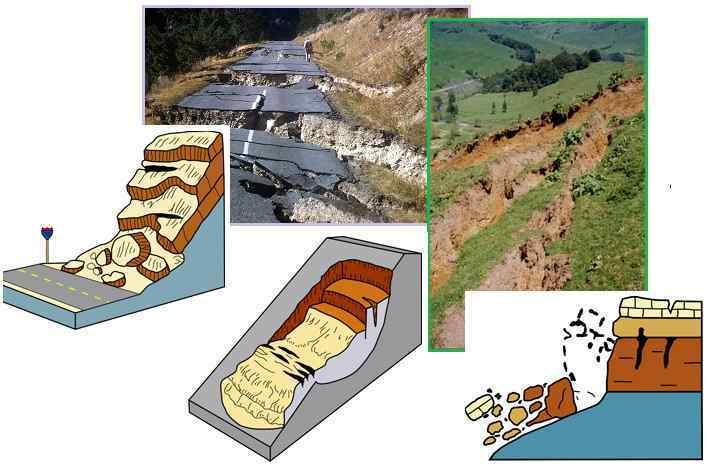
Landslides

"The causes of landslides are not a mystery to mankind. Layers of rock and soil such that rain running along a clay or rock layer can create a slippery surface for the weight of the layers above it is a common cause. A rock jumble from previous mountain building, broken or fractured rock easily dislodged. We have stated that the earthquakes man experiences between the periodic passages of Planet X can be considered aftershocks from the last passage, and this is true of landslides also. Mountain building rumples the landscape, so the land is not flat but has steep ravines and hill sides. Older mountain ranges are recognized for their rounded or smoothed appearance, because of frequent landslides distributing the rubble.

"As we approach another passage, another Pole Shift, the pace of landslides has picked up. Why would this be? Plates under pressure will put pressure on regions that contain rumpled hillsides and deep ravines, as these give more readily than strictly flat land, thus act as a weak link. In addition, due to the wobble, the weather has gotten more extreme, with drought and deluge increasing in extremes. Dry ground, suddenly flooded with rainwater needing to seek its level as runoff, will create internal water slides between the rock and soil layers that constitute the rumpled hillsides. Is there an early warning system that mankind could use? The trembles that soil about to slide emits could be detected, yes. These are not earthquakes, and have their own frequency. "

ZetaTalk Chat Q&A: March 22, 2014

Load Previous Comments
  • Tracie Crespo

    https://www.the-sun.com/news/15823520/coffins-cliff-cemetery-landsl...

    NINTCHDBPICT001052563641

    Around 20 coffins slid into the ravine below the cliff-side cemetery in Crotone, southern Italy, as intense rainfall caused a landslide in the lower part of the old cliff-side cemetery.NINTCHDBPICT001053299584


    Coffins tumble down cliff face after landslide hits Italian cemetery as storms lash Europe


    Coffins tumble down cliff face after landslide hits Italian cemetery as storms lash Europe


    Shocking footage shows a fierce wave smashing through a street in CumeraCredit: X/Top_Disaster

    Mayor Levino Rajani said the damage of San Mauro Marchesato cemetery was a “profound wound” to the community.

    “It’s a wound that affects the memory, respect and dignity of our loved ones, causing endless pain,” he said.

    He said skilled climbers would recover the coffins as soon as it was safe to do so.

    Sicilians had to run for their lives from towering storm-surge wave which smashed straight into the harbour while two people died in Greece and Malta experienced ice torrents, as wild weather ravages Europe.

    FLOOD TRAGEDY


    Woman is killed by car swept away as European city is drenched by storm

    MEGA STORM


    Moment locals run for their lives as streets flood on Italian holiday island

    Sicily was lashed with wild weather as Cyclone Harry continues to cause havoc, prompting a state of emergency.

    In what looks like a tidal wave, a street in Letojanni – north of Catania – was engulfed by flood water on Tuesday evening, with the currents taking everything in its wake.

    Loose rubbish bags were the first items to be washed away in the storm, followed by chairs and heavily weighted pot plants.

    In another video from Messina, giant waves are flooding the coastal city, rolling straight in from the sea.

    A horrifying video shows the moment the sky becomes dark, the light blocked out by an enormous wave, before it crashed down to the shore and flooded the street.

    Cyclone Harry has been wreaking havoc across the Mediterranean island, with governors pushing for the government to call a regional state of emergency, as Sicily, Calabria, and Sardinia were placed on red alert.

    The island is also expecting up to 300 millimetres of rain in just two days.

    Shocking videos show the moments Sicilian streets are turned into rivers, leaving residents running, with rubbish, pot plants, outdoor furniture and cars washing away.

    Powerful waves submerged roads and pavements, as sea foam appeared to reach the ground floors of nearby buildings.

    Passersby could also be seen wading through the water trying to get to safety.

    Meanwhile in Greece, a woman tragically died while walking home from work in a horror fl....

    The 56-year-old was traversing raging flood waters in her southern Athens suburb when she was knocked off her feet by the torrential water stream.

    She was swept along the road, which had turned into a roaring murky river, and was eventually trapped under a parked car.

    Local media report that she couldn’t get her head above the water and drowned.

    She passed away despite the best efforts of witnesses who rushed to her aid but could not free her.

    Authorities warned of the hazardous weather conditions which saw strong rain, thunderstorms and gale-force winds ravage overnight.


    A view shows areas affected by bad weather on the seafront in Catania, SicilyCredit: EPA


    LetojanniCredit: X/@volcaholic1

    Torrential rain flooded homes and businesses across Athens and other parts of Greece.

    The dangerous flow carried cars, garbage cans and debris though residential streets, submerging homes and causing extensive damage.

    The fire brigade received hundreds of calls to pump water out of flooded buildings in Athens.

    The Peloponnese, central Greece, the greater Athens area, Thessaly, the northern Aegean and western Macedonia have all been placed under a state of mobilisation.

    Residents of Athens, Viotia and Evia have received emergency text alerts urging them to limit their movements.

    Schools have also been closed in several regions.

    Earlier on Wednesday, a coast guard officer was washed away by the rough sea in a port in Peloponnese, southern Greece.

    “Ηe fell into the sea while he was trying tie up a small boat in the harbour,” said a coast guard official.

    The rainstorm is expected to move to the eastern part of the country later in the week.


    A man tries to clean a flooded street covered with rubble after a heavy rainfalls in southern AthensCredit: AFP


    The aftermath of severe flooding is seen in the Glyfada districtCredit: Getty

    Malta, a Mediterranean hotspot usually associated with bright blue skies and beautiful coastlines, experienced the severe storm over the weekend.

    Dramatic video shows rivers of mini icebergs flowing down streets and large accumulation of hail trapping cars.

    Authorities can be seen working furiously to clear the roads, with diggers shovelling heaps of ice off the roads.

    Catastrophic’ storm with devastating ice & snow forecast from Texas to Carolinas

    The western regions of Rabat and Bahrija were the most seriously affected and experienced several centimetres of hail.

    The Civil Protection Department put out a warning on Sunday evening urging residents to avoid rooftops, balconies and hillsides overnight, as the country braced itself for gale-force winds.


    Areas affected by bad weather near Mazzeo beach in TaorminaCredit: EPA

     Bad weather hits Aci Trezza seafront11


    Areas affected by bad weather are seen on the seafront in Aci Trezza, SicilyCredit: EPA

  • Tracie Crespo

    https://timesofmalta.com/article/piece-filfla-breaks-off-duing-stor...

    Piece of Filfla breaks off during Storm Harry

    Experts warn stronger and more frequent storms will endanger marine and bird species

    January 22, 2026| Matthew Bonanno |
    facebook sharing button
    The missing piece of Filfla on the island's eastern side. Photo: Jonathan BorgThe missing piece of Filfla on the island's eastern side. Photo: Jonathan Borg

    If you gazed towards Filfla today and thought it looked a bit different than usual, that’s because it is, after a substantial piece of the tiny island off Malta’s south coast collapsed during Storm Harry earlier this week.

    Photos taken by Times of Malta and from Facebook page Dwardu Photography show a missing piece and a new sheer cliff on the eastern side of the islet when compared to photos taken before the storm. 

    Speaking to Times of Malta, biologist Alan Deidun said that while he had not heard about the collapse, he was not surprised by it, as the rock is fragile and highly unstable.  

    A close-up of the collapsed cliff face. Photo: Dwardu PhotographyA close-up of the collapsed cliff face. Photo: Dwardu Photography

    Not only is the islet exposed to the elements on all sides, but up until 1971 it was used by the Royal Navy and Royal Air Force for target practice. Unexploded ordnance from these bombardments can still be found on and around Filfla. 

    While it is mostly barren, since 1980 Filfla has also been a bird reserve. Martin Austad, the head of seabird research at Bird Life Malta, said the island is home to the biggest colony of European storm petrels (Kanġu ta' Filfla) in the Mediterranean.  

    “Filfla is constantly changing due to weather and sea erosion. If it were ever to be lost, it would have huge knock-on effects on the species around the world,” he said. 

    Austad said that the effects of climate change, which resulted in stronger and more frequent storms, together with increased construction and light pollution, were putting pressure on species of birds that roost in cliff faces, such as the Yelkouan shearwater 

    “Having fewer places where to lay their eggs means that colonies will be more concentrated into smaller areas, making the species more vulnerable to coastal erosion,” he said.  

    Meanwhile, Deidun said the worst hit marine flora and fauna during Storm Harry were those that lived in shallow areas and couldn’t move to caves or deeper waters to seek shelter, including Neptune grass (Posidonia oceanica), coral, sea urchins and other similarly immobile creatures.  

    “The degradation of Posidonia meadows also worsens the impact of such storms, as the grass absorbs some of the energy of the waves before they reach the shore,” he said. 

    Filfla was by no means the only place to face the full force of Storm Harry, which peaked on Tuesday. In Siġġiewi’s Għar Lapsi, which is located directly opposite Filfla, the storm demolished a platform popular with bathers ,as well as the lower end of a slipway and a flight of steps that lead to the cave.  

  • Tracie Crespo

    At least 6 people killed and 89 are missing after a landslide in Pasirlangu, Cisarua District, West Java, Indonesia 🇮🇩

    Via https://t.me/Disaster_News

    https://www.aljazeera.com/news/2026/1/24/seven-dead-82-missing-afte...


    Seven dead, dozens missing after landslide in Indonesia’s West Bandung

    Latest disaster comes just weeks after deadly floods and landslides left more than 1,000 people dead in Indonesia’s west.


    A view shows a brown landslide through a village surrounded by green.
    An aerial view shows the scene of a landslide at Condong village in Bandung, West Java province, on December 7, 2025 [File: Timur Matahari/AFP]

    Rescue teams are searching for survivors after a landslide in the West Bandung region of Indonesia’s West Java province left at least seven people dead and dozens missing, local officials have said.

    “The number of ​missing persons ‌is high, we will try to optimise our search and rescue efforts today,” ‌Abdul Muhari, the spokesperson for Indonesia’s disaster mitigation agency, said on Saturday.

    Indonesian news outlet Kompas said a landslide hit Pasirlangu village in West Bandung at about 2am local time on Saturday morning (19:00 GMT on Friday).

    “A strong flow” of water and loose soil from the slopes of Mount Burangrang smashed into some 30 homes in the village while most of their inhabitants were sleeping, Kompas said.

    Local Police Chief AY Yogaswara said the landslide was accompanied by flash flooding, according to Jakarta-based Antara news agency.

    “When the incident occurred, residents heard a loud rumbling sound,” Yogaswara said.

    Indonesia’s armed forces, the regional disaster management agency, volunteers, and the local community are all involved in emergency response efforts, he said.

    Fearing further tragedy, local authorities have ordered the evacuation of residents in areas which are known to be prone to landslides. The area affected by the landslide on Saturday is estimated to cover some 30 hectares (74 acres), Kompas reports.

    Antara also reported that flooding hit 20 of the 30 sub-districts of West Java’s Karawang regency, due to the Citarum and Cibeet rivers overflowing. Regional government officials had advised residents living near the rivers to evacuate immediately, according to Antara.

    Hundreds of people have also fled flooding in East Jakarta amid heavy rains across much of the archipelago nation, according to Antara.

    Saturday’s disaster follows deadly landslides and flooding last month that left more than 1,170 people dead across Indonesia’s North Sumatra, West Sumatra, and Aceh provinces.

    The Indonesian government has filed lawsuits against six companies over environmental degradation suspected of contributing to the deadly disaster.

    Indonesia is facing increased risks of natural disasters due to environmental changes, including deforestation – often linked to global palm oil demand – climate change and rising sea levels. 

    A view shows a brown landslide through a village surrounded by green.