Earth Changes and the Pole Shift
Volcano watch
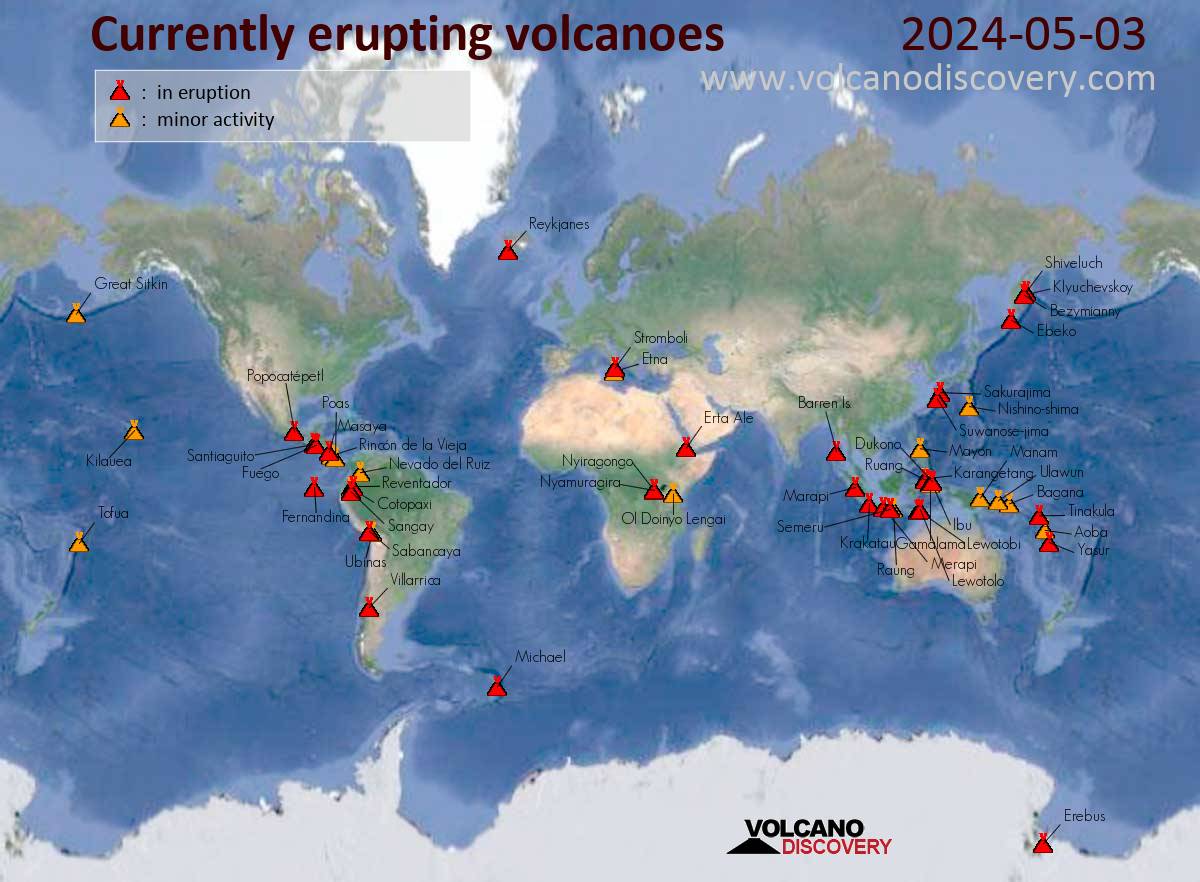
Benevolent extraterrestrials monitoring volcanoes to provide early warning to human partners.
Volcanic activity worldwide 18 October, 2025: Kilauea in Hawaii, Santiaguito volcano, Fuego, Semeru, Ibu, Dukono, Reventador, and soon "all volcanoes that have been active within the memory of man will begin spewing and burping and oozing, and many that were not expected to become active will reactive."
"Of course, all volcanoes will explode, as this is going to be a very severe pole shift. What about the months and years preceding the pole shift? It is no secret that Mammoth Lake and the caldera of Yellowstone are warming up, and the populace has been prepared for these occurrences by the movie Volcano where there, in the middle of LA, lava is bubbling up. In fact, there is a fault line running from the approximate San Diego/LA area, up into the Sierras, and this is liable to rupture rather violently during one of the quakes that precedes the pole shift by some months. Volcanic eruptions from that area in the Sierras can be expected. Will Mount St. Helen erupt? All volcanoes that have been active within the memory of man will begin spewing and burping and oozing, and many that were not expected to become active will reactive." ZetaTalk - Feb 15, 2000
Howard
Increasingly Frequent Explosions at Sumatra's Sinabung Volcano (Feb 28)
In addition, collapses of parts of the lava lobe generated small to moderate pyroclastic flows that traveled up to 3 km down on the ESE side. One of them on Saturday reached again the (already mostly destroyed and abandoned) village of Simacem on the ESE flank at only 3 km distance from the crater.
For the local population, this means the long-lasting (more than 2 years now) crisis has no end in sight: the exclusion zone of 4-5 km radius around the volcano (depending on which sector) remains in place. More than 9500 people evacuated from villages in this risk area continue to live in a total of 9 now semi-permanent shelters.
Source
http://www.volcanodiscovery.com/sinabung/news/56582/Sinabung-volcan...
Feb 29, 2016
Mark
ERUPTION WARNING issued for Mount Io after 30 volcanic trembles recorded
http://www.express.co.uk/news/science/648452/ERUPTION-WARNING-issue...
The 1,317m high volcano is long overdue an eruption having not blown since October, 1936.
However, the Japan Meteorological Agency (JMA) has said more than 30 volcanic trembles were recorded before 7PM on Sunday, 28 February.
It is the highest amount of trembles that has been recorded at the site since seismometers were installed in 2013.
As a result, the JMA has issued a warning and said that none of Kyushu island’s 13 million plus residents are allowed within a kilometre of the volcano.
In early February, inhabitants of Kyushu – the most southern island in Japan – were sent into a frenzy when Sakurajima volcano began erupting.
The volcano, in south-west Japan, was seen with lava flowing down the mountain.
Last time it erupted in 2013, it coated the nearby city Kagoshima in ash.
Mar 1, 2016
Howard
Ecuador's Tungurahua Volcano Increasingly Violent (Mar 8)
Pyroclastic flows descended over 2000 m towards the Mandur and Achupashal areas.
Similar explosive activity, with increasing tendency, had already been occurring during the previous days, in particular since Sunday.
Very strong explosions also occurred Monday afternoon at 16:28 local time, two around noon (also Monday), as well as at 19:35 and 05:35 local time on Sunday (6 March).
All of them produced pyroclastic flows into various directions towards the western (Romero and Achupashal) and northern sectors (Mandur).
Violent shock waves that rattled windows and doors and ground rumblings accompanied the explosions and most of the time, a steam and ash column was rising 3-4 km from the volcano. At night, explosions could be seen ejecting incandescent material to great height (many 100 meters) and distances over the volcano's cone, generating spectacular avalanches.
Considerable ash fall has been affecting various areas around the volcano. In particular, the western sectors have suffered most. A team of IGEPN scientists measured a load of 7700 g/m2 of ash had accumulated since the end of February in the areas of Manzano and Choglontus. The area is rich in corn fields which have been severely damaged by the ongoing eruption.
In the El Manzano community, in the shadow of the restive volcano, residents covered their faces as they walked outdoors. Farmer Jose Morocho checked on his animals and said the eruptions had been relentless.
"Since 5 o'clock in the afternoon yesterday (Sunday), we have had an attack from the earth like never before. It has rained down on us up to sunrise. It has rained earth and so now, since we have nowhere to go, we must put up with whatever comes", Morocho said.
Sources
http://www.volcanodiscovery.com/tungurahua/news/56804/Tungurahua-vo...
http://www.ibtimes.co.in/ecuador-tungurahua-volcano-continues-fiery...
Mar 9, 2016
Howard
Powerful Eruption at Alaska's Pavlof Volcano Sends Ash 20,000 Feet (Mar 27)
"As of 4:18 p.m. AKDT (00.18 UTC), ash was reportedly moving northward from the volcano," officials wrote. "Seismicity began to increase from background levels at about 3:53 pm (23:53 UTC) with quick onset of continuous tremor, which remains at high levels."
The volcano, which is located 625 miles southwest of Anchorage, produced an ash cloud more than 400 miles into interior Alaska.
The Aviation Color Code has been raised to red and the Volcano alert has been raised to Warning.
Mar 28 Update:
Alaska Airlines has canceled 41 flights to and from six cities across the state due to the "massive ash cloud" created by the Pavlof eruption.
"Flights are suspended to Barrow, Bethel, Fairbanks, Kotzebue, Nome and Prudhoe Bay until Alaska is able to assess weather reports after daylight (Tuesday). If weather conditions improve, Alaska will resume its regularly scheduled 54 flights to the affected six cities tomorrow (March 29)."
Moderator Note:
Likely correlated with significant event at buoy 21415 in Alaska waters on March 27.
Sources
http://www.ktuu.com/news/news/pavlof-volcano-begins-erupting-sunday...
http://www.youralaskalink.com/news/pavlof-volcano-begins-erupting-s...
http://www.cbc.ca/news/canada/british-columbia/pavlof-volcano-erupt...
http://www.theepochtimes.com/n3/2006241-watch-two-volcanoes-in-nort...
http://www.ktuu.com/news/news/pavlof-eruption-alaska-village-covere...
Mar 28, 2016
Howard
Major Eruption at Mexico's Popocateptl Volcano (Mar 27)
Local officials encouraged residents of the area to cover their noses and mouths with a moist towel.
A 7.5-mile security ring around the volcano keeps people from getting too close to the eruptfion.
People are being warned to cover their mouths and noses if they go outside.
Officials have also warned anybody within this perimeter runs the risk of being hit by falling debris.
This marks the second major volcanic eruption in North America on March 27.
A powerful eruption at Alaska's Pavlof Volcano sent a towering column of ash 20,000 feet high and over 400 miles into the Alaska interior (see previous post).
Sources
http://www.kristv.com/story/31577240/volcano-erupts-in-mexico
http://www.dailymail.co.uk/news/article-3512393/CCTV-cameras-captur...
Mar 29, 2016
Howard
Powerful Explosions Resume at Japan's Sakurajima Volcano (Mar 29)
Ash plumes rose to up to 10-12,000 ft (3-3.6 km) altitude.
The remarkable novelty is that most of the recent explosions occurred from the Minamidake crater, the volcano's old summit vent, and not from the Showa crater on its eastern flank, which had been (an almost exclusive) protagonist during the 10 years since 2006 until very recently.
Source
http://www.volcanodiscovery.com/sakurajima/news/57028/Sakurajima-vo...
Mar 30, 2016
Howard
Violent Eruption at Mexico's Popocatepetl Volcano (Apr 3)
The eruption occurred at 8:31 p.m. local time, producing an ash cloud that reached 1.2 miles in height, raining down burning rock fragments as far as 3,500 meters away.
The volcano registered 40 exhalations over the past 24 hours, after weeks of increased activity.
Officials have warned nearby residents to avoid the area, adding that low-level to intermediate-level explosive activity is expected. Falling ash may affect nearby towns.
Authorities confirmed on Sunday that a large dome of lava formed in January has been destroyed during recent explosions.
Sources
http://www.upi.com/Top_News/World-News/2016/04/04/Mexicos-Popocatpe...
http://globalnews.ca/news/2616712/watch-mexicos-popocatepetl-volcan...
http://www.upi.com/Top_News/World-News/2016/04/04/Mexicos-Popocatpe...
http://www.12news.com/opinion/go-ask-ozzy/amazing-images-from-volca...
http://www.wptv.com/news/world/video-violent-volcanic-eruption-caug...
Apr 5, 2016
Howard
Violent Explosions at Japan's Sakurajima Volcano (Apr 4)
Source
http://www.volcanodiscovery.com/sakurajima/news/57146/Sakurajima-vo...
Apr 5, 2016
Starr DiGiacomo
https://www.youtube.com/watch?v=yjLuVlBVPak
Embedding has been disabled but Mary Greeley is on top of the Yellowstone situation, 5 EQ's today
Stay Alert - Yellowstone Volcano, Jackson Hole, Earthquake Lake Across the park
Apr 8, 2016
jorge namour
VOLCANO BÁRÐARBUNGA, ICELAND APRIL 9 2016
http://lechaudrondevulcain.com/blog/2016/04/09/april-09-2016-en-bar...
http://en.vedur.is/
An earthquake of magnitude 4.2 hit the Bárðarbunga volcano – under the famous Vatnajökull glacier in Iceland – just after midnight last night.
This is the largest earthquake hitting the region since the last volcanic eruption of Bárðarbunga that ended in February 2015.
The earthquake was followed by a dozen of aftershocks, the largest measured M 3.5 and occurred at 1:01.
Apr 10, 2016
Howard
Airport Closures Continue from Mount Bromo's Ongoing Eruption (Apr 10)
Since April 9, the mountain's volcanic activities has been increasing and it has been spewing ashes and other volcanic materials to the direction of Malang regency and its surrounding areas.
Mount Bromo began ejecting ash and thick smoke on April 1.
Based on the monitoring done by the Volcanology and Geological Disaster Mitigation Center (PVMBG), ashes began to spew from the crater of the mountain at around 7:32am and it moved to west and south west at the height of 1,200 meters from the peak of the mountain.
The closure of the airport began on Sunday, April 10 at 1:30pm.
A Batik Air flight and one by Sriwijaya Air, both from Jakarta, had to be redirected to Juanda Airport in East Java's capital Surabaya, 90 kilometers away.
All other flights to and from the Malang airport, some 30 kilometers from the volcano, had to be canceled.
Juanda Airport spokeswoman Liza Anindya said officials are bracing for a possible influx of passengers if the closure of the airport at Malang continues.
Sources
http://en.tempo.co/read/news/2016/04/10/056761397/Malang-Airport-Cl...
http://jakartaglobe.beritasatu.com/news/malang-airport-closed-due-m...
http://www.9news.com.au/world/2016/04/11/00/01/indonesia-s-mount-br...
Apr 11, 2016
Howard
Mexico's Popocatepetl Volcano Erupts, Closes Airport (Apr 18)
Mexico's national disaster prevention agency reports that the eruption began around 2:30 a.m. (3:30 EDT; 0730 GMT) Monday.
Officials are urging residents to wear masks to avoid inhaling the fine grit that has covered houses and cars.
Civil Protection authorities warned against approaching the volcano.
'It is important to respect the security radius of 12 kilometers (seven and a half miles) due to the danger of incandescent fragments being emitted,' national coordinator Luis Felipe Puente tweeted on Monday.
Sources
http://www.ctvnews.ca/sci-tech/mexican-volcano-spews-ash-on-nearby-...
http://www.dailymail.co.uk/news/article-3546419/Mexican-volcano-eru...
Apr 19, 2016
Howard
Powerful Eruption at Guatemala's Santiaguito Volcano (Apr 19)
Pyroclastic flows traveled several kilometers to the S and SE and an ash column rose to 4.5 km altitude, and drifted 25 km SW.
Moderate to strong ash fall affected areas to the W and SW including Loma Linda (6 km distance), San Marcos Palajunoj (16 km), Retalhuleu (25 km).
Media have reported that fine ash particles have fallen on Quetzaltenango city, some 200 kilometers (125 miles) west of the capital.
Sources
http://latino.foxnews.com/latino/news/2016/04/19/guatemala-santiagu...
http://www.volcanodiscovery.com/guatemala/santiaguito/news/57287/Sa...
Apr 21, 2016
SongStar101
Wow! There are nearly 40 volcano's erupting currently with more on eruption activity alert warnings! The South American peninsula is red and active with big quakes!
http://earthquakes.volcanodiscovery.com/
Currently erupting:
Alaid (Northern Kuriles): intense thermal signal from summit crater, strong degassing (updated 20 Apr 2016)Ambrym (Vanuatu): active lava lakes in several craters (updated 18 Feb 2016)
Aso (central Kyushu, Japan): degassing, sporadic steam / ash explosions (updated 8 Mar 2016)
Batu Tara (Sunda Islands, Indonesia): strombolian explosions, ash plumes up to 500 m, extrusion of a small lava dome with rockfalls (updated 28 Nov 2015)
Chikurachki (Paramushir Island): new eruption since end of March 2016 (updated 31 Mar 2016)
Colima (Western Mexico): sporadic small explosions (updated 31 Mar 2016)
Copahue (Chile/Argentina): seismic unrest, occasional ash venting (updated 22 Mar 2016)
Dukono (Halmahera): mild strombolian activity, continuous intense ash emissions (updated 20 Apr 2016)
Erebus (Antarctica): active lava lake in summit crater (updated 8 Dec 2014)
Erta Ale (Danakil depression, Ethiopia): overflowing lava lake (updated 2 Mar 2016)
Fuego (Guatemala): lava flows on S and W flanks, lava fountaining from summit vent (updated 13 Apr 2016)
Ibu (Halmahera, Indonesia): stromolian and phreatomagmatic explosions (updated 29 Oct 2015)
Karymsky (Kamchatka): occasional small explosions, thermal anomaly (updated 1 Mar 2016)
Kerinci (Sumatra): intermittent ash emissions (updated 14 Apr 2016)
Kilauea (Hawai'i): new lava flow from vents on NE flank of Pu'u 'O'o (updated 28 Apr 2015)
Kliuchevskoi (Kamchatka): mild strombolian activity in summit crater (updated 20 Apr 2016)
Masaya (Nicaragua): active lava lake in summit crater since mid Dec 2015 (updated 3 Apr 2016)
Momotombo (Nicaragua): intermittent vulcanian explosions (updated 29 Mar 2016)
Nevado del Ruiz (Colombia): intermittent explosions, steaming, ash venting (updated 31 Mar 2016)
Nyiragongo (DRCongo): new vent on crater floor (updated 8 Mar 2016)
Ol Doinyo Lengai (Tanzania): effusion of natrocarbonatite lava inside the crater (updated 8 Jul 2013)
Pacaya (Guatemala): intense spattering from intra-crater cone (updated 29 Mar 2016)
Popocatépetl (Central Mexico): degassing, sporadic explosions, slowly growing lava dome (updated 20 Apr 2016)
Rabaul (Tavurvur) (New Britain, Papua New Guinea): lava fountains, ash emissions from Tavurvur cone (updated 12 Sep 2014)
Reventador (Ecuador): lava flow on SW flank (updated 24 Feb 2016)
Sakurajima (Kyushu, Japan): sporadic vulcanian explosions from Minamidake and Showa crater (updated 14 Apr 2016)
Sangay (Ecuador): small strombolian activity in summit crater (updated 4 Apr 2016)
Santiaguito (Guatemala): increased effusive / explosive activity from Caliente dome (updated 20 Apr 2016)
Semeru (East Java, Indonesia): growing lava dome, lava flow, strombolian activity (updated 14 Feb 2016)
Shiveluch (Kamchatka): growing lava dome (updated 31 Mar 2016)
Sinabung (Sumatra, Indonesia): continuing pyroclastic flows (updated 31 Mar 2016)
Stromboli (Eolian Islands, Italy): weak, intermittent strombolian explosions (updated 31 Mar 2016)
Suwanose-jima (Ryukyu Islands): strombolian explosions in Ontake crater (updated 20 Apr 2016)
Tungurahua (Ecuador): large and frequent explosions, ash columns rising several km (updated 9 Mar 2016)
Ubinas (Peru): sporadic vulcanian explosions (updated 16 Jan 2016)
Villarrica (Central Chile): lava lake in summit crater, spattering, strombolian explosions (updated 4 Apr 2016)
Yasur (Tanna Island, Vanuatu): ash emissions, weak strombolian explosions (updated 13 Nov 2015)
Zhupanovsky (Kamchatka, Russia): steaming / degassing (updated 31 Mar 2016)
Eruption warning / minor activity:
Bagana (Bougainville Island, Papua New Guinea): mild ash emissions (updated 3 Mar 2016)
Barren Island (Indian Ocean): weak thermal hot spot (updated 3 Mar 2016)
Bezymianny (Central Kamchatka Depression): steaming, weak seismic activity (updated 3 Jul 2014)
Bromo (East Java, Indonesia): degassing, mild ash venting (updated 4 Apr 2016)
Bulusan (Luzon Island, Philippines): occasional sporadic explosions (updated 23 Feb 2016)
Canlaon (Central Philippines): occasional sporadic explosions (updated 30 Mar 2016)
Cerro Negro (Nicaragua): increased earthquake activity (updated 16 Feb 2016)
Chirinkotan (Northern Kuriles, Russia): sporadic ash emissions (updated 28 Jul 2015)
Chirpoi (Kurile Islands, Russia): thermal hot spot visible on satellite imagery (updated 14 Apr 2016)
Cleveland (Aleutian Islands, Alaska): intermittent explosions (updated 19 Apr 2016)
Cotopaxi (Ecuador): vulcanian explosions (updated 16 Aug 2015)
Etna (Sicily, Italy): weak, dilute ash emissions from NE crater (updated 19 Apr 2014)
Heard (Australia, Southern Indian Ocean): strombolian activity, lava flow from Mawson Peak summit crater (updated 1 Feb 2016)
Karangetang (Siau Island, Sangihe Islands, Indonesia): rockfalls, glowing lava dome (updated 13 Jan 2016)
Kavachi (Solomon Islands): no eruption since 2007 (updated 16 Jun 2014)
Kick 'em Jenny (West Indies, Grenada): volcanic unrest, eruption warning (updated 24 Jul 2015)
Krakatau (Sunda Strait, Indonesia): steaming, seismic unrest (updated 15 Nov 2015)
Kuchinoerabu-jima (Ryukyu Islands): large explosive eruption on 29 May 2015 (updated 27 Mar 2015)
Langila (New Britain, Papua New Guinea): intermittent ash emissions (updated 14 Apr 2016)
Lascar (Northern Chile): sudden explosion on 30 Oct 2015 (updated 31 Oct 2015)
Lokon-Empung (North Sulawesi, Indonesia): seismic unrest, eruption warning (updated 9 Mar 2016)
Lopevi (Vanuatu): eruption warning (updated 16 Dec 2014)
MacDonald (Austral Islands, ): steaming observed (updated 6 Feb 2016)
Manam (Papua New Guinea): large explosion on 31 July 2015 (updated 4 Mar 2016)
Mayon (Luzon Island, Philippines): steaming (updated 18 Dec 2014)
Merapi (Central Java, Indonesia): sporadic phreatic explosions (updated 21 Aug 2015)
Michael (United Kingdom, South Sandwich Is): unspecified activity detected as hot spot on satellite data (updated 3 Oct 2015)
Nevados de Chillán (Central Chile): sporadic ash emissions, seismic unrest (updated 20 Apr 2016)
Nyamuragira (DRCongo): lava lake in summit crater disappeared in early April 2016 (updated 16 Apr 2016)
Ontake-san (Honshu): steaming, low seismic activity (updated 18 Dec 2014)
Papandayan (West Java): steaming (updated 6 May 2013)
Poas (Costa Rica): phreatic explosions (updated 14 Oct 2014)
Rasshua (Central Kuriles)
Raung (East Java): intra-caldera eruption with lava flow and strombolian activity (updated 27 Aug 2015)
Rincón de la Vieja (Costa Rica): occasional explosions from the crater lake (updated 3 Apr 2016)
Sabancaya (Peru): steaming, elevated seismic activity (updated 11 Oct 2015)
Sacabaya (Northern Chile, Bolivia and Argentina)
San Cristobal (Nicaragua): possible ash emission on 11 April (updated 9 Mar 2015)
San Miguel (El Salvador): intermittent ash emissions (updated 15 Jan 2016)
Sangeang Api (Indonesia): weak lava extrusion from summit crater (updated 11 Nov 2015)
Sirung (Pantar Island, Indonesia ): degassing (updated 10 Jul 2015)
Slamet (Central Java): steam emissions (updated 12 Jan 2015)
Soputan (North Sulawesi, Indonesia): steaming, weakly active lava dome (updated 31 Mar 2016)
Telica (Nicaragua): lava glow from crater, degassing, occasional light ash emissions (updated 8 Apr 2016)
Turrialba (Costa Rica): sporadic ash emissions, weak crater glow (updated 4 Apr 2016)
Ulawun (New Britain, Papua New Guinea): degassing, ash venting (updated 5 Aug 2013)
The data in the red borders above is from yesterday 4/20. Today the active volcano's page errors:
http://www.volcanodiscovery.com/erupting_volcanoes.html
Apr 21, 2016
jorge namour
Minor eruption forms new crater on White Island - NEW ZEALAND
30 APRIL 2016
http://www.nzherald.co.nz/nz/news/article.cfm?c_id=1&objectid=1...
The White Island crater from the volcano camera situated at the abandoned sulphur works.
A new crater has formed on White Island following a minor eruption on Wednesday but it's likely little or no magma was ejected.
During an aerial inspection of the site on Whakaari, volcanologists found the new crater in the northeast corner of the complex and found evidence of a landslide. Hot translucent gas was being emitted from the new vent but GeoNet said gas levels were only slightly elevated.
Seismic activity remains low and the Volcanic Alert Level remains at Level 2.
At about 9.50pm on Wednesday, the volcanic island in the Bay of Plenty erupted, covering at least 80 per cent of the floor of the main crater and up two sides of the crater wall with a dark-green ash.
------------------------------
First White Island rumbles, now Mt Ruapehu is making volcanologists sit up - NEW ZEALAND NZ HERALD
http://www.nzherald.co.nz/nz/news/article.cfm?c_id=1&objectid=1...
29 APRIL 2016. First it was White Island's crater lake that was making scientists sit up - and now it is the one atop Mt Ruapehu. But the timing of White Island's latest bout of unrest, which culminated in an overnight eruption this week, and a volcanic earthquake swarm 241km away beneath Mt Ruapehu's crater lake should be seen only as a coincidence, a volcanologist says.
This afternoon, GNS Science reported that the mountain's crater lake had risen from 25C in mid-April to 40C.
The lake temperature had been rising since late 2015, at a similar rate to that observed in March 2011, April 2014 and February 2015. And over the past few days, scientists had been recording an earthquake swarm beneath the lake - something that has been an uncommon occurrence there over recent years.
IMAGE: The temperature of the crater lake at the top of Mt Ruapehu has risen in temperature. Photo / Getty Images
May 1, 2016
Howard
Two Costa Rican Volcanoes Erupting (May 1)
Two Costa Rican volcanoes, Turrialba in Cartago province and Rincón de la Vieja in Guanacaste began erupting over the weekend.
An explosion of ash and rocks was recorded at Turrialba Volcano at 3 a.m. on Saturday. The dark column of ash was visible next to the white column of vapor and gases that has been rising from the crater over the past few weeks.
Once again, access to Turrialba volcano and national park has been closed off due to the near-continuous ash emissions.
Small explosions have also continued. Between Friday morning and the early hours of Monday, RSN recorded more than 200 explosions, many of them hurling ash and rock out of the crater.
One of these explosions, at around 6 a.m. Monday, reached two kilometers high, RSN reported.
A five kilometre (3.1 mile) perimeter around the volcano has been established, the Comisión Nacional de Emergencias (CNE) – national emergency commission – said Sunday.
“Due to the constant activity at the Turrialba volcano and the arrival of tourists and the curious, authorities,” have decided to restrict access, said the CNE statement.
The Red Sismológica Nacional(RSN) – National Seismology Network – registered at least six eruptions on Sunday morning that released gas and ash into the atmosphere.
On Monday afternoon, the National Emergency Commission (CNE) called on the population to remain calm. CNE President Iván Brenes said the increase in the volcano’s activity has caused classes to be suspended at five public schools in Turrialba.
He said officials are monitoring crops for the presence of ash, and checking for possible harm to animals on the numerous dairy farms in the northern part of Turrialba canton.
A prolonged release of ash along with a high level of seismic activity was registered almost all day on Saturday, the RSN said.
Area residents are being asked to remain outside the restricted area around the volcano, which is located within the Turrialba national park, located some 70 kilometres (40 miles) east of San Jose.
Turrialba has entered its most active eruption phase since October 2014. On March 2015, the ash spewed from the volcano reached the greater metropolitan area of San Jose, forcing the temporary closure of the international airport on three separate occasions.
At the northern end of the country, in Guanacaste province, OVSICORI reported a moderate explosion at Rincón de la Vieja Volcano on Sunday at 2:37 p.m.
OVSICORI instruments also recorded an increase in seismic activity for some 11 minutes following the explosion.
Sources
http://qcostarica.com/turrialba-volcano-continues-with-ash-eruptions/
http://www.laht.com/article.asp?ArticleId=2411194&CategoryId=23558
http://www.ticotimes.net/2016/05/03/costa-rica-turrialba-volcano-ri...
May 3, 2016
KM
https://www.sott.net/article/317907-Earthquake-swarms-a-sign-Mount-...
Earthquake swarms a sign Mount St. Helens is recharging
"At this point, there is absolutely no sign that it will erupt anytime soon, but the data we collect tells us that the volcano is still very much alive," theU.S. Geological Survey said.
The low-magnitude quakes have increased in frequency to about 40 a week, as recorded by the Pacific Northwest Seismic Network (PNSN). The PNSN has a network of 300 seismology stations in Washington and Oregon, working to monitor earthquake and volcanic activity across the Pacific Northwest.
There have been no signs indicating any change in gas emissions, and no signs of magma formation beneath the surface, says the USGS, and more importantly, no signs of an imminent eruption, reports CNN. The agency reminds us that a recharge can continue for many years beneath a volcano without an eruption.
The earthquakes are actually too small to be felt, even if you are standing over the spot where one is occurring. They range from 0.5 to 1.2 magnitude, just enough to register on a seismograph. "The earthquakes are volcano-tectonic in nature, indicative of a slip on a small fault. Such events are commonly seen in active hydrothermal and magmatic systems," says the USGS.
While each volcano behaves differently, improvements in computer technology and scientific experience give us a greater understanding of what is happening, improving our ability to locate earthquakes and seismic activity, and if necessary, provide eruption warnings.
Mount St. Helens erupted on May 18, 1980, killing 57 people. That eruption was preceded by over 10,000 small earthquakes. The force of the eruption blew off over 1,000 feet of the mountain's top, leaving an immense crater. The hot ash ignited forest fires and caused flooding as the snow melted from surrounding mountain tops, reports CBS News.
May 9, 2016
Howard
Powerful Eruption at Costa Rica's Turrialba Volcano (May 12)
Tobías Bolaños Airport, in western San José, was closed while staff cleaned off the landing strip.
The eruption was very strong and reached some 3 kilometers above the volcano’s summit.
Many people posted messages and pictures on the Facebook page of the University of Costa Rica’s National Seismological Network reporting profuse ashfall and a strong smell of sulfur in the communities of Cartago, Alajuela, Heredia and San José provinces.
The eruption was recorded at 1:19 a.m.
Sources
http://www.ticotimes.net/2016/05/12/turrialba-volcano-spreads-ash-a...
http://todaycostarica.com/central-valley-wrapped-in-a-gray-cloud-wi...
May 13, 2016
Howard
Powerful Explosions at Guatemala's Santa Maria Volcano (May 16)
The explosions could be heard up to 30 km away and volcanic bombs reached 3 km in distance.
The eruptions produced ash plumes that rose 3-4 km above the dome and multiple pyroclastic flows that traveled up to 2 kilometers.
The current phase of activity has been the highest recorded at the volcano since at least 2 years.
Moderate to heavy ash fall occurred in the towns and villages of Nuevo Palmar, San Felipe Retalhuleu, Aldea Loma Linda, San Marcos Palajunoj El Patrocinio, among others.
Source
http://www.volcanodiscovery.com/guatemala/santiaguito/news/57617/Sa...
May 17, 2016
Howard
Quake Swarm at Oregon's Mt Hood Volcano follows Mt St Helen Swarm (May 16)
One week quake summary (May 11- 17)
Close to 100 tiny quakes shook the area around Mount Hood Village between 6 p.m. Sunday night (May 15) and Monday morning (May 16).
Maps from the Pacific Northwest Seismic Network and the U. S. Geological Survey show quakes are happening frequently southeast of Timberline between there and Mt. Hood Meadows. They are small and shallow. The largest quake recorded since they started on Sunday is 1.9.
Between March 14 and May 7, more than 130 small earthquakes trembled beneath the surface of Mount St. Helens.
The magnitude of the quakes ranged from less than 0.5 to 1.3. The frequency of the quakes reached nearly 40 per week during this time.
Mount St. Helens last erupted on May 18, 1980.
The most recent eruption on Mount Hood occurred in 1865.
Sources
http://www.opb.org/news/series/unprepared/mount-hood-oregon-earthqu...
http://fox6now.com/2016/05/07/swarm-of-earthquakes-strikes-mount-st...
http://www.oregonlive.com/pacific-northwest-news/index.ssf/2016/05/...
http://mynorthwest.com/category/earthquake_tracker/
May 18, 2016
Howard
Italy's Mt Etna Reawakens (May 17)
Since the evening of 17 May 2016, there has been intense Strombolian activity at Etna's Northeast Crater (NEC), with ejection of incandescent bombs above the crater rim and fall of pyroclastics over the flanks of the cone.
Vulcanologists define strombolian activity as explosive bursts of cinder, ash and smoke ejected with great force.
Shortly after 12:50 local time on 18 May 2016, eruptive activity evolved into a pulsating lava fountain within just a few minutes.
Volcanic tremor amplitude soon showed a rapid increase and an ash plume rose to 3000-3500 m above the summit and was blown by the wind to east-southeast.
During the afternoon, lava started to overflow from the western rim of the Voragine-Bocca Nuova depression, feeding a minor lava flow toward west.
At the time of this update, lava fountaining is ongoing.
The current eruption is the most significant period of activity on the volcano since December 2015, when the mountain witnessed one of its most severe eruptions of the last two decades.
Sources
http://www.volcanodiscovery.com/etna/current-activity.html
http://www.thelocal.it/20160518/huge-ash-cloud-over-etna-as-volcano...
May 19, 2016
Howard
Powerful Eruptions at 2 Guatemalan Volcanoes (May 18)
At Fuego, an ash column reaching 5,500 meters (18,000 feet) has emerged with a strong pyroclastic flow and moderate rumbling of the mountain.
Fallen ash is reported in the villages of El Rodeo, La Rochelle, Osuna, Panimache, Morelia, Sangre de Cristo and Yepocapa.
At least one school has been evacuated in the municipality of Alotenango.
Two explosions occurredon May 19 at 09:34 and 09:56 local time, producing ash plumes that rose 2-3 km to 15,000 ft (4.5 km) altitude.
Loud detonations accompanied the eruptions which also generated pyroclastic flows.
Ash fall occurred in up to 25 km distance to the south and southwest, in particular in the farms of El Faro, Patzulin, Monte Bello, as well as in Loma Linda, San Marcos Palajunoj, Las Marias and other villages of the municipality of San Felipe in the department of Retalhuleu.
https://www.rt.com/news/343476-guatemala-volcano-erupts-evacuation/
http://www.volcanodiscovery.com/guatemala/santiaguito/news/57692/Sa...
May 20, 2016
Howard
Explosive Activity at Costa Rica's Turrialba Volcano (May 19)
A volcano in central Costa Rica is spewing smoke and ash 9,840 feet (3,000 meters) into the sky, sending hundreds of people to the hospital with breathing difficulties and forcing dozens of flights to be diverted.
Activity at Turrialba Volcano increased significantly on Thursday with constant ash emanations and at least three big explosions.
The first explosion occurred at 2:05 p.m. and formed a plume of gas and ash that reached nearly 1 km high.
The second, and most prolonged one, occurred at 3:46 p.m. and lasted three minutes. A few minutes later, at 4:09 p.m., a third explosion was recorded.
The column of gases and ash at about 4:20 p.m. rose to more than 500 meters above the crater and wind conditions at that time caused ash to disperse from the volcano, mostly to the southwest, RSN reported.
Ash has been reported in San José and Heredia provinces.
“It seems to me to be the strongest Turrialba eruption in the past six years,” according to volcanologist Gino Gonzalez.
The National Emergencies Commission in a Facebook statement called people to take masks and wear tight clothing to protect their lungs and skin from the ash and smoke.
Since the start of the eruption, hundreds of local residents reportedly sought medical help due to breathing and skin problems.
People took to social media to describe the “all-hell-broke-loose” situation in the region. They spoke about a strong sulfur smell and added that ash has reached four provinces of Costa Rica.
Turrialba Volcano has seen increased activity following explosions in late April, some of which extended for several hours. The National University’s Volcanological and Seismological Observatory of Costa Rica (OVSICORI) reported that micro-tremors and ash eruptions from the volcano have been constant since an eruption recorded at 10:07 p.m. Wednesday.
On Wednesday, the National Emergency Commission (CNE) established a 5-km restricted access area around the volcano. Entrance to the Turrialba Volcano National Park has been closed to all visitors since 2014.
In a report, CNE geologist Blas Sánchez said ash and other materials from the explosions are visible on various farms located west of the volcano. He also reported that ash is accumulating in various nearby rivers.
Sources
http://www.ticotimes.net/2016/05/19/costa-rica-turrialba-volcano-ex...
http://www.volcanodiscovery.com/turrialba/news/57687/Turrialba-volc...
https://www.rt.com/news/343875-costa-rica-volcano-erupts/
http://news.nationalgeographic.com/2016/05/160521-turrialba-volcano...
May 20, 2016
Tracie Crespo
www.thebigwobble.org/2016/05/mount-sinabung-volcano-north-sumatra.html
Mount Sinabung Volcano North Sumatra Kills Three After It Blasted Ash 3 Kilometers Into The Sky Saturday
Deadly Eruption at Sumatra's Mt Sinabung -May 21
Mt Sinabung blasted volcanic ash 2 miles high, with pyroclastic flows that tumbled down the slopes for 3 miles.
Three people were killed and four were critically injured after Mount Sinabung erupted in Sumatra Saturday.
All of the victims were working on their farms in the village of Gamber 2.5 miles away from the base of the volcano.
"Seven people were exposed to the hot clouds, killing three and leaving four others in critical condition," he said in a statement, adding the injured had been taken to hospital.
Several houses were also destroyed during the eruptions.
https://weather.com/news/news/indonesia-sumatra-mount-sinabung-erup...
http://www.bangkokpost.com/news/asean/982513/3-die-as-sumatra-volca...
http://www.wsj.com/articles/volcano-erupts-in-western-indonesia-kil...
May 21, 2016
Howard
Frequent Explosions at Guatemala's Santa Maria Volcano Causing Severe Ash Fallout
(May 22)
Very elevated activity continues at the active Caliente lava dome. Yesterday, another two strong explosions occurred at 08:30 and around 13:00 local time.
Both explosions produced tall ash plumes that rose 3-4 km above the dome, reaching altitudes of 15,000-20,000 ft as well as triggering several pyroclastic flows that descended several kilometers on the flanks of the dome.
The frequent explosions are beginning serious problems related to ash falls. Determined by the prevailing winds, ash plumes from the explosions again drifted W and SW, causing ash fall in the same areas that have been subject to fallout during much of the previous weeks already: Nuevo Palmar, San Marcos Palajunon, Coatepaque and others.
The ash fall is not only causing much damage to houses, cars, motorcycles, farmlands, but it is almost impossible to avoid breathing in the fine glassy particles. Prolonged exposure to fine dust is very unhealthy and can cause serious damage to the pulmonary system. Residents are advised to wear dust masks.
Another major concern is the pollution of drinking water by the fine ash.
Source
http://www.volcanodiscovery.com/guatemala/santiaguito/news/57721/Sa...
May 23, 2016
Howard
Severe Ash Fallout from Costa Rica's Turrialba Volcano (May 23)
The spewing of ash, rocks and gases that started Friday at Turrialba Volcano continued almost uninterrupted Monday afternoon. The volcano has been spewing materials for over 75 hours, with only brief periods of calm.
Ashes from the explosions caused a power outage in an area within 5 kilometers of the volcano and also affected OVSICORI’s cameras and measuring instruments at the crater.
Citizens over the weekend posted reports on OVSICORI’s Facebook page of ash falling in communities all over the Central Valley, which comprises the provinces of San José, Cartago, Heredia and Alajuela.
In San José most of the reports were from people in the northern cantons of Goicoechea, Coronado and Moravia.
OVSICORI also received reports of falling ash from the Heredia cantons of Santo Domingo, San Isidro and Belén, and as far as La Guácima in Alajuela province.
Communities around the volcano were affected by ash mainly in the Cartago cantons of Oreamuno and Turrialba.
Oreamuno Mayor Catalina Coghi Ulloa said material from the volcano affected some 20 dairy farms and nearly 2,000 animals in these cantons. “Milk production in the area has been reduced by at least 15 percent in the past days due to the constant ashfall,” she said.
Iván Brenes, president of the Emergency Commission, on Monday morning said that it started distributing hay bales and that experts from the Agriculture and Livestock Ministry (MAG) are evaluating animals.
Ministry officials also are conducting inspections to assess the effect of ash on crops.
Agriculture is one of Cartago’s main economic activities, and farmers in the north of the province are the country’s top potato producers, supplying 80 percent of all potatoes consumed in Costa Rica, according to MAG.
The region also is the largest producer of onions, while hundreds of other farmers also grow carrots, beets, cabbages, yucca, flowers and other crops.
Early estimates from MAG say ash from Turrialba would have affected some 55 percent of the crops in the region.
Source
http://www.ticotimes.net/2016/05/24/ash-turrialba-volcano
May 25, 2016
Howard
Ash Covers Villages after Mt Sinabung Eruption (May 23)
At least seven people died after clouds of hot ash and gas consumed farmland around the mountain on Sunday.
Rescuers are still searching for survivors.
The ash reached towns 12km (seven miles) away, local military head Agustatius Sitepu told AFP, including Gamber village in North Sumatra.
Even though the eruptions have subsided since Sunday, residents are still being warned to stay away.
"We urge the people surrounding Mount Sinabung to keep away from the red zones, which are within a three kilometre radius from the crater, or within a four kilometre radius from the equator in the north to northeast sector, or a six to seven kilometre in the south and southeast sector," said local official Muhammad Nuril Ansori.
Sinabung had been dormant for 400 years when it began erupting again in 2010.
Source
http://www.bbc.com/news/world-asia-36365966
May 25, 2016
jorge namour
Etna, outstanding video CAI Lingfield: the eruption from close!
SICILY - ITALY May 25, 2016 -
VIDEO: http://www.meteoweb.eu/video-gallery/etna-eccezionale-video-del-cai...
https://translate.google.com/translate?sl=it&tl=en&js=y&...
https://translate.google.com/translate?sl=it&tl=en&js=y&...
Etna, continues the activity of the volcano: violent explosions from the "Chasm"
Etna, continuous eruptive activity began yesterday evening: loud noises from the main crater of the volcano
Continue the activities' eruption of Etna, but since last night has changed scenario: only violent explosions from the volcano. Cosi deafening in the summit area of the volcano from being heard by the sea.
There 'no ash emission, it' presence of magma, such as casting or lava fountains. The tremors of internal ducts remain medium-high.
The system 'monitored National Institute of Geophysics and Volcanology in Catania. The airport of Catania and 'fully operational.
May 25, 2016
Howard
Ongoing Eruption at Costa Rica's Turrialba Volcano Eradicates Flora (Jun 3)
The ash and gases expelled by the volcano since 2010, when the volcano first reawakened, until recent weeks, have caused the disappearance of the flora.
The first eruption occurred at 10:40pm June 1, the second and third at 12:37am and 5:10am on June 2, respectively.
The third eruption sent ash, rocks and smoke reaching 1,000 meters into the sky.
Sources
http://qcostarica.com/flyby-of-turrialba-volcano-evidence-of-disapp...
http://qcostarica.com/turrialba-blows-it-stack-in-early-morning-eru...
http://news.xinhuanet.com/english/video/2016-06/03/c_135409396.htm
Jun 4, 2016
Howard
Increased Activity at Sumatra's Kerinci Volcano (Jun 5)
Activity at Kerinci volcano has increased since a 6.6 quake struck off western Sumatra June 1.
The Vulcanology and Geological Disaster Mitigation Agency (PVMBG) has established a three kilometer exclusion zone.
Mount Kerinci is Indonesia's tallest active volcano and is located the border of the Sumatran provinces of Jambi and West Sumatra, 138 kilometers southeast of West Sumatra's capital Padang.
National Disaster Mitigation Agency (BNPB) spokesman Sutopo Purwo Nugroho said the eruption has not posed any real danger to surrounding villages, but officials are monitoring the volcano closely since its activities “continue to rise.”
Since Mount Kerinci is Sumatra's tallest mountain, volcanic clouds could reach airplane's cruising altitude and disrupt flights,” he said.
Prior to small ash emissions in April 2016, Mt Kerinci has been mostly dormant since 2013.
Sources
http://jakartaglobe.beritasatu.com/news/sumatras-mount-kerinci-sees...
https://www.volcanodiscovery.com/kerinci/news/57831/Kerinci-volcano...
Jun 7, 2016
M. Difato
Spectacular ash explosion at Philippine volcano
A volatile volcano in the eastern Philippines sent a spectacular column of ash and steam high into the sky on Friday. http://www.dailymail.co.uk/wires/afp/article-3635038/Spectacular-as...
Mount Bulusan is an active volcano in the eastern Philippines that has been credited with nine similar ash explosions since May 2015 ©Philippines Institute of Volcano (AFP)
The plume of ash from Mount Bulusan in the rural eastern province of Sorsogon went two kilometres (1.24 miles) into the air, the Philippine Institute of Volcanology and Seismology said in an advisory.
Institute head Renato Solidum said nobody was living within a four-kilometre (2.48 miles) danger zone near the volcano, but that people in nearby communities should wear masks outside or stay indoors.
Solidum said that inhaling the ash could cause difficulty in breathing and respiratory illnesses.
Bulusan has had nine similar explosions since May last year. Solidum said Friday's lasted for about 30 minutes, and that more could be expected.
The Philippines is located in the seismically active Pacific "Ring of Fire" and has over 20 active volcanoes.
Jun 10, 2016
Howard
Strong Explosion at Mexico's Popocatépetl Volcano (Jun 12)
Source
https://www.volcanodiscovery.com/popocatepetl/news/57964/Popocatepe...
Jun 14, 2016
Howard
Kamchatka's Klyuchevskaya Volcano Spews Ash Nearly 4 Miles High (Jun 14)
Eurasia's largest volcano in Russia’s Far East erupted shooting hot ash miles into the air on Tuesday, the local geophysical service said.
"The eruption was detected early Tuesday morning. The eruption column rose 3.7 miles. The steam-gas plume stretched for 47 kilometers to the west of the volcano.
The 15,580-feet volcano in Russia’s Kamchatka peninsula has been rumbling to life since the beginning of April and the number of tremors and ash eruptions has been on the rise.
Sources
http://sputniknews.com/environment/20160614/1041278666/klyuchevskay...
http://www.kscnet.ru/ivs/kvert/index_eng.php
Jun 14, 2016
Howard
Mt Kanlaon Volcano Erupts in Philippines (Jun 18)
The eruption prompted aviation officials to issue a warning for all pilots to stay away from the area.
The volcano, located about 510 kilometres south of Manila, has been more active than usual since November, prompting the Government to ban hikers from its slopes.
Ash fall alert was raised in provincial capital city, Bacolod, as well as in the cities of Bago, La Carlota, and San Carlos and the towns of Moises Padilla, Murcia, and Pontevedra, all in Negros Occidental.
Phivolcs has placed Mt. Kanlaon under Alert Level 1 and Caelian said it is only when it reaches Level 3 that evacuation will be imposed.
Meanwhile, Phivolcs warns that there is a no-entry zone along a four-kilometer radius from the volcano.
On March 29, Kanlaon erupted, affecting several residents by ash fall. The eruption destroyed hectares of grassland in Negros Occidental.
Sources
http://www.manilatimes.net/kanlaon-volcano-erupts/268624/
http://www.mb.com.ph/caap-issues-notam-warning-over-mt-kanlaon-airs...
http://www.mb.com.ph/ash-fall-alert-raised-after-kanlaon-erupts/
http://www.ibtimes.sg/philippines-mount-kanlaon-erupts-again-spewin...
Jun 18, 2016
Howard
Powerful Explosion at Guatemala's Santiaguito Volcano (Jun 17)
Pyroclastic flows descended the base of the cone and ash falls occurred in downwind areas to the west and southwest, including the towns and villages of Loma Linda, San Marcos Palajunoj, San Felipe Retalhuleu, El Nuevo Palmar and others.
Santiaguito volcano has gone through 58 eruptive phases so far this year.
Sources
https://www.volcanodiscovery.com/santiaguito/news/58045/Santiaguito...
http://sputniknews.com/environment/20160618/1041548454/guatemala-vo...
Jun 18, 2016
Howard
Costa Rica's Turrialba Volcano Repeatedly Spews Ash (Jun 16)
Repeated ash emanations at the volcano reaching nearly a mile high and 7.5 miles from the crater arrived at nearby communities along with the smell of sulphur.
Sustained tremor activity that started at 8 p.m. Wednesday marked a new spike in activity at Turrialba Volcano. At 1:45 a.m. Thursday the crater began spewing ash and vapor.
The gas and ash plume reached some 1,500 meters (4,900 feet) above the crater of the volcano, located some 50 kilometers east of San José.
Emanations remained constant until 7:15 a.m.
Two more ash spewings occurred at 8:05 a.m. and 9:05 a.m. and lasted 20 and 10 minutes respectively.
Wind conditions during the morning caused ash to disperse from the volcano at about 12 kilometers (7.5 miles) northwest of the crater.
Ash from the plume reached communities north of Cartago and San José provinces, and as far as Braulio Carrillo National Park.
Residents of the northern Cartago canton of Oreamuno and from various communities north of Heredia province reported a slight smell of sulfur Thursday morning on OVSICORI’s Facebook page.
At 3:59 p.m. RSN monitoring stations recorded a new burst of ash that lasted about seven minutes and reached some 2,000 meters height (6,560 ft).
Turrialba Volcano since October has recorded important activity, with dozens of explosions of ash, gas and rocks that increased in late April, some of which extended for several hours.
The National Emergency Commission (CNE) in May established a 5-km restricted access area around the volcano. Entrance to the Turrialba Volcano National Park has been closed to all visitors since 2014.
Materials expelled by the volcano have reached communities in San José, Alajuela, Heredia, Cartago and Limón provinces.
Source
http://www.ticotimes.net/2016/06/17/turrialba-volcano-ash-spewings
Jun 18, 2016
Howard
El Salvador's San Miguel Volcano Erupts (Jun 18)
This new explosion covered the surrounding area with dust and was preceded by a sharp increase in seismic activity.
At the end of May 2016, seismograms started recording a very significant increase in tremors, most probably related to fluid circulation within the giant. The activity gradually declined until June 13 where again, 400 tremors were recorded and 500 the day after and another 500 on June 15.
This succession of seismicity peaks in June was accompanied by an increase in the amount of SO2 in the plume degassing.
Ash has been reported in villages around the volcano.
Degassing is still observed from the crater forming a plume about 400m high.
The last eruption of the San Miguel volcano occurred on December 29, 2013. It prompted the evacuation of thousands of people living in a 3 km radius around the volcano and was also preceded by increased seismic activity.
Source
http://strangesounds.org/2016/06/san-miguel-volcano-erupts-el-salva...
Jun 19, 2016
Howard
Philippines Mt Bulusan Volcano Explodes a Day After Mt Kanlaon (Jun 19)
The explosion took place at around 1:03 in the afternoon. The explosion was steam-driven and created a 300-meter ash column above the crater.
The event lasted for about seven minutes based on the seismic record, drifting towards the northwest portion of the volcano.
Last week, the volcano exploded at 11:35 a.m., sending an ash column about 2,000 meters high.
This latest event comes only a day after the nearby Mt Kanlaon eruption yesterday.
Kanlaon and Bulusan are both active volcanoes that had a recent history of eruptions. They have not record however, of undergoing eruptions at the same time or one after the other.
A possible simultaneous eruption could put a stress on volunteer and government disaster management authorities and this early, President Benigno Aquino III has ordered the National Disaster Risk Reduction Management Council (NDRRMC) to closely monitor developments and prepare for the evacuation of people living in vulnerable areas if necessary.
“Field personnel are being mobilised to ensure the safety of the people. There are permanent exclusion zones being observed within a certain perimeter near the two volcanoes,” according to Philippines Institute of Volcanology and Seismology (Phivolcs), Presidential Communications Operations Office Secretary Herminio Coloma.
Sources
http://www.manilatimes.net/bulusan-volcano-spews-ash-anew/268697/
http://gulfnews.com/news/asia/philippines/two-volcanoes-in-the-phil...
http://www.rappler.com/nation/136953-sorsogon-mount-bulusan-volcano...
Jun 19, 2016
Howard
Volcanoes Erupt in Indonesia, Guatemala (Jul 1)
The first eruption occured at around 1:00 pm local time. A second and more powerful eruption happened 4 hours later at 5:22 pm.
Mount Sinabung, which has been active since September 2013, has started to spew lava and ash clouds that have spread as far as 1,200 kilometers away from the crater, Meteorology, Climatology and Geophysics Agency (BMKG) deputy chairman Yunus Swarinoto said on Friday.
“People who live within a 4 to 6 kilometer radius of the mountain have to be evacuated to safe places,” Yunus said in a press statement.
The BMKG also warned people living near rivers to remain alert as the lava might also flow along rivers and spill out in downstream areas.
Ash and gas were ejected more than 5000 meters above the crater and may have caused ballistic expulsions up to 1 meter in diameter up to 3 kilometers from the dome.
Sources
http://strangesounds.org/2016/07/3-volcanic-eruptions-on-july-1-201...
http://www.thejakartapost.com/news/2016/07/01/weather-agency-urges-...
Jul 2, 2016
M. Difato
Turrialba Volcano Made Tow New Eruptions Monday Morning; Two Sunday Night
"Romeros" are being recommended to wear facemasks given the increase in volcanic activity at the Turrialba
http://qcostarica.com/turrialba-volcano-made-tow-new-eruptions-mond...
The Volcanological and Seismological Observatory of Costa Rica (OVSICORI) informed through his Facebook page, that at 7:22am the volcano had an eruption that reached a height of 3,000 metres above the summit. A second eruption was recorded at 8:26am, this time reaching only a height of 1,500 metres.
Sunday night two eruptions were recorded, the first at 9:23pm and the second at 10:17pm, reported the OVSICORI, with ashfall reported in area of Barva de Heredia and Poas in the Central Valley and also in Cartago.
In the Sunday night eruption, the winds scattered thea ashes in the direction of the Orosi Valley, Gerardo de Dota and Quepos, all southwest of the volcano.
The Monday morning eruptions are believed to be tied to an increase in volcanic tremors recorded starting at 11:00pm Sunday night.
Given the increased activity of the volcano, OVSICORI volcanologist Javier Pacheco, recommends “romeros” – the faithful making their pilgrimage to Cartago in this year’s celebration of Virgen de los Ángeles (Our Lady of the Angels) on August 2, wear facemasks – especially those suffering from respiratory ailments.
Watch this great new video of Costa Rica´s Turrialba´s eruption on Friday!
https://www.youtube.com/watch?v=qJ_VstEXSl4
Jul 25, 2016
Howard
Powerful Eruption at Japan's Sakurajima Volcano (Jul 26)
The eruption occurred at 12:02 a.m. at the mountain's Showa crater.
This is the first time that the active volcano in southern Kyushu has spewed out a smokestack that high since an eruption on Aug. 18, 2013, according to the Kagoshima Meteorological Office.
It marked the 47th eruption this year, and the observatory is warning residents and travelers in the area that traffic accidents may occur because of the falling ash.
The Japan Meteorological Agency continues to keep Sakurajima on an alert level of “3,” which closes off the entire mountain except for residential areas along the coast. It has been at that level since February.
Sources
http://www.asahi.com/ajw/articles/AJ201607260026.html
http://www.dailymail.co.uk/sciencetech/article-3711378/Watch-breath...
Jul 27, 2016
Mark
Clouds of ash cover the skies over Indonesia: Flights are disrupted as THREE volcanoes erupt in just three days
http://www.dailymail.co.uk/sciencetech/article-3721081/Eruptions-3-...
Giant clouds of ash engulfed the skies as Mount Sinabung became the third volcano to erupt in Indonesia, in the space of just three days.
Mount Rinjani on Lombok island near Bali erupted on Monday, with the Sinabung volcano on Sumatra island and Mount Gamalama in the Moluccas chain of islands following suit late yesterday.
No one has been injured but flights at two airports have been disrupted.
The eruptions darkened skies in parts of the archipelago and disrupted some flights.
Sutopo Purwo Nugroho, the spokesman for Indonesia's Disaster Mitigation Agency, said that Gamalama and Sinabung erupted late yesterday, blasting debris high into the air.
'People are advised to stay calm,' said Sutopo Purwo Nugroho, adding authorities were not yet planning evacuations.
Nugroho said farms and trees around the three volcanoes were covered in gray ash, but nearby towns and villages were not in danger.
Hot ash tumbled down the Sinabung slopes as far as 2,000 metres (6,562 feet) southward into a river.
The volcano has been put on alert its highest level since June 2015 following a significant increase in activity.
Aug 3, 2016
M. Difato
Highest volcano in Eurasia spews ash 7.5 kilometres in the air
http://siberiantimes.com/other/others/news/n0695-highest-volcano-in...
The 7,000 year old volcano is the highest mountain in Russia outside the Caucases.
Ash is carried to the north-east. The concrete size of the ash plume is unknown since a large area near the volcano is covered in thick clouds.' Picture: Denis Budkov
Satellite images show the ash column spiralling to 7.5 km above sea level, said the Geological Service in Kamchatka.
'Ash is carried to the north-east. The concrete size of the ash plume is unknown since a large area near the volcano is covered in thick clouds,' said a statement.
So far there are no reports about volcanic ash eruptions in settlements of the Ust-Kamchatsky district, where the volcano is located.
The Klyuchevskoy, also called Klyuchevskaya Sopka, is located 360 km north-west of regional capital Petropavlovsk-Kamchatsky in the extreme east of Russia.
The nearest town, Klyuchi, is home to about 5,000 people. The volcano rises 4,750 metres above sea level.
It is one of 29 active volcanoes on the Kamchatka peninsula.
The Klyuchevskoy, also called Klyuchevskaya Sopka, is located 360 km north-west of regional capital Petropavlovsk-Kamchatsky in the extreme east of Russia. Picture: The Siberian Times
Aug 3, 2016
jorge namour
Etna, fractures of tens of meters open the volcano [GALLERY] - SICILY- ITALY
August 3, 2016
http://www.meteoweb.eu/foto/etna-fratture-decine-metri-si-aprono-su...
https://translate.google.com/translate?sl=it&tl=en&js=y&...
Volcanologist INGV Catania (Osservatorio Etneo) Boris Behncke has published on its facebook page photos of a glowing fracture in the area between the two cones of the Southeast Crater of Etna. "It's not lava or magma - explains the expert - is the rock heated by the hot gas flow (around 700 ° C). To make I had to increase contrasts and colors red visible .
"it is a single fracture system along a few tens of meters."
https://www.facebook.com/etnawalk/photos/?tab=album&album_id=12... PHOTOS
https://www.facebook.com/etnawalk/videos/1245508412140262/?hc_locat... VIDEO
Aug 5, 2016
M. Difato
Second eruption in last seven days.
Klyuchevskoy volcano in Russia's Far East sends ash seven kilometers high
PETROPAVLOVSK-KAMCHATSKY, 10 August (BelTA - TASS) - Klyuchevskoy volcano on the Kamchatka Peninsula in the Russian Far East has spewed ash up to seven kilometers into the sky, the Kamchatka Volcanic Response Team (KVERT) told Tass on Wednesday. "The volcano continues erupting. The ash plume has spread 264 kilometers east and southeast of the volcano," its source said. An ‘orange' aviation alert code has been assigned to the volcano, second after the highest - red code, warning about the hazard eruptions may pose to aircraft flying on local and international routes. No ash fall has been registered in settlements of the region, the Kamchatka department of the Russian Ministry for Emergency Situations reports.
Source and full text at: http://eng.belta.by/society/view/klyuchevskoy-volcano-in-russias-fa...
Aug 11, 2016
Howard
Shiveluch (Kamchatka): The activity of the volcano remains essentially unchanged. Part of the dome collapsed yesterday morning and generated a pyroclastic flow that traveled down the SW valley. The flow reached approx. 1500 m length and was 300-400 m wide. A second flow of similar size occurred immediately after. The resulting ash plume rose approx. 1 km.
Suwanose-jima (Ryukyu Islands): The volcano's activity has picked up again. Since yesterday, webcam images show constant red glow and intense degassing as well as intermittent ash emissions some of which have also been reported by Tokyo VAAC. Most likely, a new phase of intense strombolian activity is currently taking place at the active O-Take crater on the remote island.
Source
https://www.volcanodiscovery.com/volcano-activity/news/58741/Volcan...
Aug 15, 2016
Howard
Powerful Explosion at Guatemala's Santa Maria (Santiaguito) Volcano (Aug 16)
The ash plume drifted to the WNW and caused significant ash falls in areas as far as the border with Mexico (e.g. Cacahotàn, 75 km distance). Light ash fall was even recorded in greater distances, e.g. the Mexican town of Soconusco in 145 km distance.
The eruption came bare 48 hours after the previous one on Sunday. It can well be that the volcano is currently entering a phase of particularly increased activity.
Source
https://www.volcanodiscovery.com/santiaguito/news/58743/Santiaguito...
Aug 17, 2016
Howard
Mexico's Popocatépetl Volcano Erupts 4 Times (Aug 16)
CENAPRED in March raised the environmental alert level to the second degree out of three, meaning nearby residents should be prepared to evacuate.
Source
http://www.upi.com/Top_News/World-News/2016/08/16/Mexicos-Popocatpe...
Aug 17, 2016
M. Difato
Mt. Sinabung spewed ash 86 times Thursday.
Island focus: Residents told to stay away from Sinabung
http://www.thejakartapost.com/news/2016/08/27/island-focus-resident...
The local disaster mitigation agency has warned people living in the vicinity of Mount Sinabung to find safe places because of the danger of hot ash from recent volcanic activities.
On Thursday, Mt. Sinabung spewed ash, leaving hundreds of houses in the districts of Simpang Empat, Berastagi and Dolatrayat covered in volcanic debris.
The three districts are located far to the east of the volcano.
Mt. Sinabung also spewed hot ash the day before.
Igan Sutawidjaja, a researcher with the Volcanology and Geologic Disaster Mitigation Center (PVMBG), said the volcano spewed hot ash 86 times on Thursday.
He predicted the volcano would spew more hot ash in the new few days, most probably to locations east of it.
“The possible direction of the hot ash can be seen from the position of the crater,” he said on Thursday.
Therefore, it is dangerous for people to undertake activities in the vicinity during a volcanic eruption, he added.
Meanwhile, Karo Disaster Mitigation Agency (BNPD) official Natanael Perangin-angin said his office strengthened coordination with other institutions in anticipation of potential large-scale eruptions in the coming days.
“We have had coordination meetings with villages surrounding Mt. Sinabung to keep a distance from the ‘red zone’,” Natanael said.
He added the areas included in the danger zone are those within a 3-kilometer radius from the peak of the mountain, 7 km to the south-southeast, 6 km to the southeast-east and 4 km to the northeast.
Aug 27, 2016
jorge namour
Soon to Blow? Iceland’s Katla Volcano Rattled By Unusually Strong Earthquakes
30.08.2016
http://sputniknews.com/europe/20160830/1044756491/iceland-katla-vol...
Katla, one of Iceland's largest volcanoes, was rocked by two abnormally strong earthquakes Monday morning, raising concerns that the volcano may soon erupt.
The southern-Iceland volcano has not erupted since 1918, and scientists believe that a violent release is long overdu
In the early hours on Monday the area was hit by magnitude 4.5 and 4.6 quakes, similar to movements it experienced in 2011.
The nearby Eyjafjallajokull volcano erupted in 2010, creating so much dense ash that it shut down a large area of airspace for nearly a week.
Interestingly, the volcano is covered by a large icecap, which would likely delay the eruption for around 60 to 90 minutes, according to Roberts. The delay could give people time to evacuate and assist air traffic control in redirecting aircraft. The ice cap itself presents hazards, though. “The other hazard might be a jökulhlaup, or glacial outburst flood. Melting from the summer within the Myrdalsjökull icecap and that meltwater can accumulate until it spills over as a flood of water, ice, and debris. These have occurred often and do not need to be associated with any volcanic activity,” Wired explained.
------------------------------------------------------------------------
Earthquakes, earthquake swarm at Campi Flegrei: Pozzuoli shock, felt by the population - ITALY
August 30, 2016
The seismic swarm was caused by a volcanic phenomenon, namely the lifting of the ground (bradisismo) in place at Campi Flegrei
http://www.meteoweb.eu/2016/08/terremoti-sciame-sismico-ai-campi-fl...
https://translate.google.com/translate?sl=it&tl=en&js=y&...
A very superficial seismic swarm was detected yesterday afternoon at Campi Flegrei: starting at 16:22 (local time) on August 29, 2016, explains the Vesuvius Observatory, "it was recorded a swarm of 40 events in the area of Campi Flegrei. The major energy event, recorded at 17:45, had a magnitude of 1.7. The area affected by the swarm is to Pisciarelli-Solfatara. The depth of the events is approximately 1 km below the sea level. The last event (instrumental) of the swarm was recorded at 18:27 ".
The population, in the afternoon, in the upper area of Pozzuoli near the Solfatara volcano, warned both the roar is the vibration of the ground.
There are no connections to the earthquake in central Italy, as, announces the Vesuvius Observatory, the seismic swarm was caused by a volcanic phenomenon, namely the lifting of the ground (bradisismo) in place at Campi Flegrei.
At the moment is in place a phase of lifting of a few millimeters per year. The most relevant event was recorded last October with a swarm of over center shook with maximum magnitude of 2.3, the occasion felt directly by the people
Aug 30, 2016