Earth Changes and the Pole Shift
Volcano watch
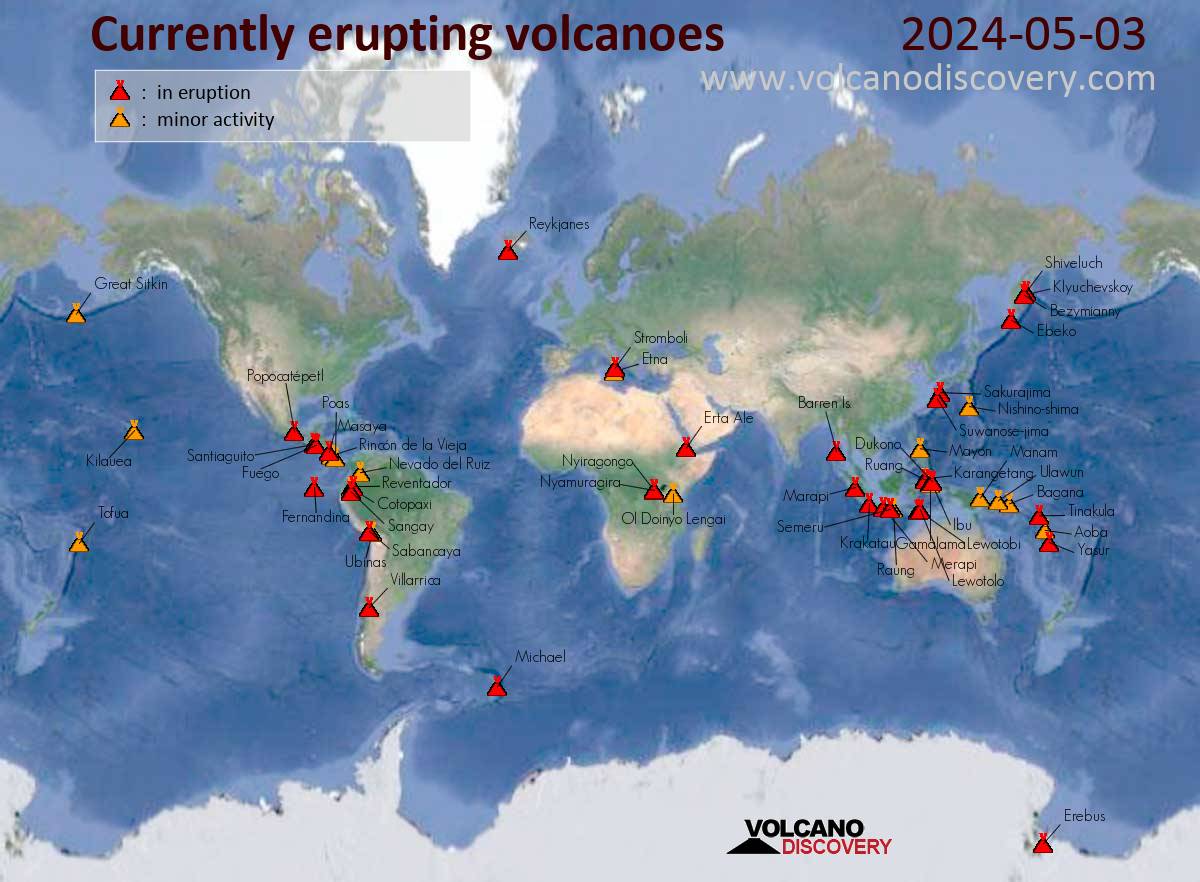
Benevolent extraterrestrials monitoring volcanoes to provide early warning to human partners.
Volcanic activity worldwide 18 October, 2025: Kilauea in Hawaii, Santiaguito volcano, Fuego, Semeru, Ibu, Dukono, Reventador, and soon "all volcanoes that have been active within the memory of man will begin spewing and burping and oozing, and many that were not expected to become active will reactive."
"Of course, all volcanoes will explode, as this is going to be a very severe pole shift. What about the months and years preceding the pole shift? It is no secret that Mammoth Lake and the caldera of Yellowstone are warming up, and the populace has been prepared for these occurrences by the movie Volcano where there, in the middle of LA, lava is bubbling up. In fact, there is a fault line running from the approximate San Diego/LA area, up into the Sierras, and this is liable to rupture rather violently during one of the quakes that precedes the pole shift by some months. Volcanic eruptions from that area in the Sierras can be expected. Will Mount St. Helen erupt? All volcanoes that have been active within the memory of man will begin spewing and burping and oozing, and many that were not expected to become active will reactive." ZetaTalk - Feb 15, 2000
Howard
Sumatra's Sinabung Volcano Unleashes Pyroclastic Flow (Jul 27)
Effusion of viscous lava continues to feed the lava dome with two active lobes on the SE and E upper flanks.
At 12:22 local time today, a part of the eastern lobe collapsed into a pyroclastic flow that traveled approx. 2.5 km towards the outskirts of the already evacuated and destroyed villages of Bekerah and Simacem.
Source
http://www.volcanodiscovery.com/sinabung/news/53876/Sinabung-volcan...
Jul 27, 2015
Howard
Karymsky (Kamchatka): An ash plume from an explosion produced an ash plume that rose to 14,000 ft (4.2 km) altitude and drifted north this morning. The volcano continues to produce intermittent strombolian- to vulcanian-type explosive eruptions.
Chirinkotan (Northern Kuriles): Ash emissions were recorded on satellite imagery on 26 July, producing a plume that rose to 15,000 ft (4.5 km) altitude and drifted NW.
Kirishima (Kyushu): Elevated seismic activity has been recorded since early July, the Japan Meterological Agency (JMA) reported. Yesterday, a phase of volcanic tremor occurred that lasted 3 minutes and a slight ground deformation was detected. Sudden phreatic explosions could occur any time and pose a significant risk if visiting the crater area.
Akan (Hokkaido): A swarm of shallow volcanic earthquakes under the Ponmachineshiri crater of Mt Meakan volcano has been occurring since yesterday.
The swarm follows a gradual increase in seismicity under the volcano noted since April this year.
Raung (East Java): The eruption, now over 4 weeks old, continues with no significant changes. Strong lava effusion inside the summit caldera is accompanied by near-constant ash emissions rising 1-2 km and drifting up to 100-200 km in mostly westerly directions.
Sinabung (Sumatra, Indonesia): A series of pyroclastic flows yesterday noon (see previous post) and this morning destroyed a part of the eastern lava lobe.
... [read more]
Dukono (Halmahera): Strong ash emissions continue at the volcano. VAAC Darwin reported an ash plume extending 25 km north of the volcano yesterday.
Popocatépetl (Central Mexico): The activity at the volcano has remained more or less unchanged over the past months. During the past days, explosive activity has been a bit higher than average. Intermittent explosions occur from the summit crater, where lava domes slowly grow until a series of stronger explosions destroy it and a new one grows.
Source
http://www.volcanodiscovery.com/erupting_volcanoes.html
Jul 30, 2015
Howard
Large Explosive Eruption at Papua New Guinea's Manam Volcano (Jul 31)
VAAC Darwin changed aviation color code to red.
Ash from the Manam eruption has coated a number of towns, including Bogia, on the coast of New Guinea.
This explosion is the largest at the volcano in over 10 years. It seems to be similar to the powerful 24 Oct 2004 explosion.
In a bit of an eerie coincidence, officials from Manam and Bogia just recently settled their discord over the resettlement of over 1,000 volcanic refugee from the 2004 eruption of Manam to Bogia. The refugees from 2004 have yet to find permanent homes after having to leave the island. More than 9,000 were initially evacuated in 2004.
More than 5,000 people still live on the island and are being evacuated to the Madang mainland and will likely be permanently resettled. Two injuries from the eruption have been reported so far as well.
Sources
http://www.volcanodiscovery.com/manam/news/53987/Manam-volcano-Papu...
http://www.wired.com/2015/07/manam-papua-new-guinea-unleashes-large...
Aug 1, 2015
Derrick Johnson
Volcano erupts on Indian Ocean island of Reunion - video
Aug 2, 2015
Howard
Violent Eruptions Continue at Sumatra's Sinabung Volcano (Aug 4)
Heavy ash falls were reported southeast of the volcano, forcing shops to close and people stay indoors.
Source
http://www.volcanodiscovery.com/sinabung/news/54046/Sinabung-volcan...
Aug 5, 2015
Howard
Ongoing Eruption at Java's Raung Volcano Continues to Disrupt Air Travel (Aug 4)
Virgin Australia has cancelled all flights to and from Bali today as volcanic ash from the erupting volcano continues to wreak havoc on airline travel.
“The latest advice from our team of meteorologists and the Volcanic Ash Advisory Centre is that conditions are not suitable for operations into and out of Denpasar Airport today,” the airline said in a statement.
“We have been advised that Mt Raung continues to erupt and winds are blowing in an unfavourable direction, and are forecast to continue to do so for the rest of the day.”
Jetstar has also had to cancel and delay flights to and from Bali again after seriously deteriorating flight conditions.
According to Indonesian press reports, new fissures have been reported and incandescent ejecta were seen to up to a height of 1500 m.
Sources
http://www.volcanodiscovery.com/raung/news/54051/Raung-volcano-East...
http://www.9news.com.au/world/2015/08/05/04/15/flights-in-and-out-o...
http://www.dailymail.co.uk/news/article-3185114/Jetstar-cancels-fli...
http://www.smh.com.au/business/aviation/volcanic-ash-cloud-again-de...
Aug 5, 2015
Howard
Mexico's Colima Volcano Spews Huge Ash Cloud (Aug 3)
Mexico's famous "volcano of fire" spewed an ash cloud two miles (3km) into the sky on Monday.
Source
http://www.independent.co.uk/news/world/americas/colima-volcano-fir...
Aug 5, 2015
Howard
Inactive Geyser Bursts Through New Zealand City Centre (Aug 10)
Parts of a New Zealand city have been closed after an old geyser suddenly burst back into life and started spitting steam and water 15m into the air.
Rotorua city, on the country’s north island, is well-known for its geothermal activity, with many tourists drawn to its unusual boiling mud pools and geysers.
But the old bore that began spraying dirt and gravel onto roofs yesterday provided an unlikely CBD spectacle for tourists.
Video posted to the Rotorua Daily Post shows the geyser gushing up from underneath the ground down a small cobbled lane in front of concerned onlookers.
"Mum, shall I ring 911?" says the man recording the footage. Police were called and shops in the surrounding area were reportedly closed for several hours.
A spokesperson from the local council said the geyser burst through an old bore in the city centre.
"Once the bore has been shut down contractors and staff will have a better idea about why it blew this afternoon," he said.
"The area has been cordoned off for safety reasons and we will have security guards there overnight to ensure public safety."
Sources
http://www.9news.com.au/world/2015/08/10/06/05/15m-geyser-bursts-in...
http://www.stuff.co.nz/waikato-times/70960901/old-rotorua-bore-burs...
http://www.newstalkzb.co.nz/news/emergency/geyser-erupts-in-rotorua...
Aug 10, 2015
M. Difato
Cotopaxi Volcano in Ecuador Erupts after 75 Years - August 14
Reports of falling ash and the smell of sulphur is being reported in nearby Machachi, Ecuador following Cotopaxi volcano eruption.
The last major eruption was in 1940, but since then the Cotopaxi had been quiet. However, in the last few months, Ecuador's volcano monitoring agency - IG-EPN had raised fears that the volcano may go active again as there have been some 100 small earthquakes per day in the region. Signature tremor associated with fluid movement at volcano also was reported.
Ash from Cotopaxi has considerably affected visibility in Quito and other areas. Local residents are wearing masks in the city streets. * Two phreatic eruptions took place at Cotopaxi volcano this morning. A phreatic eruption is a steam eruption without lava ejection. It is a common precursor of volcanic activity.
Volcanologists from the Instituto Geofisico are expected to visit the summit to access the situation.
Locals have been asked by the government officials to use precautions when venturing outside to avoid inhaling ash. No evacuations have been ordered yet. * "We are monitoring the situation closely,"
Ecuador's volcano monitoring agency - IG-EPN. * Locals heard two loud explosions followed by a rain of ash and strong smell of sulphur. *
Cotopaxi is one of the highest active volcanoes in the world and the second highest summit in the country.
Cotopaxi's most violent eruptions in historical times occurred in the years 1744, 1768, and 1877. In the 1877 eruption pyroclastic flows descended all sides of the mountain, with lahars travelling more than 100 km into the Pacific Ocean and western Amazon basin draining the valley.
There was a major eruption in 1903 through 1904, and some minor activity in 1942 as well as 1975 but it did not produce any major events. (via sguisard.astrosurf.com)
Source: http://www.ibtimes.co.in/live-cotopaxi-volcano-ecuador-erupts-after...
https://www.bing.com/images/search?q=cotopaxi+volcano+map&view=...
Aug 14, 2015
Mark
Sakurajima volcano threatens to erupt: Thousands prepare to evacuate as huge blast feared just miles from nuclear reactor
http://www.mirror.co.uk/news/world-news/sakurajima-volcano-threaten...
Japan warned Sakurajima volcano, which is just 50 km (31 miles) from a nuclear reactor is showing signs of increased activity.
The mountain - on the southern island of Kyush - is one of Japan's most active volcanoes and erupts almost constantly.
But a larger than usual eruption could be in the offing, an official at the Japan Meteorological Agency said.
"There is the danger that stones could rain down on areas near the mountain's base, so we are warning residents of those areas to be ready to evacuate if needed," the official added.
The agency also said it had raised the warning level on the peak, 990 km southwest of Tokyo, to an unprecedented 4, for prepare to evacuate, from 3. Roughly 100 people could be affected.
Japan on Tuesday restarted a reactor at the Sendai nuclear plant, some 50 km from Sakurajima. It is the first reactor to be restarted under new safety standards put in place after the 2011 Fukushima disaster.
Aug 17, 2015
Howard
Northwest side of the Indo-Australian Plate feeling pressure lately with buoy 23227 off Sumatra showing undersea displacements as well as Barren Island volcano to the north.
Barren Island, a possession of India in the Andaman Sea about 135 km NE of Port Blair in the Andaman Islands, is the only historically active volcano along the N-S-trending volcanic arc extending between Sumatra and Burma (Myanmar).
Sources
http://www.volcanodiscovery.com/barren-island/news/54298/Barren-Isl...
http://www.ndbc.noaa.gov/station_page.php?station=23227&type=2&...
http://www.ndbc.noaa.gov/
Aug 20, 2015
Derrick Johnson
Mexico's Colima Volcano erupts twice, spewing ash into air
Thursday, August 20, 2015, 4:22 - The Colima Volcano erupted twice on Thursday (August 20) morning, spewing ash and smoke more than 3 kilometres (1.86 miles) into the air.
Located in the southwestern Mexican state of Colima, the Fire Volcano's first eruption occurred at 8:00 am local time (1300 GMT) and the second at 9:20 am (1420 GMT).
The volcano has been exhibiting activity since July 9. Over the last month, nearby villages have been blanketed with thick coats of ash, prompting evacuations.
Officially known as the Colima Volcano, it was previously active in January and February of 2015 and is part of the Pacific's Ring of Fire Mexico contains over 3,000 volcanos but only 14 are considered active.
Major eruptions have included the 1953 eruption of the Paricutin Volcano in Michoacan, the 1982 eruption of Tacana Volcano in Chiapas and the 1986 eruption of the Colima Volcano.
The Colima Volcano has erupted more than 40 times since the 16th century and local authorities have an emergency plan that includes continuous observation of the volcano and mandatory evacuations, if needed.
Source: http://www.theweathernetwork.com/us/news/articles/extreme-weather/m...
Aug 22, 2015
Howard
Increasing Activity at Ecuador's Cotopaxi Volcano (Aug 22)
Ash fall occurred in several populated areas including Mulalo, Chaupi, Lasso, Machachi, Aloag, Tambillo.
According to Ministry of Security, evacuation routes and over 120 "albergues" - shelters - have been prepared to accommodate evacuees.
On August 21, the volcano’s penetrating sulfurous gases burned the nose and throat of Marco Toctauano, 32, as he chased his sheep down the mountain.
The surgical mask shielding his nose and mouth was of little help little. The crater is less than 2 miles away.
“We have cattle up on the mountainside. There’s no more we can do,” he said. “With the ash, they’re suffocating and could be dying. We’re pretty bad, too.”
Toctauano figures he’s lost 17 or 18 head of cattle worth a total of some $7,500. A lot more could be lost if Cotopaxi were to blow.
All but a quarter of Ticatitlin’s 200 residents have evacuated. Those who remain are mostly elderly, like 84-year-old Adelaida Iza. She is more or less resigned to fate, noting as she cut alfalfa for her animals.
“If the volcano blows, we’re dead.”
Sources
http://www.volcanodiscovery.com/cotopaxi/activity/aug2015-eruption....
http://globalnews.ca/news/2180386/few-linger-in-shadow-of-ecuadors-...
Aug 24, 2015
M. Difato
Piton de la Fournaise Volcano erupts on Reunion Island
http://www.ibtimes.co.in/piton-de-la-fournaise-volcano-erupts-on-re...
The Piton de la Fournaise volcano on Reunion Island erupted on 24 August, prompting tourists and locals to endure the cold night to watch molten lava erupt from the crater. This was the fourth eruption this year for the Piton de la Fournaise, one of the most active volcanos in the world.
The previous eruption happened on 31 July while Reunion Island was in the spotlight as beach cleaners found a piece of plane wing believed to have come from missing Malaysia Airlines flight MH370.
The Piton de la Fournaise volcano erupted at 6.50pm local time, after an increase of its seismic activity during the entire day, local authorities said in a written press release. The eruption was visible from Piton de Bert located at 2000m and not accessible by car, but reachable after a one hour walk.
Local hikers and tourists eager to watch the volcano in action ventured on the path at night with their headlamps, hiking shoes, cameras and a temperature of about zero degrees. This is the first eruption of my life, this is the first time I come here, it has been all about first times in the last 24 hours, said Francoise, a tourist from Clermont-Ferrand, in Mainland France.
If some of the tourists on the site saw a volcanic eruption for the first time, others were regular watchers of eruptions, such as Romain, who is originally from Mainland France, but has moved to la Reunion Island in 2014.
It is so wonderful that I am always ready. You put your sport shoes on and you go directly there. It is too beautiful; there is nothing more beautiful than that. It makes some nice souvenirs pictures, Romain, who hasnt missed an eruption in 2015, said.
Hikers stayed watching the volcanos lights, red smoke and lava all night. The road leading to the path to reach the view spot was particularly busy all night, with many cars queuing. As cars proceeded slowly towards the beginning of the path, local policemen were busy managing the traffic.
Our experience during the last eruptions – those of end of July and May – shows that we can see some 2500 cars per day, between eight and midnight, local police captain Tanguy Madec said.
Aug 25, 2015
M. Difato
Mount Lokon erupts on August 28, 2015
Mount Lokon in Tomohon, North Sulawesi, erupted on 11:49 p.m. local time on Saturday and spewed volcanic ash from its Tompaluan Crater, which reached several areas of Manado city.
Local residents reported that Mt. Lokon spewed a column of ash around 1,500 meters high, which spread in a northern and northeastern direction away from the volcano.
“Winds have pushed the volcanic ash areas, starting from Manado to North Minahasa. The ash is covering our houses. We have to get masks,” said Amanda, a Winangun resident, on Sunday.
Kompas.com reported that Saturday’s eruption had caused flight delays at Sam Ratulangi Airport in Manado as thick volcanic ash covered its runways.
At least three flights that should have departed for Balikpapan (East Kalimantan), Jakarta and Surabaya (East Java) on 6 a.m. local time on Sunday had to be rescheduled.
Authorities said they delayed their departures because of the poor condition of the airport’s runways.
There have been no reports of fatalities or injuries during the eruption. Lokon is one of active volcanoes in North Sulawesi that has frequent eruptions. Lokon last erupted in May. (ebf)
Source: http://www.thejakartapost.com/news/2015/08/30/mount-lokon-erupts.html
Aug 30, 2015
Mark
Flurry of activity at Kilauea Volcano last week on Hawaii Island
http://www.hawaiimagazine.com/content/flurry-activity-kilauea-volca...
Readers may recall the Puu Oo cone from its June 27, 2014 flow that sent lava northeast from its crater and oozing toward subdivisions, roads and even homes late last year.
The new Puu Oo cone breakout occurred off of a lava tube supplying distant and ongoing flows. The activity died on the same day, after traveling about 1,640 feet. Lava is still being supplied to a forested area northeast of the crater, but is not near structures and remains within about five miles northeast of the Puu Oo crater. The portion of the lava flow that edged close and threatened residential communities stopped receiving fresh lava in early March.
According to the USGS’s Hawaiian Volcano Observatory’s (HVO) daily updates, none of Kilauea’s lava flows or breakouts from existing flows currently pose a threat to area communities. However, it is unknown how breakout activity—like the one that occurred on Thursday—might impact “the vigor of the distant flows to the northeast,” reports HVO.
Beginning on Friday, Kilauea’s summit experienced some inflation and deflation—an indication that magma below the surface is moving—and seismic tremors have caused some spattering on the summit lava lake, sometimes visible on Hawaii Volcanoes National Park webcams [see below for links].
Sep 5, 2015
Howard
Large Ash Plume at Sumatra's Mt Sinabung (Sep 15)
The associated ash plume rose to 18,000 ft (5.4 km) altitude.
During the past months, Sinabung has continued to extrude viscous lava that accumulates at its top in the form of a dome with lobes on the upper slopes.
When parts of these unstable features collapse, they generate avalanches of hot gas and rock that can reach speeds of 700 km/h (450 mph) and temperatures up to 1,000 °C (1,830 °F).
Source
http://www.volcanodiscovery.com/sinabung/news/54599/Sinabung-volcan...
Sep 15, 2015
Mark
Mauna Loa recent volcanic activity could pave the way for an eruption
http://www.dailytimesgazette.com/mauna-loa-recent-volcanic-activity...
As per West Hawaii Today, the USGS had reported that the volcano had been displaying “signs of unrest” since Sept. 17, 2015, paving the way for the change in alert levels from normal to advisory.
Frank Trusdell, a geologist, said that. “It doesn’t mean an eruption is imminent, but it’s a reminder to the residents of Hawaii, that Mauna Loa is still an active volcano.”
Mauna Loa, which last erupted in 1984, has been observed with an increase in seismic activity, prompting officials to issue warning to residents.
10 earthquakes every week is common for the area, but as of late more than 40 earthquakes were registered per week have been registered by the Hawaiian Volcano Observatory (HVO).
Sep 20, 2015
jorge namour
Strong activity Telica volcan / Nicaragua
Wednesday September 23, 2015
http://www.el19digital.com/articulos/ver/titulo:33841-fuerte-activi...
https://translate.google.es/translate?sl=es&tl=en&js=y&...
https://www.youtube.com/watch?v=_66OtNhpl14
The Telica volcano in western Nicaragua , expelled a large amount of gas and ash Wednesday morning.
From about 8 am, the colossus began to emanate a huge column that could be seen from several kilometers.
As a result of this strong activity, ashfall was reported in communities like Los Angeles and Quezalguaque.
political secretary in the department of León, reported that already activated the Municipal Committee for the Prevention and Attention to Disasters (COMUPRED) to address the effects on families by falling ash in the already cited communities. CONTINUE...
MAP; https://en.wikipedia.org/wiki/Telica_%28volcano%29
Sep 24, 2015
Howard
Residents Warned of Falling Debris from Mexico's Colima Volcano (Sep 24)
The Colima Volcano continues to be active, sending a 1,500-meter column of smoke skyward at 7:08 this morning.
Civil Protection’s national coordinator, Luis Felipe Puente Espinosa, reported the eruption on his Twitter account, advising that the smoke, with a low ash content, was moving southwest.
The ash expelled by the volcano consists of material less than two millimeters in diameter and moves with the wind. But rock projectiles from the Volcano of Fire, as it is also known, are a different matter.
They can be up to 50 millimeters in diameter and are sent shooting out of the crater at high speed, before falling to the ground. This volcanic material can cause damage and injuries in populated areas, particularly if they are hot, which can result in fires.
The falling pieces of rock can be a danger within a five-kilometer radius of the volcano.
Puente Espinosa issued a call to residents near the volcano to stay informed about the volcano’s activity. It has been active since early July, when ash falls were severe enough to require the evacuation of 700 people from nearby communities. The volcano straddles the border between Colima and Jalisco.
Sources
http://mexiconewsdaily.com/news/more-activity-seen-at-the-colima-vo...
http://media.watoday.com.au/featured/timelapse-of-mexican-volcano-6...
Sep 25, 2015
Howard
Increased Explosions at Nicaragua's Telica Volcano (Sep 26)
A series of 5 moderately strong explosions lasted half an hour. It produced dense ash plumes and ejected blocks to up to 500 m distance.
"Five explosions of medium intensity accompanied by a volcanic tremor were registered," said First Lady Rosario Murillo, citing reports by the Nicaraguan Institute of Earth Studies.
Murillo, who is the government's chief spokesperson, said the activity had raised concerns that a volcanic eruption may be in the offing. "We had 25 minutes of anomalous activity," she said, adding that experts were closely monitoring the activity.
Earlier this week, the volcano sent up dense columns of ash after a series of explosions and produced ash plumes that rose to approximately 500 meters. Ash fell up to 30 km west of the volcano in the department of Chinandega.
Telica, which is 1,060 meters (3,478 feet) high, is located some 150 kilometres (93 miles) northwest of the capital Managua.
Sources
http://www.channelnewsasia.com/news/world/nicaraguan-volcano/215328...
http://www.volcanodiscovery.com/telica/news/54675/Telica-volcano-Ni...
http://www.volcanodiscovery.com/telica/news/54692/Telica-volcano-Ni...
Sep 27, 2015
Howard
Eruptions Increasing at Peru's Ubinas Volcano (Sep 29)
Authorities have issued an ash alert for towns and communities surrounding the volcano.
On Sunday, Ubinas volcano registered a large explosion lasting 59 seconds and sending a large amount of ash 3,600 feet above the base of the crater,
“In the last six days, OVS stations reported an increased number of earthquakes of the volcano-tectonic type, but with low energy. This activity is associated just to the variation in the internal pressure in the mountains,” said Orlando Macedo, director of the South Volcano Observatory (OVS).
The OVS report said that the emission of ash was recorded for about 37 minutes. The wind blew the current toward the east of the volcano.
It is estimated the eruption emitted an energy of 5 Megajoules (MJ). OVS experts don’t doubt that new mild or moderate exhalations will occur in the upcoming days.
Prior to Sunday's eruption, the last strong eruption occurred Sept. 21 and caused a plume of ash that reached 1,500 meters above the crater and then scattered in a radius of 10 kilometers.
Sources
http://www.belfasttelegraph.co.uk/video-news/world/video-perus-ubin...
http://www.peruthisweek.com/news-ubinas-volcano-registers-new-explo...
http://www.peruthisweek.com/news-new-ubinas-volcano-explosion-affec...
Sep 30, 2015
Howard
Large Pyroclastic Flows at Guatemala's Santa Maria Volcano (Sep 29)
The National Institute of Seismology, Volcanology, Meteorology and Hydrology (Insivumeh) and the National Coordinator for Disaster Reduction (CONRED) report that Santiaguito volcano is in a phase of high activity.
So far no community near the volcano is being affected.
Sources
http://www.soy502.com/articulo/volcan-santiaguito-encuentra-activo-...
http://www.volcanodiscovery.com/guatemala/santiaguito/news/54715/Sa...
Oct 3, 2015
Howard
Active Undersea Volcano Discovered off Alaska (Sep 23)
About two years ago, geologists studying an ocean channel near Ketchikan spotted something unusual. It was a submerged volcano, about 150 feet below the surface.
It was dormant. The experts estimated it hadn’t erupted for about 10,000 years.
Now, scientists have discovered another underwater volcano, near Dixon Entrance, just north of Alaska’s maritime border with British Columbia.
“Nothing like that had been mapped in the area before, so we knew then that we had discovered something new,” said Gary Greene, a marine geologist working with the Sitka Sound Science Center.
He and a Canadian counterpart found the volcano Sept. 23 during a study of the Queen Charlotte-Fairweather Fault System. That’s been the epicenter of some recent earthquakes.
“We had just completed some survey work and we modified our line to go to another place to look. And as we were transiting, we came across this big plume and this big cone where the plume was coming out of,” he said.
The plume, made up of methane gas, was being released by a volcanic vent about 3,000 feet below. It stretched up about two-thirds of the way to the ocean’s surface.
But Greene said there was no fresh lava — or anything else to worry about.
“We worked over the vent, right over the vent. And we’re still around to tell about it. So I think it’s probably OK for mariners,” he said.
He said the discovery sheds light on the workings of the Queen Charlotte-Fairweather Fault System, which is offshore British Columbia and Southeast Alaska.
It’s where a huge, moving chunk of the Earth’s crust, called the Pacific Plate, rubs up against the North American Plate.
“It means that this fault acts as a conduit to deeper in the Earth to places where either magma or fluids that are heated by magma or geothermally heated at depth can migrate up through the fault to the surface,” he said.
Tory O’Connell, research director for the Sitka Sound Science Center, said the research is providing “really important new information about earthquake hazards in our area.”
“It’s also helping direct future research that will help define the significance of understanding the fluidity of that fault,” she said.
Lava and other volcanic fluids lubricate faults, lessening the chance of sudden movement. But that can increase pressure on other areas along the fault, forcing them to jerk forward, causing earthquakes.
Greene said the new volcano was found as scientists investigated another underwater hazard.
“This is an area that had had indications that there were failures occurring on the slope here. And large failures, that is, large landslides that may general tsunamis,” he said.
The new volcano is not alone. Greene said the study found others nearby, but none were active.
Several other venting volcanos have been found along the fault in recent years off the shores of British Columbia.
The Queen Charlotte-Fairweather Fault study took place Sept. 15-23 on board a Canadian Coast Guard ship, the John P. Tully. It included Greene, Vaughn Barrie of the Geological Survey of Canada and other scientists and technicians from the Geological Survey of Canada and the U.S. Geological Survey. Funding for Greene’s work came from the U.S. Geological Survey, through the Sitka Sound Science Center.
Source
http://www.alaskapublic.org/2015/10/02/active-underwater-volcano-fo...
Oct 3, 2015
Howard
Ecuador Volcano Spews Giant Ash Columns (Oct 8)
The country's Geophysics Institute says Cotopaxi shot out a plume more than a mile (2 kilometers) high on Wednesday, and an impressive new emission burst from the volcano on Thursday. And it says incandescent material has been seen in the crater.
The giant ash column was visible from Quito, 45km to the north of the volcano, considered one of the world's most dangerous because its snow cap is vulnerable in an eruption and because of its close proximity to densely populated areas.
Ecuador's security coordination ministry said ash rose 2 000m above the volcano's crater, and warned some could fall on Quito's southern neighbourhoods.
The government declared a state of emergency in August after the volcano roared to life and has been conducting evacuation drills among the population.
An estimated 325 000 people could be affected if the eruption triggers mudslides and avalanches, according to the authorities.
The 19,347-foot (5,897-meter) volcano is just about 30 miles (50 kilometers) from Ecuador's capital of Quito and a sizable eruption could affect tens of thousands of people. The last large eruption was in 1877.
Sources
http://www.news24.com/Green/News/Ecuador-volcano-spews-giant-ash-co...
http://www.foxnews.com/world/2015/10/08/new-bursts-ash-and-gas-rise...
Oct 9, 2015
Howard
Strong Activity at Guatemala's Fuego Volcano (Oct 8)
A volcano near the Guatemalan capital roared back to life on Wednesday, spewing ash high into the air.
Pulsating lava fountains from two summit vents also fed two lava flows that descended the southern and western flanks of the volcano through the Trinidad and Santa Teresa canyon, reaching 1000 and 600 m, respectively.
The Fuego volcano, which is just 50 kilometers (30 miles) from Guatemala City and its population of one million people, coughed out gas and ash 4,800 meters (16,000 feet) above sea level.
Despite at least two lava flows, Alejandro Maldonado, secretary of the disaster reduction office CONRAD, said the so-called "Fire Volcano" was not yet sufficiently dangerous to justify the evacuation of nearby villages.
The activity so far has not resulted in the generation of the much-feared pyroclastic flows, but remains intense and could trigger such flows, if parts of the lava flows on the steep flanks collapse.
Experts say the volcano -- one of the most active in Central America -- may become increasingly violent in the coming hours and could affect air traffic.
In February, a powerful eruption at Fuego forced authorities to declare an alert and close the airport in the capital.
Sources
http://www.volcanodiscovery.com/fuego/news/54819/Fuego-volcano-Guat...
http://news.yahoo.com/guatemala-volcano-roars-back-life-214146249.html
Oct 9, 2015
Howard
Strong Explosions at Colima Volcano (Oct 5)
Along with the ash cloud and gas, the volcano expelled pyroclastic flows that travelled hundreds of metres down the slope. The day before, a spectacular explosion was recorded at 6.29pm, sending clouds of ash and smoke 2,500m above the crater.
Located in the south-western Mexican state of Colima, the Fire Volcano has been exhibiting activity since 9 July. Over the past two months, nearby villages have been blanketed with thick coats of ash, prompting evacuations.
Source
http://www.ibtimes.co.uk/mexico-colima-volcano-erupts-again-spewing...
Oct 9, 2015
Derrick Johnson
Second volcano spews ash near Ecuador's capital
Published Monday, October 12, 2015 1:57PM EDT
QUITO, Ecuador - A second volcano is once again spewing plumes of ash in the mountain chain near Ecuador's capital.
The country's Geophysics Institute says the Tungurahua volcano shot out several bursts of gas and ash over the weekend, with one reaching about 2 kilometres above 5,023-metre summit. It also hurled incandescent rock onto its slope.
The Cotopaxi volcano closer to the capital was relatively calm Monday after several outbursts in recent days. It shot ash and gas about 2.5 kilometres above its crater on Sunday.
It poses a greater threat to populated areas, standing about 50 kilometres southeast of Quito. Tungurahua is 140 kilometres south of the capital.
Source: http://www.ctvnews.ca/sci-tech/second-volcano-spews-ash-near-ecuado...
Oct 13, 2015
Howard
Volcanoes Erupt in Mexico and Peru (Oct 21)
Winds then sent the cloud of ash 10 kilometers to the northeast and east of the crater.
The cloud affected the districts of Querapi, Ubinas and Escacha.
Mexico's National Centre for Disaster Prevention (Cenapred) reported that a total of 42 exhalations were reported that day.
Sources
http://www.peruthisweek.com/news-ubinas-volcano-erupts-emitting-ash...
http://www.ibtimes.co.in/mexico-rumbling-popocatepetl-volcano-erupt...
Oct 22, 2015
Howard
Volcanoes Erupt in Russia and Indonesia (Oct 22)
Shiveluch Volcano on Russia's Far Eastern Kamchatka Peninsula erupted this morning.
"Seismic stations nearby Shiveluch have registered that the giant volcano sent a plume of ash up to six kilometres into the sky today [October 22]," a spokesperson for the Kamchatka branch of the Russian Academy of Sciences' Geophysical Service told TASS on Thursday.
Earlier, TASS cited the Klyuchevskaya volcano observatory of the Far Eastern branch of the Russian Academy of Sciences as saying that Shiveluch had been demonstrating increased activity in recent days as fire avalanches were going from the lava dome down up to 0.5-1km along the volcano slopes towards the Baidarnaya and Bekesh rivers.
Sources
http://tass.ru/en/society/830786
http://www.volcanodiscovery.com/batu-tara/news/55008/Batu-Tara-volc...
Oct 22, 2015
Derrick Johnson
Rinjani volcano (Lombok Island, Indonesia): small eruption reported this morning
No significant seismic activity seems to have accompanied the explosion. The ash emission was too small to be detected on satellite data. The aviation alert level of the volcano was raised to Orange (VAAC Darwin).
Oct 26, 2015
Howard
Volcanic Activity Summary (Oct 26)
Aso (Kyushu): While the volcano continues to degas strongly and has intermittent, mostly small ash emissions, a stronger explosion occurred again early on 23 Oct around 6 am local time. An ash plume rose approx. 1.5 km above the Nakadake crater and dissipated quickly. Alert level remains at 3 out of 5, and an exclusion zone of 2 km around the crater is in place.
Bagana (Bougainville Island, Papua New Guinea): Ash emissions occurred from the volcano yesterday, suggesting ongoing mild explosive activity. VAAC Darwin reported a low-level plume extending 50 km northwest from Bagana.
Batu Tara (Sunda Islands, Indonesia): A volcanic ash plume at 5,000 ft (1.5 km) altitude extending 80 km west of the volcano was reported by VAAC Darwin this morning.
Soputan (North Sulawesi, Indonesia): The volcano is calm at the surface, but seismic activity shows it is at unrest and might erupt again soon. Deep volcanic quakes (5-10 km depth) and shallow tremors has been more frequent (10 -15 times per day) since 3 oct - 22 October. This suggests there is probably magma raising up slowly, but there are still no glowing spots visible.
Dukono (Halmahera): The volcano continues to erupt continuous, loud, roaring jets of gas and small amounts of spatter from vents at the bottom of the deep crater.
Ash plumes are regularly being reported by VAAC Darwin.
Turrialba (Costa Rica): After several months of relative calm, the volcano began to erupt ash plumes again since 23 Oct. Some of the explosions have been relatively strong and caused very small pyroclastic flows limited to the crater area. The origin of these emissions are likely phreatic explosions, i.e. caused by overheated ground water flashing to steam. Whether this is the case or at least some fresh magma is involved is unclear. Seismic activity, which could suggest the rise of new magma, has been reported to have picked up recently.
Cotopaxi (Ecuador): No significant changes have occurred during the past days. The activity remains characterized by intense degassing and occasional mild ash emissions mixed into the plume.
Tungurahua (Ecuador): Mild to moderate ash emissions, with ash plumes rising 1-2 km above the crater, have become more frequent over the past days, suggesting the volcano's activity has started to picking up. An explosion at 04:33 yesterday morning was seen ejecting incandescent material that rolled down the western flank to up to 1 km distance.
Light ash fall occurred later in Chacauco, Cotaló and Manzano. The ash was reported to be black and red in color and sugary in grain size. The first (color) suggest that it is from new magma (as opposed to typically gray-brown colored ash from pulverized older rock). The volcano observatory also reported an increase in seismic activity associated with fluid movements. One possibility is that the volcano (after all, one of the world's most active ones) enters a more vigorous phase of activity in the near future, as often occurred in the past.
Source
http://www.volcanodiscovery.com/volcano-activity/news/55101/Volcani...
Oct 26, 2015
Derrick Johnson
Costa Rican Volcano Spews Ash; Latest in a Continuing Series of Eruptions
Costa Rica's Turrialba volcano released a column of gas and ash into the sky on Tuesday in the latest of a series of eruptions at the site in central Costa Rica.
The eruption, which occurred at about 8:30 Tuesday morning, is a continuation of a series of eruptions which have been generated since the end of the week, geologist Floribet Vega told the International Business Times.
“Today's [eruption] was a little bit stronger, not extremely bigger that it sent ash to the central valley, but it's a little bigger than what we have seen,” she said.
Costa Rica’s National Emergency Commission told QCostaRica.com that the volcano was especially active over the preceding weekend, with at least 26 eruptions accompanied by seismicity.
The Turrialba Volcano National Park, about an hour’s drive from the capital in San Jose, has been shut since 2009 due to the increased activity at the site, the IBT reports.
Although significant emissions of ash have been reported at the volcano in recent years, magma has rarely been observed at Turrialba's crater.
"When there is a magmatic eruption, we're not going to find that a high proportion of material has been moved around,” said volcanologist Geoffroy Avard. “We're going to find a majority of material which is fresh and young and very little material which has been moving around. So the proportion is going to be the opposite of what we have today.”
Source: http://www.weather.com/science/nature/news/costa-rica-volcano-spews...
Oct 29, 2015
Derrick Johnson
An Unexpected Eruption From Chile’s Lascar Volcano
Due to this minor eruption, the SERNAGEOMIN has raised the alert status at Lascar to Yellow, although the volcano is in a fairly remote part of the Chilean Andes—the Global Volcanism Program reports only ~8,100 people living within 100 kilometers (62 miles) of Lascar.
It has been over 2 years since Lascar last did anything and its last major eruption of Lascar was in 2005. However, it has produced some spectacular eruptions in the recent past, including the 1993 eruption that was a VEI 4. As with any of these small blasts, volcanologists will watch Lascar to see if this is a sign that it is awakening or merely a blip. Based on images on the Lascar webcam, the eruption appears to have waned rapidly (see below).
The SERNAGEOMIN maintains two webcams pointed at Lascar, although only one is running right now.
Sources: http://www.wired.com/2015/10/unexpected-eruption-from-chiles-lascar/
http://www.volcanodiscovery.com/chile/lascar/news/55130/Lascar-volc...
Oct 31, 2015
Howard
Flights to Bali Canceled by Volcanic Eruption (Nov 3)
By Wednesday, that had resulted in the cancellation of 692 flights, both domestic and international, leaving many travelers stuck on the island or unable to reach it.
Two other airports in the region -- one on Lombok and the other in Banyuwangi in East Java -- have also been closed for the same period as Denpasar, Barata said.
Days after the Indonesian island volcano Mount Rinjani erupted, the blast has deterred travel to and from the area for many people, pro golfers included. Jessica Korda, Beatriz Recari, Azahara Munoz and So Yeong Ryu were all stuck on Bali, a nearby island, as ash, smoke and debris left the surrounding area unsafe for air travel.
The eruption has intensified considerably over the past few days. Activity takes place from a lateral vent on the Barujari cone inside the volcano's caldera, producing continuous ash emissions and feeding a new viscous lava flow. The lava flow has been advancing more than 500 m in two lobes towards the NE.
This current more intense phase of the eruption seems ot have started in the early afternoon of 2 Nov, when ash emissions became large enough to produce a plume that drifted westwards and reached Bali, where the airport of Denpasar was shut down. The plume was almost 400 km long this morning and the shut-down of the airport has been causing significant flight disruptions. When it can be reopened will depend on whether ash emissions continue and the prevailing wind direction in the coming days.
On Lombok island itself, the rumblings from the eruptions are heard in many areas. Access to the summit area of Rinjani has been closed and a 3 km exclusion zone around the caldera rim is in place. Several villages on Lombok reported ash falls.
Sources
http://www.wpbf.com/money/travel/hundreds-of-bali-flights-canceled-...
http://www.golfdigest.com/story/lpga-pros-wd-from-japan-event-after...
http://www.watoday.com.au/wa-news/jetstar-virgin-australia-cancels-...
http://www.volcanodiscovery.com/rinjani/news/55144/Rinjani-volcano-...
http://www.smh.com.au/business/aviation/virgin-and-jetstar-cancel-b...
http://www.volcanodiscovery.com/rinjani/news/55174/Rinjani-volcano-...
Nov 3, 2015
Howard
Peru's Ubinas Volcano Erupts Again (Nov 5)
The Volcanological Observatory of the Institute of Geological Mining and Metallurgy (Ingemmet) reported that the eruption has sent ashes over Querapi, Ubinas, Escacha, Tonohaya, Sacohaya and San Miguel villages.
The explosion was recorded at 12:15 p.m. today and emitted a moderate plume of ashes and gases that reached about 2,000 meters above the crater of Ubinas volcano.
The ashes dispersed over a distance of 10 kilometers to the southeast toward the mentioned villages.
About 600 families live near Ubinas volcano within a radius of 12 kilometers. In situations such as these, authorities advise that locals protect themselves with masks and goggles and guard water supplies from contamination.
Source
http://www.peruthisweek.com/news-ubinas-volcano-registers-new-erupt...
Nov 6, 2015
Mark
Guatemala issues orange alert over erupting Fuego Volcano
http://tribune.com.pk/story/989179/guatemala-issues-orange-alert-ov...
The 12,346-foot high colossus, whose name means “fire” in Spanish , showed heightened activity overnight, sending columns of ash high into the sky, spilling lava down its side and provoking small tremors.
Fine ash was falling on at least six villages and on the town of San Pedro Yepocapa, in the indigenous province of Chimaltenango, a state spokesman for the Disaster Reduction National Coordination Committee, David de Leon, told reporters.
The country’s Seismology and Vulcanology Institute urged authorities to consider taking precautionary measures for air traffic.
Nov 12, 2015
jorge namour
Etna, the expert: "impressive increase in outgassing" [LIVE PHOTOS]
SICILY- ITALY
November 12, 2015
https://translate.google.com/translate?sl=it&tl=en&js=y&...
"Impressive increase in outgassing from the New Southeast Crater accompanied by high amplitude of volcanic tremor, November 12, 2015 - clear signs that Etna is desperately
trying to resuscitate his youngest son.
------------------------------------------------------------------------------
https://www.facebook.com/OficialSismologiaMundial/photos/a.80614832...
Volcán Laguna Del Maule-Chile. 12/11/2015.
World Seismology
#Now SERNAGEOMIN Report seismic swarm in Laguna del Maule Chile Volcano. 12/11/2015.
⚠
.
In the recent report it was published in 30 minutes were recorded 45 earthquakes with local magnitude VT Maxima 1.6 Located 9.7 km SW of the center of the lagoon, with a depth of 2.6 km
It is located in the Cordillera de Los Andes
------------------------------------------------------------------------------------------
Offshore mud volcano erupts in Sea of Azov (VIDEO)
Published time: 27 Oct, 2015
https://www.rt.com/news/319795-mud-volcano-azov-sea/
An abandoned autumn beach looking out on the Sea of Azov became a popular sightseeing attraction over the weekend, after mother nature created an incredible mud volcano, which formed a wide, flat island just a few dozen meters away from the shore.
Spewing a slurry made of water and gases mixed with sand and dirt, the mud volcano shot several meters into the air as it started forming an artificial island on Sunday, just off the coast of the Taman Peninsula.
The act of nature was recorded by local beach strollers who witnessed the mud volcano, most typically formed after hot water below the earth's surface begins to blend with mineral deposits, pushing the mixture to the surface. But unlike an actual volcano, the muddy imitation produces no lava.
MAP: https://en.wikipedia.org/wiki/Sea_of_Azov
Nov 13, 2015
Howard
Flights Out Of Bali Still Limited As Volcano Continues To Spew Ash (Nov 15)
Thousands of tourists were stranded on three Indonesian islands after ash from an erupting volcano forced the closure of airports and blanketed villages and farmlands.
Mount Rinjani on Lombok Island blasted ash and debris roughly 3,500 metres into the air on Wednesday, said Sutopo Purwo Nugroho, the National Disaster Mitigation Agency spokesman.
Airlines Virgin Australia and Jetstar have been taking people home with recovery flights. All flights had to be cancelled the whole weekend of Nov. 14 and 15 due to another bout of ash cloud emission. Virgin Australia has already stated that its priority is bringing Aussies home from Bali rather than risk more people going into the holiday destination.
"As Mt Rinjani continues to erupt and flying conditions remain unpredictable in the days to come, our priority is to bring guests home from Bali, rather than fly more guests in who could potentially be delayed in returning home due to ongoing eruptions," Virgin Australia said in a statement.
Likewise, Jetstar also made an announcement of the airlines' flight activities in their website. "All flights on Sunday, 15 November from Australia to Bali have been cancelled... The movement of the ash cloud is highly unpredictable and flights are subject to change based on assessment of safety to fly and local approvals from airport authorities," it announced.
Sources
http://www.techtimes.com/articles/106759/20151115/flights-out-of-ba...
http://www.cbc.ca/news/world/indonesia-volcano-bali-airport-1.3303168
Nov 16, 2015
Mark
Indonesia's Mt Sinabung volcano erupts again
http://news.asiaone.com/news/asia/indonesias-mt-sinabung-volcano-er...
No casualties were reported following the eruption, but pyroclastic flows drifting to the southeast affected a number of villages that have long been abandoned by residents.
"The current wind direction is directed to the southwest, but if it blows to the east the Lake Toba Festival will be disrupted as the spread of ash would reach Berastagi," Mt. Sinabung Observation Station staff member Deri Hidayat told The Jakarta Post.
Deri said the volcano discharged the clouds at 1:47 a.m. and 9:28 a.m.
He added the pyroclastic clouds, which drifted as far as 3.5 kilometers, affected Bekerah and Simacem villages.
He said both villages had long been left empty as they were inside a designated danger zone.
Deri added that Mt. Sinabung had also emitted volcanic ash to a height of 2,000 meters toward the southwest. He said the spread of ash could disrupt the Lake Toba Festival if the wind changed direction in coming days.
He said volcanic activity could increase within the week, adding that the volcano could discharge a bigger volume of pyroclastic flows and ash.
"The biggest eruption took place on Tuesday, when the volcano discharged pyroclastic clouds 13 times, compared to only twice today," said Deri.
According to him, the potential for pyroclastic flows remained great due to a lava dome buildup on the southeastern section of the peak.
Deri said the lava dome could collapse anytime and trigger huge pyroclastic flows.
Consequently, added Deri, his office had recommended that the regional administration evacuate human settlements within the danger zone.
Since an eruption in September 2013, volcanic activity at Mt. Sinabung has never entirely ceased. Thousands of residents moved away at that time, only returning home last month after the volcano showed decreased activity.
The eruptions have killed at least 17 people and destroyed thousands of houses and hectares of farmland.
Nov 20, 2015
Howard
Ecuador's Tungurahua Volcano Buries Locals With Ash (Nov 19)
Residents from communities near Ecuadors Tungurahua volcano faced a massive cleaning operation after the volcano erupted, covering houses and fields with smoke and ash.
Authorities issued an orange alert as emissions reached 2,500 metres above the crater.
In nearby Queros, one of the most affected communities, officials registered 10kg of ash per square metre.
As he swept the street near his house, resident Luis Vaca said the volcanic material was damaging crops. Ash is falling everywhere; its strong, especially in the countryside where its falling more heavily. Its damaging the crops. It would be good if the president came to visit us, he said.
Volcanologist Patricia Mothes confirmed that eruptions have been substantial. These accumulations of ash that have been falling are the greatest masses of ash that we've registered in the past five years, she said.
Most residents are staying off the streets to avoid breathing in the ash while schools in the provincial capital of Ambato, have been closed.
Sources
http://www.ibtimes.co.in/ecuador-tungurahua-volcano-erupts-covering...
http://phys.org/news/2015-11-ecuador-volcanic-ash-falls-dozens.html
http://www.plenglish.com/index.php?option=com_content&task=view...
Nov 21, 2015
Mark
The island that came out of nowhere: Incredible images reveals how volcanic island of Nishinoshima has become TWELVE times bigger since if first erupted from the Earth just two years ago
http://www.dailymail.co.uk/sciencetech/article-3332607/Volcanic-isl...
The tiny islet first surfaced in November 2013, next to the island Nishinoshima, and kept growing until the two merged into one.
Today, the Japanese Coast Guard has revealed the volcanic island has now grown 12 times its initial size.
The new Nishinoshima now measures 1,900 meters east to west, about 1,950 meters north to south and more than 100 meters tall, the Japanese Coast Guard told Japan Today
Eruptions from the volcano keeps adding land, and scientists believe this activity won't fizzle out anytime soon.
On a recent aerial survey of the island, the Coast Guard observed a 1,200-meter plume of smoke stemming from the eruption as well as volcanic rock spouting from the volcano several times per minute.
Initially, scientists were unsure how long it would last because volcanic islets of that type tend to be reclaimed by the sea after a short time.
Its also been years since this volcano has seen any action, as the last major eruption took place just a little less than 60 years ago, from 1973 to 1974.
Scientists view this island as a rare opportunity to study how life begins to colonize barren land.
Nov 25, 2015
Howard
Summary of this week's volcanic activity.
Philippines Kanlaon Volcano Spews Steam (Nov 29)
In its bulletin, Phivolcs said the smoke plume reached 50 meters above the summit.
Alert Level 1 is still hoisted over Kanlaon Volcano due to threat of phreatic eruptions, prohibiting entrance to the four-kilometer radius Permanent Danger Zone.
Phivolcs recorded three volcanic tremors overnight.
Canlaon City Mayor Jimmy Clerigo guaranteed that the local government is prepared should the volcano's activity escalate.
Clerigo, however, admitted that despite their information drive, residents around the volcano have yet to evacuate, as of posting. Some 11,000 individuals are still inside the Permanent Danger Zone in barangays Malusog, Malaiba, Pula and Linothangan.
Aircraft are advised against venturing near the volcano.
On November 24, the alert level of the volcano was raised following an increase in activity.
Starting from 21:55 local time on 24 Nov, a series of phreatic explosions occurred from the summit crater, producing ash plumes that rose up to approximately 1 km.
According to PHILVOLCS, this explosive activity was followed by increased seismicity and volcanic tremor.
An exclusion zone of 4 km radius around the crater was put in place, to prevent similar accidents as when 3 climbers were killed by a sudden explosion in the 1990s.
Aside from the Kanlaon Volcano, also currently under Alert Level 1 are Bulusan Volcano in Sorson, Mayon Volcano in Albay and Taal Volcano in Batangas.
Sources
https://www.abs-cbnnews.com/nation/regions/11/29/15/kanlaon-volcano...
http://www.volcanodiscovery.com/canlaon/news/55542/Canlaon-Kanlaon-...
Two Explosions at Mexico's Colima Volcano (Nov 28)
The volcano had two explosions at 1:50 AM local time and a second one at 12:04 PM.
Colima is located approximately 428 miles from Mexico City.
Authorities have warned people to stay away from the crater, but have not ordered evacuations.
Source
http://whnt.com/2015/11/29/colima-volcano-continues-to-erupt-in-mex...
Increasing Ash Emissions at Chile's Copahue Volcano (Nov 28)
Overall, the volcano's activity seems to be gradually increasing.
A larger landslide occurred yesterday from the eastern flank.
Source
http://www.volcanodiscovery.com/copahue/news/55527/Copahue-volcano-...
Indonesia's Mount Rinjani Cancels Flights from Austrailia to Bali (Nov 27)
Several flights heading to Denpasar had been forced to turn back.
Virgin Australia said in a statement that it had cancelled all flights to and from Bali for Friday.
'Conditions for flying in the vicinity of Denpasar Airport have deteriorated and it is unsafe to operate our scheduled services. As a result, Virgin Australia has cancelled all flights between Bali and Australia today.'
Virgin Australia said it was reviewing Saturday's services.
Meanwhile, Jetstar said it had no aircraft in Bali to fly people back to Australia after two of its planes - from Melbourne and Brisbane - were forced to return to Australia mid-air.
'We've been advised that the current ash cloud close to Bali is of a lesser scale than we have seen recently so we are hopeful that our customers won't be disrupted for extended periods,' a Jetstar spokeswoman said.
Earlier this month, volcanic ash from Mount Rinjani forced Virgin Australia and Jetstar to stop flights between Bali and Australia for 16 days.
It's the fourth time this year the troubling volcano on Lombok Island has caused major disruptions for air travel to and from Bali, leaving thousands upon thousands of tourists stranded on the island.
Source
http://www.dailymail.co.uk/news/article-3336045/Flights-Australia-B...
Continuing Lava Dome Growth and Pyroclastic Flow at Kamchatka's Shiveluch Volcano (Nov 22)
Incandescent avalanches occur to both the southeast and southwest corridor.
Occasional larger collapses cause small to medium sized pyroclastic flows, such as one yesterday morning
Source
http://www.volcanodiscovery.com/shiveluch/news/55547/Shiveluch-volc...
Sudden Powerful Explosion at Nicaragua's Telica Volcano (Nov 22)
The powerful explosion ejected a dense plume of ash and ballistic blocks that fell in considerable distances and killed several cows.
The ash plume reached more than 2 km height and a small pyroclastic flow might have accompanied a partial eruption column collapse.
It is yet unclear whether the eruption, the third of its kind in 2015 so far, involved fresh magma or was simply caused by over-pressurized hydrothermal fluids under a solid plug in the upper conduit.
A family living in the small hamlet of Agua Fría, less than 1 km distance from the volcano, was evacuated immediately.
Source
http://www.volcanodiscovery.com/telica/news/55537/Telica-volcano-Ni...
Nov 29, 2015
Howard
Guatemala's Fuego Volcano Eruptions Increasingly Violent (Nov 30)
Pulsating lava fountaining and strong, detonating strombolian explosions several hundred meters high from the summit vents are currently feeding at least 3 relatively large lava flows descending on the western and southern flanks:
- through the Trinidad drainage (S): approx. 2400 m long,
- through the Santa Teresa drainage (W): approx. 2000 m long,
- through Las Lajas ravine (SW):approx. 1300 m long.
These steeply and rapidly emplaced lava flows are very likely to generate pyroclastic flows, in a similar way as occurred during the last paroxysm on 10 Nov only 3 weeks ago, threatening a vast area around the southern and western feet of the volcano, in particular valleys.
Sources
http://www.volcanodiscovery.com/fuego/news/55564/Fuego-volcano-Guat...
http://www.reuters.com/video/2015/11/30/guatemalas-fuego-volcano-sp...
Dec 1, 2015
Howard
Kamchatka's Zhupanovsky Volcano Sends Ash 30,000 Ft (Nov 30)
It was clearly visible even from the capital Petropavlovsk.
The aviation color code of the volcano was raised to orange.
New ash emissions occurred on 27 Nov, detected on satellite imagery.
A plume about 300 km long was seen drifting east from the volcano at estimated 18,000 ft (6 km) altitude.
Sources
http://www.volcanodiscovery.com/zhupanovsky/news/55581/Zhupanovsky-...
http://www.volcanodiscovery.com/zhupanovsky/news/55576/Zhupanovsky-...
Dec 2, 2015
Howard
Nicaragua's Momotombo Volcano Re-awakens (Dec 1)
Marking the first eruptive activity in 110 years, at least 4 explosions occurred at the volcano this morning, producing steam and ash plumes that rose up to approx. 1 km from the summit.
The eruption has been intensifying with near-continuous explosions. Hot ejecta and/or lava flow can be seen be seen from the summit crater.
Ash was observed in the community of El Papalonal and near the Momotombo geothermal plant to the SW of the volcano.
Local residents have told media that the gases given off by the volcano were strong and were affecting at least five villages nearby.
Up to now, "Momotombo has been one of the calmest volcanoes" in the country, according to Nicaraguan First Lady Rosario Murillo, who also serves as the government's spokesperson.
The last confirmed eruption of Momotombo having been back in 1905. Since 1524, the volcano has known 16 recorded eruptions. Larger eruptions occurred in 1605 and 1609, when explosions ejected larger bombs and blocks to considerable distances, reportedly landing in the area of the now abandoned town of León Viejo approx. 6 km west from the volcano.
The volcano has been showing seismic unrest during the past few years already with frequent shallow earthquakes occurring in the area.
Sources
http://www.volcanodiscovery.com/momotombo/news/55601/Momotombo-volc...
http://www.volcanodiscovery.com/momotombo/news/55622/Momotombo-volc...
http://www.news24.com/Green/News/nicaragua-volcano-belches-ash-2015...
Dec 2, 2015
Howard
Increased Activity at Guatemala's Santiaguito Volcano (Dec 1)
Since yesterday, activity has been elevated at the volcano.
The largest event so far occurred this morning at 07:07 local time, when a strong explosion produced an ash plume that rose 2-3 km with a likely pyroclastic flow.
Ash fall occurred in nearby villages and towns including San Marcos Palajunoj, and Finca La Florida.
During the preceding days, several smaller, but significantly larger than average explosions occurred from the Caliente lava dome, which on average had only been producing 2-3 small explosions per day before.
The above video was made on the evening of 28 November and shows one of the explosions. Several similar ones followed during the night.
Source
http://www.volcanodiscovery.com/guatemala/santiaguito/news/55606/Sa...
Dec 2, 2015
Recall 15
Dec 2 2015:
Nicaragua’s Momotombo Volcano Has Erupted For the First Time in 100 Years:
Quoted: "LAST NIGHT NICARAGUA’S Momotombo started its first eruption since 1905. The vigorous Strombolian eruption (see above and below) produced an impressive lava fountain along with a dark ash plume over the area near Lake Managua. Local reports suggest that people started feeling tremors and noticing steam plumes from Momotombo over the past few weeks. Then, late on Monday night, a new eruption began, sending incandescent volcanic debris cascading down the slopes of the volcano (see video below). By morning, the activity had waned, though a strong steam plume can still be spotted coming from the volcano on theINETER webcam pointed at Momotombo. At least six communities around Momotombo reported ash fall and as a precaution, schools in the region have been closed." end quoted
http://www.wired.com/2015/12/nicaraguas-momotombo-volcano-erupted-f...
Dec 2, 2015
jorge namour
Etna, the eruption of the night among the strongest in the last 20 years, lava fountains of 1km! [PHOTO] - SICILY- ITALY
December 3, 2015
Etna, experts INGV explain all the details of the eruption of the night, "one of the most intense in 20 years"
http://www.meteoweb.eu/2015/12/etna-leruzione-della-notte-tra-le-pi...
https://translate.google.com/translate?sl=it&tl=en&js=y&...
Experts INGV - Osservatorio Etneo - explain in a statement the eruptive activity of Etna in the night. Experts explain that after a progessive intensification on the evening of December 2, 2015, the eruptive activity in the crater Chasm (often also called "Central") Etna culminated in the early hours of December 3 in a short but very paroxysm violent, with high lava fountains and an eruption column several kilometers high.
The cloud of pyroclastic material was moved by the wind to the northeast, causing fallout of ash on villages as Linguaglossa, Francavilla di Sicilia, Milazzo, Messina and Reggio Calabria.
At dawn the eruptive activity had almost ceased, although some weak ash emissions occurred yet is the Chasm is the Crater of the Northeast and the small crater pits that opened recently on the high side of the New Southeast Crater
The paroxysmal event tonight is among the most violent of Etna last two decades;
Dec 3, 2015
Mark
Incredible skyline created as Mount Etna's Voragine crater erupts for the first time in two years
http://www.dailymail.co.uk/news/article-3344031/Worth-waiting-Incre...
Dec 3, 2015