Earth Changes and the Pole Shift
AfterTime Power, Super Intelligence and AI Data Centers
Trump announces the formation of Super Intelligence Force (SIF)
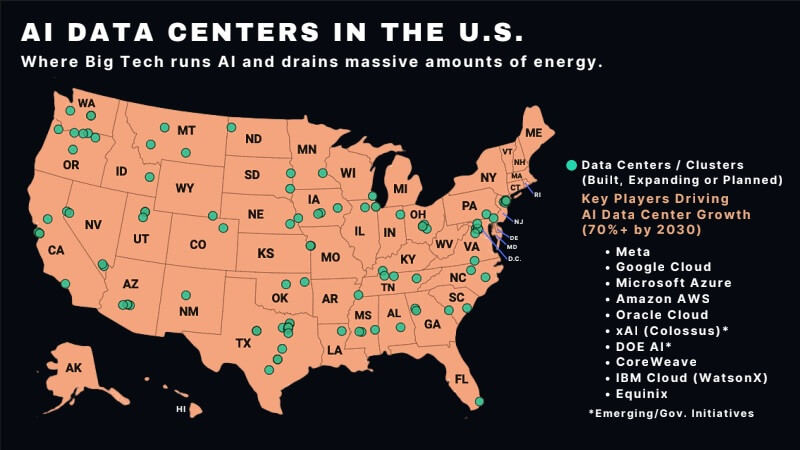
How many U.S. data centers are there?
There isn't a definitive government count. One reason is that there is no central regulatory requirement to register every data center. Data Center Map explicitly warns that databases therefore cannot be 100% complete. [datacentermap.com]
One current industry directory lists 4,767 U.S. data centers across all 50 states, operated by about 1,900 operators. These are not all AI centers. They include cloud, colocation, hyperscale and other facilities.
Thousands of data centers already operate in the United States, while a major new generation of very large, AI-oriented facilities is being built or proposed.
The scale is easier to establish through energy demand than building counts. The U.S. Department of Energy reported that data centers consumed about 4.4% of total U.S. electricity in 2023 and projected approximately 6.7% to 12% by 2028. [energy.gov]
Short takeaway: From a ZetaTalk perspective, distributing data centers across many locations can be interpreted as a quiet form of resilience-building — something that could align with preparations for grid fragility, infrastructure decentralization, and post‑Shift survivability. This does not mean mainstream planners are consciously preparing for a Pole Shift, but the pattern matches ZetaTalk’s long‑standing warnings about centralized systems failing.
🧭 ZetaTalk Interpretation: Why Many Data Centers?
ZetaTalk consistently emphasizes decentralization, local autonomy, and distributed infrastructure as critical for surviving both the Last Weeks and the Aftertime. When you apply that worldview to modern AI and cloud infrastructure, several parallels emerge.
🌐 1. Decentralization = Survival During Grid Down
ZetaTalk says the Pole Shift will:
fracture the grid
destroy long-distance transmission lines
isolate regions
break centralized control systems
A distributed data‑center architecture mirrors the survival principle:
“Small, local nodes survive better than one giant hub.”
In ZetaTalk logic:
A single mega‑center = vulnerable
Many smaller centers = redundancy
This is exactly how hyperscale cloud providers now operate:
dozens of regional zones
edge compute nodes
micro‑data centers near population clusters
It’s a grid-fragmentation survival pattern.
⚡ 2. Local Power Generation = Micro‑Grids (ZetaTalk’s Aftertime Model)
Trump’s comment about data centers “producing their own energy” aligns with:
solar micro‑grids
hydrogen fuel cells
natural‑gas micro‑turbines
small modular reactor proposals
battery farms
ZetaTalk repeatedly says:
centralized grids will fail
local generation is the only stable model
communities must be energy‑independent
A data center with its own micro‑grid is essentially a proto‑Aftertime energy node.
🛰️ 3. Edge Computing = Surviving Communication Collapse
ZetaTalk predicts:
satellites failing
long-distance communication disrupted
fiber lines severed
EMP-like surges
Modern “edge compute” is designed to:
keep local services running even if the backbone fails
process data without relying on distant servers
maintain autonomy during outages
This mirrors ZetaTalk’s survival doctrine:
“Local processing, local decision-making, local autonomy.”
🧱 4. Physical Hardening = Pole Shift Survival Parallels
Data centers are increasingly built with:
hardened shells
underground components
isolated cooling systems
redundant fiber paths
EMP-resistant designs (for military contracts)
ZetaTalk says:
underground = safer
hardened structures survive wind blasts
redundancy is essential
The industry trend unintentionally mirrors ZetaTalk’s “trench shelter” logic:
“Protect the core systems from debris, wind, and electrical surges.”
🌍 5. Geographic Spread = Avoiding Catastrophic Regional Loss
ZetaTalk warns that:
coastlines will be devastated
fault zones will rupture
certain regions will be permanently flooded
others will become deserts
Cloud providers now place data centers:
inland
away from coasts
near stable geology
in cooler climates
This is not framed as Pole Shift preparation, but the pattern matches.
🔥 6. AI + Data Centers = Post‑Shift Knowledge Preservation
ZetaTalk emphasizes:
loss of libraries
loss of digital records
collapse of institutions
need for knowledge preservation
Distributed data centers:
store redundant copies of global knowledge
maintain multiple backups
replicate constantly across regions
This is essentially a global seed vault for information.
🧩 So… Could This Be Pole Shift Preparation?
ZetaTalk perspective:
Yes — the pattern of distributed, hardened, semi‑autonomous data centers is exactly what ZetaTalk says would be needed to survive a catastrophic grid collapse.
Mainstream perspective:
No — the industry is doing this for:
latency
reliability
cost
AI scaling
energy efficiency
But the effect is the same: A decentralized, resilient infrastructure that would survive more disruption than the old, centralized model.
What do you think?
Juan F Martinez
President Donald Trump's recent move on "Super Intelligence," he has both renamed federal references to AI as "Super Intelligence (SI)" and announced the creation of a Super Intelligence Force (SIF) to coordinate U.S. policy and leadership in the field. [whitehouse.gov]
Key points:
AfterTime Power and AI Data Centers — ZetaTalk Perspective - Earth ...
yesterday
Juan F Martinez
Elon Musk: SpaceX is a super intelligence company
AfterTime Power and AI Data Centers — ZetaTalk Perspective - Earth ...
yesterday
Juan F Martinez
Trump announces the formation of Super Intelligence Force.
22 hours ago